Xi'an · Gardens & Ancient Architecture
Giant Wild Goose Pagoda
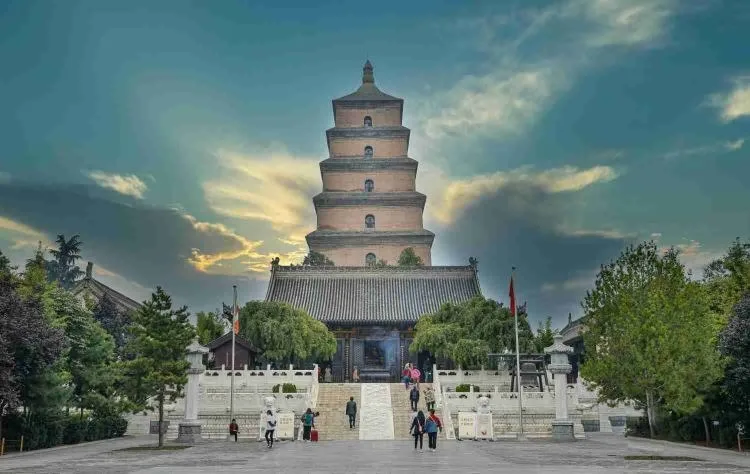
Climbing to the seventh floor of the Giant Wild Goose Pagoda, the skyline of the Qujiang New District unfolds beneath your feet as the wind sweeps through the window openings from all sides. Over 1,300 years ago, the Buddhist scriptures and statues brought back from India by the monk Xuanzang were housed within this very tower. I prefer visiting at dusk: first watching the pagoda be stained an ochre-red by the setting sun within the temple grounds, then strolling to the North Plaza to wait for the water columns of the musical fountain and the silhouette of the pagoda to meet in a single frame.
1. Location Overview:The Giant Wild Goose Pagoda is located at No. 1 Cien Road, Yanta District, Xi’an, situated within the Da Ci’en Temple of the former Jinchang Ward of the Tang Dynasty’s Chang’an city. To the north of the pagoda lies the Giant Wild Goose Pagoda North Plaza, famous for its massive musical fountain; to the south, across the South Plaza, it connects to the Great Tang All Day Mall (Great Tang Everbright City) pedestrian street; to the east and west are the modern districts and universities of the Qujiang New District. The Giant Wild Goose Pagoda Station on Metro Lines 3 and 4 is located right next to the North Plaza, and the temple’s mountain gate is just a few minutes’ walk from the exit. Located about five kilometers south of the Xi’an Bell Tower and roughly a twenty-minute taxi ride from Xi’an Railway Station, it is both a landmark of southern Xi’an and an essential stop for most travelers: visit the temple and climb the tower by day, and transition seamlessly into the lights of the “Everbright City” by night—a single pagoda that links half of Qujiang.
2. Cultural Context:In the 22nd year of the Zhenguan era of the Tang Dynasty (648 AD), Crown Prince Li Zhi built Da Ci’en Temple in the Jinchang Ward of Chang’an in memory of his birth mother, Empress Wende. In the third year of the Yonghui era (652 AD), the eminent monk Xuanzang personally presided over the construction of a five-story brick pagoda within the temple to properly preserve the scriptures, Buddhist statues, and sarira he had brought back from India; this was the predecessor of the Giant Wild Goose Pagoda. The tower subsequently underwent several reconstructions and height increases, finally taking its current form as a seven-story pavilion-style brick tower—approximately 64.5 meters high with a dignified, tapering structure—after a major renovation in the Ming Dynasty. This evolution is worth noting: the original pagoda was a five-story square tower with a brick exterior and earth core, which did not withstand the elements well; after half a century, weeds grew between the brick gaps. During the Chang’an era of Wu Zhou, Empress Wu Zetian and various nobles donated funds to demolish the old tower and rebuild it as a seven-story pavilion made entirely of brick. Later, in the Ming Dynasty, another layer of brick was added to the exterior for protection, resulting in the appearance we see today. The origin of the name is found in Xuanzang’s own writings—the “Great Tang Records on the Western Regions” describes a legend from the Magadha kingdom of India where monks buried geese and built pagodas; the name “Giant Wild Goose Pagoda” was borrowed from this tradition. In the Tang Dynasty, inscribing one’s name on the tower was a ceremony of honor for successful candidates of the imperial examinations, making “Yanta Timing” (Inscribing Names at the Goose Pagoda) a timeless tale. Bai Juyi, who passed the exam at age 27, wrote, “Under the Cien Pagoda, where I inscribe my name, I am the youngest among the seventeen,” as he was the youngest of the seventeen successful candidates on his list. This poem became the most famous footnote to the tradition. Together with Xuanzang’s translation bureau and the Qujiang River, the pagoda formed the cultural coordinates of the High Tang’s Chang’an. In 2014, the Giant Wild Goose Pagoda was inscribed on the UNESCO World Heritage List as part of the “Silk Roads: the Routes Network of Chang’an-Tianshan Corridor.” A tower built to preserve scriptures ultimately became a world-class witness to the exchange of civilizations.
3. Highlights:Climbing the tower is the core experience. Each floor displays Buddhist sarira, replicas of palm-leaf scriptures, and models of the pagoda. Climbing to the seventh floor allows you to lean against the railing and gaze upon a panoramic view of Qujiang and the silhouette of the Zhongnan Mountains, with the bronze statue of Master Xuanzang on the South Plaza clearly visible. The sights outside the tower are equally dense: the Grand Hall and the Sutra Library of Da Ci’en Temple are solemn and majestic, and the temple’s peonies and ancient trees offer scenery across all four seasons. The Xuanzang Tripiṭaka Museum tells the story of the Master’s journey to the West to fetch scriptures and his life spent translating them, serving as the best companion guide to understanding the tower. Before climbing, it is recommended to spend a few extra minutes on the first floor: embedded on the east and west sides of the south gate opening at the base of the tower are two stone tablets. The east side features the “Preface to the Sacred Teachings of the Great Tang Tripiṭaka” written by Emperor Taizong, and the west side features the “Record of the Preface to the Sacred Teachings of the Great Tang Tripiṭaka” written by Emperor Gaozong. Both were calligraphed by the Tang master Chu Suiliang and are masterpieces of regular script. The line-carved Buddhist preaching diagram on the west lintel is finely composed and is attributed to the great Tang painter Yan Liben; researchers of Tang architecture and painting often spend a long time gazing up at it. Heading north from the temple, the North Plaza musical fountain dances against the backdrop of the tower, providing Xi’an’s most classic photo opportunity. Heading south through the South Plaza, the bronze statue of Xuanzang marks the beginning of the Great Tang All Day Mall. Plan your climb for early morning or evening when the light is soft and crowds are thinner, bringing out the best hues of the pagoda’s bricks.
4. Visitor Information:Opening hours vary by season: from March 1 to October 14, 8:30–18:00 (last entry 17:00); from October 15 to February 28, 8:30–17:30 (last entry 16:30). Ticket Prices: Da Ci’en Temple entry is 10 RMB (student tickets 5 RMB; free for seniors 65+ and children under 1.2m). Climbing the Giant Wild Goose Pagoda requires a separate ticket of 25 RMB, available at the base of the tower inside the temple; specific discounts are subject to official announcements. Entry requires real-name reservation and ticket purchase via the “Da Ci’en Temple” official WeChat mini-program; booking one day in advance is recommended. Transportation: Take Metro Line 3 or 4 to Giant Wild Goose Pagoda Station; the North Plaza, South Plaza, and musical fountain are all free to access. Fountain show times are announced daily. The stairs inside the tower are narrow and steep; please hold the railings, especially on rainy days.
5. Travel Strategy:It is recommended to enter the temple in the morning. Follow the route: Mountain Gate $\rightarrow$ Grand Hall $\rightarrow$ Climbing the Tower $\rightarrow$ Xuanzang Tripiṭaka Museum. Schedule the climb for when you have the most energy to avoid the midday crowds and scorching sun; the full visit takes about two hours. In the afternoon, you can relax at bookstores or cafes around the North Plaza. Return to the North Plaza in the evening to secure a spot facing the tower for the fountain—arrive 30 minutes early if you want to capture the fountain and tower in one shot. After the fountain, walk south directly into the Great Tang All Day Mall and enjoy the evening performances, completing your Qujiang circuit for the day. For travelers who prefer a light itinerary, you can skip the temple interior: the fountain at the North Plaza, the Xuanzang statue at the South Plaza, and the distant views of the tower are all free. If you are interested in Buddhist culture, consider visiting the Giant Wild Goose Pagoda and the Small Wild Goose Pagoda (Xi’an Museum) on the same day for a comparative look at the two landmarks of Tang Chang’an. One more photography tip: the 4th-floor observation deck of Joy City on the west side of the North Plaza is currently the most popular vantage point. From there, you can capture the pagoda and the lights of the Great Tang All Day Mall in a single frame; the light is best 30 minutes before and after the lights turn on, though queues are expected during peak times. Families with children can link the pagoda and the museum into a story: first see why the tower was built to save scriptures, then visit the museum to see the journey’s route and the reconstructed translation bureau, turning the story of “Journey to the West” from a novel back into real history.
6. Best Time to Visit:Spring and autumn are the best seasons for climbing the tower, with crisp air and the best visibility for seeing the silhouette of the Zhongnan Mountains from the top. In summer, it is recommended to visit early in the morning or evening, as the interior of the tower can be stifling at noon, though the fountains and night views are most spectacular in summer. Winter sees the fewest tourists, meaning almost no queues to climb; the pagoda and temple possess a unique, serene beauty after a snowfall, making it a trip worth taking specifically for the snow. During the Lunar New Year, the area around the Giant Wild Goose Pagoda and the Great Tang All Day Mall becomes the center of Xi’an’s lantern festivals. The night scenery peaks, as do the crowds; if planning a visit during the Spring Festival, be sure to book tickets in advance and allow ample time for entry and exit.