Destination
First Principles of Tutoring Your Child’s Homework
.tfa :root{
–bg: #FAF8F3;
–ink: #1F1D1A;
–ink-soft: #4A4640;
–line: #E4DED2;
–accent: #2C5F4E;
–accent-soft: #E8EFEA;
–quote-bg: #F2EEE4;
}
.tfa{ box-sizing: border-box; }
.tfa, .tfa{ margin: 0; padding: 0; }
.tfa{
background: var(–bg);
color: var(–ink);
font-family: “Noto Serif SC”, “Source Han Serif SC”, “Songti SC”, “STSong”, serif;
font-size: 17.5px;
line-height: 1.95;
-webkit-font-smoothing: antialiased;
text-rendering: optimizeLegibility;
word-break: break-word;
}
.tfa .wrap{
max-width: 680px;
margin: 0 auto;
padding: 0 22px 80px;
}
.tfa /* ===== Hero ===== */
.hero{
padding: 64px 0 36px;
border-bottom: 1px solid var(–line);
margin-bottom: 8px;
}
.tfa .hero .kicker{
font-size: 13px;
letter-spacing: 0.25em;
color: var(–accent);
font-weight: 600;
margin-bottom: 18px;
}
.tfa .hero h1{
font-size: 32px;
line-height: 1.35;
font-weight: 900;
margin: 0 0 20px;
letter-spacing: 0.01em;
}
.tfa .hero .meta{
font-size: 14px;
color: var(–ink-soft);
}
.tfa /* ===== Body typography ===== */
article{ padding-top: 12px; }
.tfa p{
margin: 0 0 22px;
text-align: justify;
text-justify: inter-ideograph;
}
.tfa strong{
font-weight: 700;
color: var(–ink);
}
.tfa /* Divider */
hr.sep{
border: 0;
height: 1px;
background: var(–line);
margin: 44px 0;
}
.tfa /* Blockquote */
blockquote.pull{
margin: 28px 0;
padding: 18px 20px;
background: var(–quote-bg);
border-left: 3px solid var(–accent);
border-radius: 0 8px 8px 0;
color: var(–ink-soft);
font-size: 16px;
line-height: 1.85;
}
.tfa blockquote.pull strong{ color: var(–accent); }
.tfa /* Chapter heading */
section.chapter{
margin: 56px 0 28px;
padding-top: 20px;
border-top: 2px solid var(–ink);
}
.tfa .chapter-num{
display: inline-block;
font-size: 14px;
font-weight: 700;
color: var(–bg);
background: var(–accent);
padding: 3px 12px;
border-radius: 3px;
letter-spacing: 0.1em;
margin-bottom: 14px;
}
.tfa .chapter-title{
font-size: 24px;
line-height: 1.45;
font-weight: 800;
margin: 0;
letter-spacing: 0.01em;
}
.tfa /* H3 sub-section */
h3.h3{
font-size: 19px;
font-weight: 700;
margin: 36px 0 14px;
padding-left: 12px;
border-left: 4px solid var(–accent);
line-height: 1.5;
}
.tfa h2.h2{
font-size: 21px;
font-weight: 800;
margin: 36px 0 14px;
line-height: 1.5;
}
.tfa h4{
font-size: 17px;
font-weight: 700;
margin: 28px 0 10px;
}
.tfa /* Figure */
figure.figure{
margin: 28px -8px;
text-align: center;
}
.tfa figure.figure img{
max-width: 100%;
height: auto;
border-radius: 10px;
box-shadow: 0 2px 12px rgba(31,29,26,0.08);
display: block;
margin: 0 auto;
}
.tfa /* List */
ul, .tfa ol{
padding-left: 1.4em;
margin: 0 0 22px;
}
.tfa li{ margin-bottom: 10px; line-height: 1.85; }
.tfa ol.points li{
padding-left: 4px;
}
.tfa ol.points li::marker{
color: var(–accent);
font-weight: 700;
}
.tfa /* Ending */
.ending{
margin-top: 64px;
padding: 28px 22px;
background: var(–accent-soft);
border-radius: 12px;
text-align: center;
color: var(–accent);
font-size: 14px;
letter-spacing: 0.2em;
font-weight: 600;
}
.tfa /* Desktop tweaks */
@media (min-width: 768px){
body { font-size: 18px; }
.hero h1 { font-size: 40px; }
.chapter-title { font-size: 27px; }
}
Estimated Reading Time: 28 minutes
Introduction: If you are feeling overwhelmed while helping your child with their homework, please read this article carefully. In reality, this piece explores the fundamental principles of learning. No “lifelong learner” can afford to miss it!
If you are a parent, the following scenario might feel all too familiar:
- Didn’t I just explain this problem?
- Think about it a bit more carefully…
- It’s so simple, how can you not get this!
Indeed, this is a common scene when tutoring children. After explaining something patiently countless times, you start to lose your temper and begin to wonder: Is this child’s IQ really from me?
This article attempts to help you solve this problem.
Let’s step away from the homework scenario for a moment. I’d like you to take a test first; it might lead to a sudden realization.
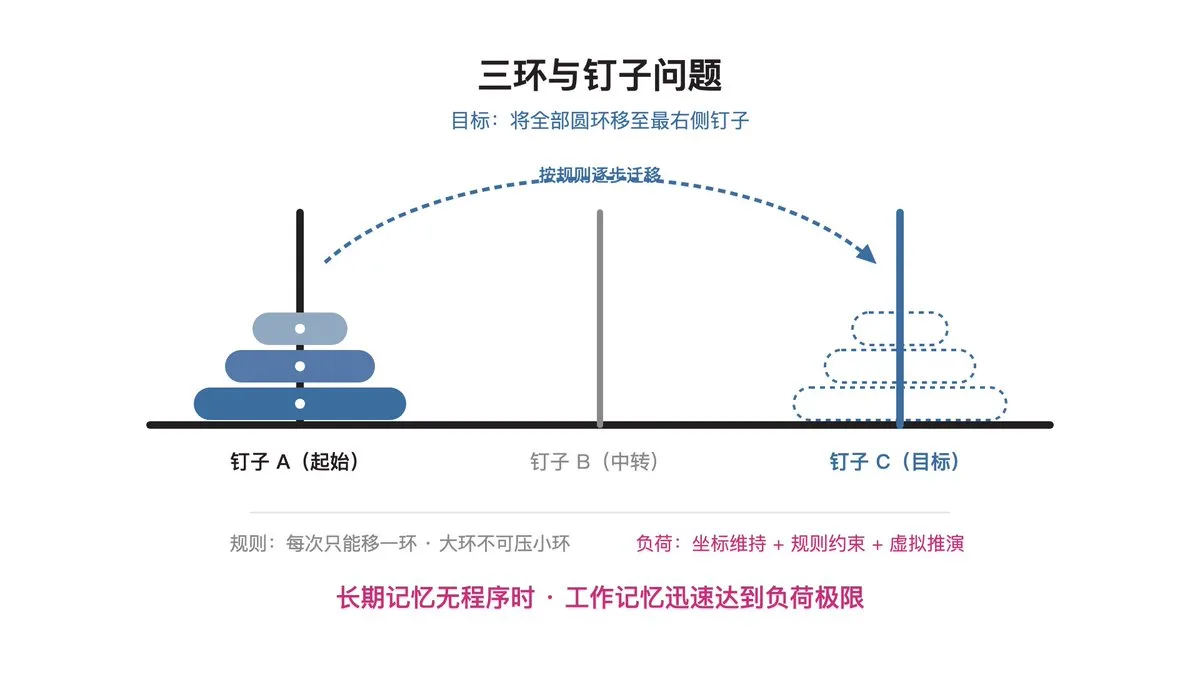
This test is a classic in cognitive psychology called the “Three Rings and Pegs Problem” (a variation of the Tower of Hanoi experiment), which clearly demonstrates the biological resistance people face when thinking. The rules are as follows:
Three vertical pegs, labeled Start A, Transit B, and Target C, stand on a horizontal base. Initially, peg A holds three rings of decreasing diameter from bottom to top—large on the bottom, medium in the middle, and small on top—while pegs B and C are empty. The final goal is to move all three rings from peg A to peg C, maintaining the original order with the large ring at the bottom and the small ring on top. Three strict rules must be followed: only one ring can be moved at a time, only the top ring of any peg can be moved, and a larger ring can never be placed on top of a smaller ring at any time on any peg.
If you’ve read this and have no idea what I’m talking about, please look at the image below (or perhaps, being clever, you’ve already started looking at the image after reading a few words):
【Caption: Three Rings and Pegs Problem: Initial Setup, Target Goal, and Constraint Rules】
Now, you can pause for a moment and try to visualize the entire process of moving these three rings in your head.
If you fully map out the reasoning process, it actually only takes 7 steps: Step 1, move the small ring to Target C; Step 2, move the medium ring to Transit B; Step 3, place the small ring on top of the medium ring at B; Step 4, move the large ring to Target C; Step 5, move the small ring back to Start A; Step 6, move the medium ring on top of the large ring at Target C; Step 7, move the small ring to C to complete the set.
【Caption: The Three-Ring and Peg Problem: 7-Step Deduction Process and State Migration】
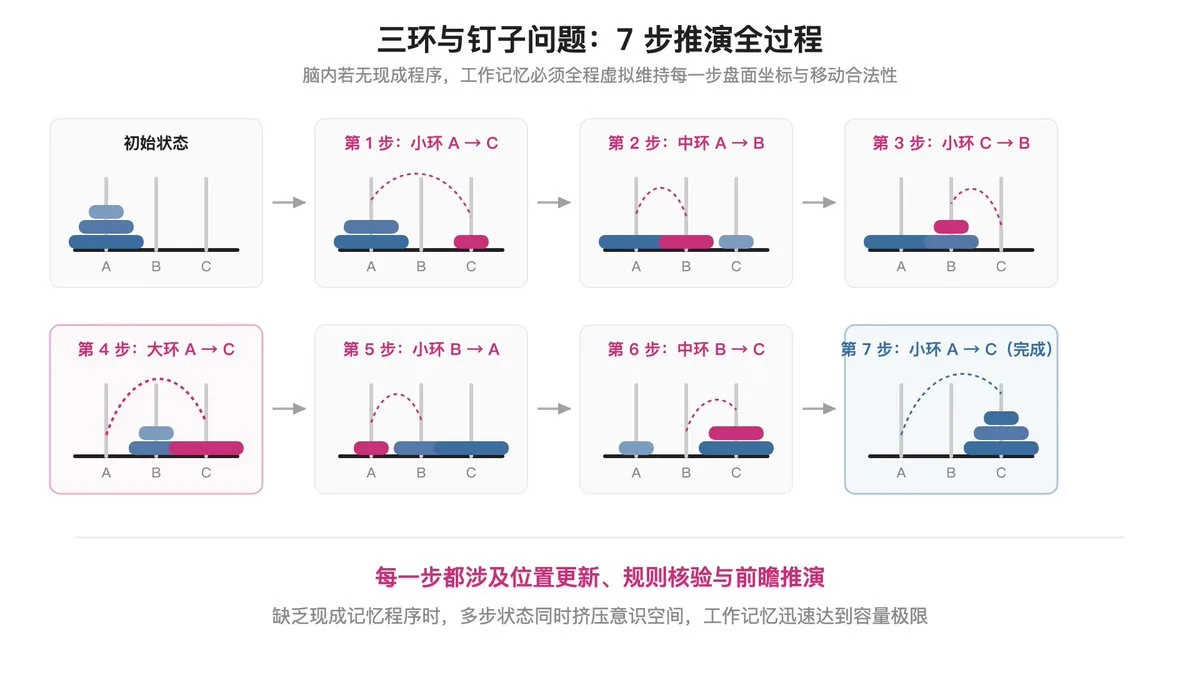
Although the entire solution takes only 7 steps, most adults will still feel significant cognitive resistance when attempting to simulate it entirely in their minds without referring to the diagram above or using physical props. The brain must not only remember which peg each of the three rings is currently on, but also verify the rule constraints during every virtual move, while simultaneously calculating the feasibility of several steps ahead. When three streams of information are maintained in parallel, the brain’s working memory channel immediately becomes congested, resulting in mental lags, the need to repeatedly check rules, or even forgetting previous steps.
If a fully mature adult feels their attention stretched thin when performing on-the-spot mental deduction for a simple rule with only three rings, imagine a child whose prefrontal cortex is not yet fully developed and who lacks existing problem-solving experience. When facing a completely unfamiliar multi-step word problem, what they experience is this exact physiological level of channel blockage. Adults mistakenly believe a problem is “simple” because their long-term memory already contains mature, automated programs; children, however, are performing high-load, real-time deductions from scratch with no existing memory to rely on. All conflicts during tutoring essentially stem from an adult’s disregard for this physical characteristic of the brain.
Behind any specific behavior, we can dig deeper into the “First Principles,” allowing science to identify the root of the problem and the solution. This article organizes core laws from cognitive psychology and cognitive neuroscience regarding the underlying mechanisms of how the brain thinks and learns. It unfolds layer by layer—from brain energy metabolism and dopamine reward mechanisms to the physical architecture of information processing—to serve as an objective foundation for deriving homework tutoring strategies, helping tutors see the essence of the issue and master scientific intervention methods.
The Biological Foundation of the Brain—The Brain is Not “Made” for Thinking
1. Evolutionary Division of the Nervous System: Perception and Action Over Logical Thinking
The functional composition of the human brain is highly asymmetrical; thinking is not its naturally strongest suit. During biological evolution, the brain’s neural circuits prioritized visual perception and physical movement, as these functions are highly reliable and low-energy. It is no accident that large areas of the cerebral cortex are dedicated to vision and motor control. In a three-dimensional natural environment full of uncertainty, the amount of data computation required to identify objects, judge distances, and adjust posture is actually greater than that required for playing chess or calculating calculus.
This difference is evidenced by the contrast between computers and the human brain. In fields such as formal logic, mathematical operations, and board games, computers have long surpassed humans. However, achieving fully autonomous driving in variable road conditions or making a robot walk flexibly across complex terrain like a human remains extremely difficult. The fact that humans can navigate uneven ground effortlessly without concentrated attention is the result of highly hardware-based algorithms operating in parallel at the brain’s base level.
Compared to the highly automated perception and motor systems, active logical deduction in humans has three clear physiological limitations. First, it is slow: the visual system can parse a complex spatial scene in milliseconds, while logical thinking must proceed step-by-step in a single thread. Second, it is taxing: seeing requires little conscious resource, but thinking must mobilize the prefrontal cortex to maintain a focus of attention; when dealing with a logical puzzle, the consciousness cannot simultaneously process other deep tasks. Finally, it is uncertain: perception systems rarely make major judgment errors, whereas the reasoning process easily deviates from the correct path or may fail to reach a valid conclusion entirely.
【Caption: Wide-Channel Parallel Processing of Visual Perception vs. Narrow-Channel Serial Processing of Logical Reasoning】

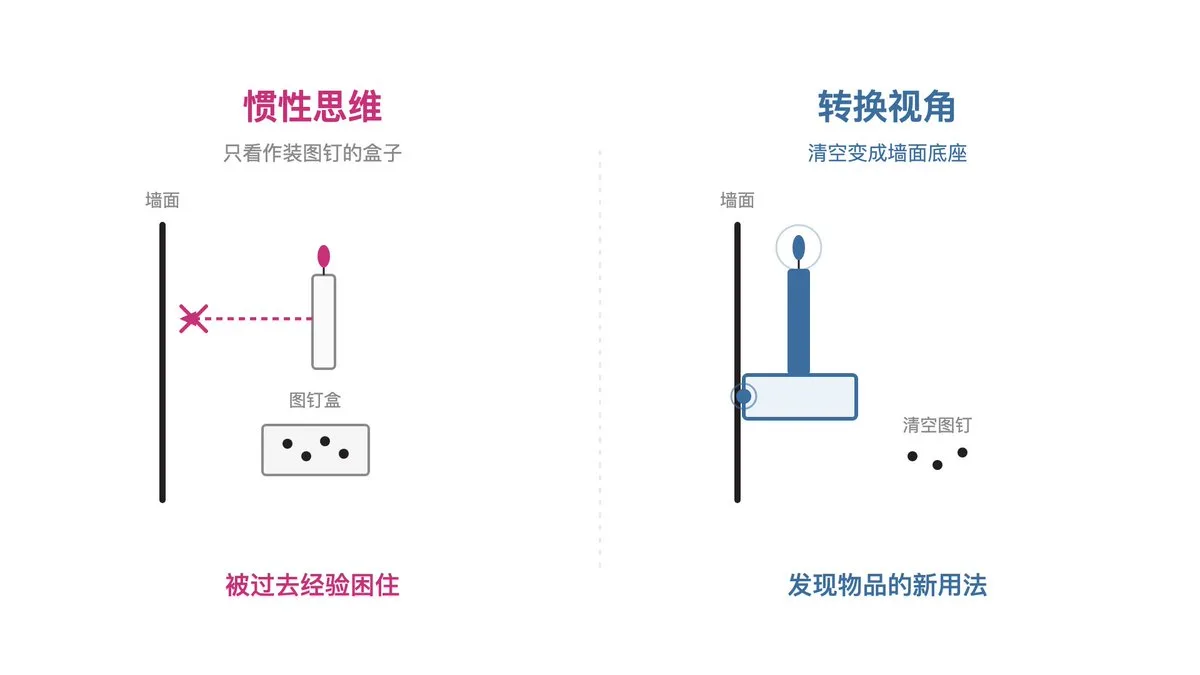
The classic “Candle Problem” demonstrates these three characteristics of thinking: participants are given a box of thumbtacks, a box of matches, and a candle, and are asked to fix the candle to a cork wall so that the wax does not drip. Most people cannot solve it within a time limit until they realize they can empty the thumbtack box and tack it to the wall as a base. This phenomenon reflects the slowness and uncertainty of logical deduction when facing non-standard scenarios.
【Caption: Inertial Thinking (Trapped by Past Experience) vs. Shifting Perspective (Discovering New Uses for Objects)】
【Cognitive Science Supplement: Metabolic Cost and the Brain’s Energy-Saving Instinct】
The adult brain accounts for only about 2% of total body weight, yet in a resting state, it consumes about 20% of the body’s glucose and oxygen reserves. High-frequency depolarization firing of neurons and the synthesis of neurotransmitters require a significant amount of ATP.
Throughout evolution, energy shortage has been a constant survival constraint. Logical reasoning relies on the continuous firing of neurons in the prefrontal cortex, with an energy consumption rate significantly higher than the baseline. Conversely, perception and automated actions are supported by the basal ganglia, cerebellum, and sensory cortex, with relatively controllable energy costs.
Therefore, the physiological mechanism of the brain is “energy minimization.” Its default strategy is to prioritize retrieving existing experiences to maintain an automated state, avoiding high-energy active thinking.
2. Default Mechanism of Behavior: Reliance on Memory Rather Than Real-Time Deduction
Humans make a vast number of decisions in daily life, but the mechanism is not based on real-time logical deduction, but on the rapid retrieval of the memory system. As long as a problem can be solved by relying on memory, the brain will not initiate “thinking.”
Most daily situations an individual faces have precedents in past experiences. Therefore, human behavior consists primarily of repeating existing patterns. For example, once the solution to the candle problem is known, the memory system can present the conclusion directly with zero deduction cost the next time it is encountered. The stability and efficiency of memory retrieval are significantly higher than those of real-time logical operations.
【Caption: Real-Time Thinking (High-Energy Circuit) vs. Memory Retrieval (Low-Energy Pathway)】
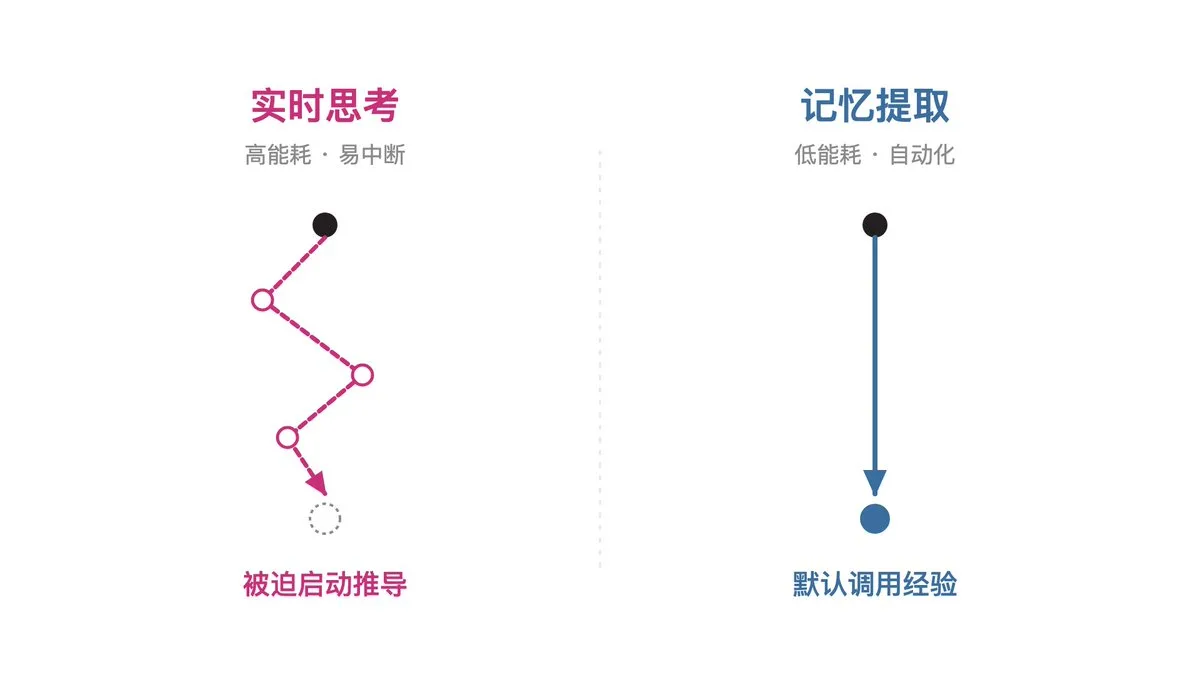
Memory stores not only factual data but also a vast array of procedural strategies. The vast majority of daily behaviors are in an automated state, requiring no conscious weighing of cause-and-effect for every step. Relying on memory protects attentional resources from exhaustion. If every minute detail required re-reasoning and verification, the cognitive system would quickly enter a state of metabolic exhaustion. The profound fatigue often felt when arriving in a foreign country where one speaks no language is precisely because existing automated memory circuits fail; even trivial tasks like buying water or identifying coins force the recruitment of full attention for active thinking.
3. Neuroplasticity and Automation Through Practice
The brain possesses the physiological property of adjusting neural pathways through experience. A foreign task that initially requires significant attention and working memory can, after sufficient repetition, undergo adaptive changes in synaptic connection patterns, transforming the task into an automated circuit supported by long-term memory.
【Caption: Before Practice (Discrete Steps Crowding Consciousness) vs. After Sufficient Practice (Solidified Circuits Releasing Consciousness)】

Take learning to drive as an example: in the early stages, the driver must concentrate intensely on allocating their gaze, controlling pedal depth, and adjusting the steering wheel angle, making it difficult to handle any outside distraction. As practice increases, basic controls shift to procedural memory, freeing up the prefrontal cortex’s working memory, allowing the driver to handle external conversations comfortably while driving.
This law indicates that: the essence of practice is to compress a deduction task—which originally occupied high computing power—into a memory call that occupies very low computing power through the consolidation of neural circuits.
The Physiological Basis of Motivation—Curiosity is Fragile
Chapter One established the hardware baseline of the cognitive system: by default, the brain follows the principle of energy minimization, prioritizing memory circuits to avoid active thinking. This biological fact inevitably leads to a core question: since the brain’s default physiological mechanism is to avoid thinking, why do humans still solve puzzles, explore the unknown, and why are students willing to actively invest mental effort in certain contexts? This requires a further investigation into the physiological conditions that awaken the drive to think.
1. Problem Solving and the Midbrain Dopamine Reward Circuit
Despite the high energy cost of thinking, humans show a tendency for active exploration under specific conditions. Humans engage in puzzle-solving, reading complex narratives, or studying crafts due to an incentive mechanism within the cognitive system.
Research in cognitive neuroscience shows a close anatomical and functional link between the cortical areas involved in cognitive processing and the dopamine reward circuits of the limbic system. When an individual successfully eliminates uncertainty in a problem scenario or discovers an unexpected pattern through their own cognitive processing, the mesolimbic pathway releases dopamine, producing an endogenous sense of satisfaction and achievement.
【Caption: Being Given the Answer (Bypassing Thinking = No Reward) vs. Autonomous Deduction (Eliminating the Unknown = Dopamine Release)】
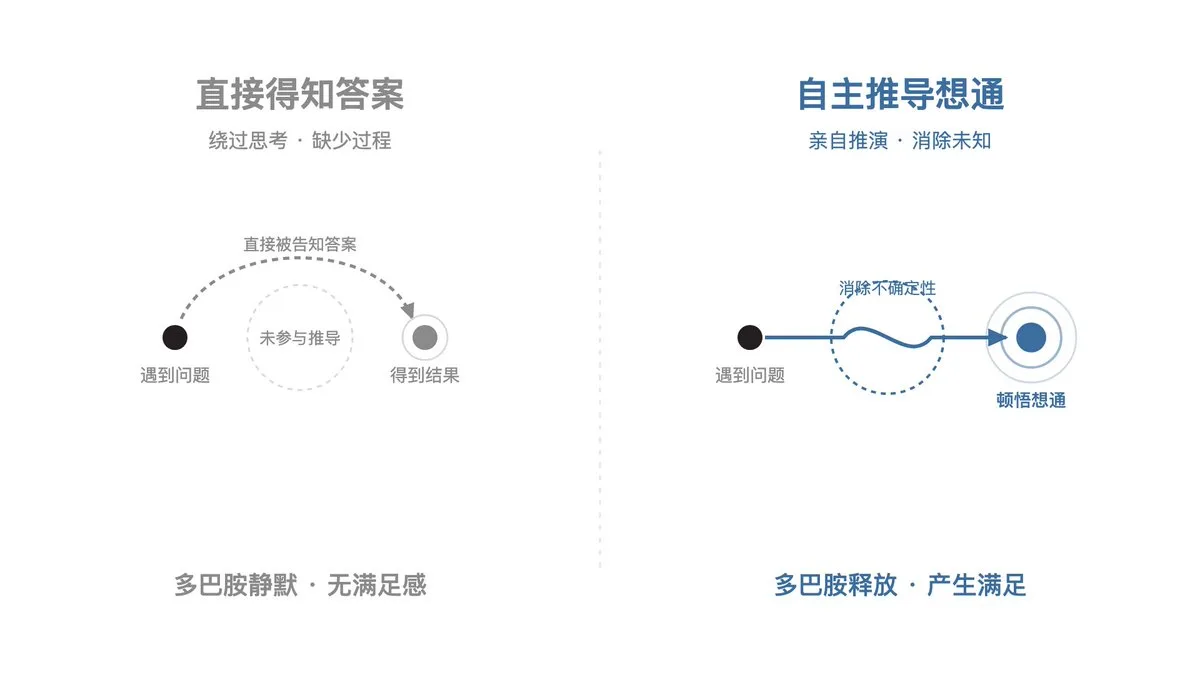
The triggering of this neural reward has strict structural requirements. If a problem is so difficult that no local progress can be made for a long period, the dopamine pathway will not be activated, and a continuous sense of incompetence will turn into frustration and boredom. Conversely, if the answer is given directly, or if too many hints are provided such that the individual does not substantially participate in the deduction of key logical nodes, the brain does not undergo the cognitive process of eliminating uncertainty, and thus no neural reward is produced.
2. Task Difficulty Prediction Mechanisms and Behavioral Maintenance
Whether an individual can maintain attention when facing a cognitive task does not depend on the “fun” packaging of the content, but on the brain’s real-time predicted probability of “whether this problem can be solved.”
【Caption: Three states of task difficulty and the neural reward circuit】
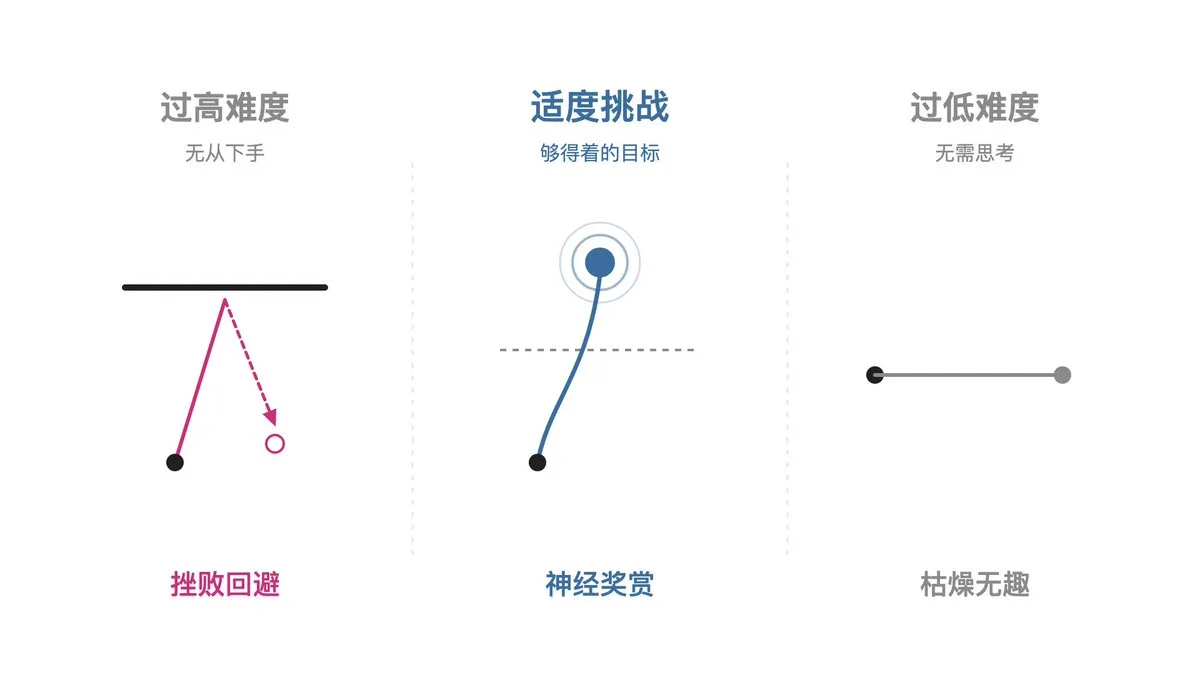
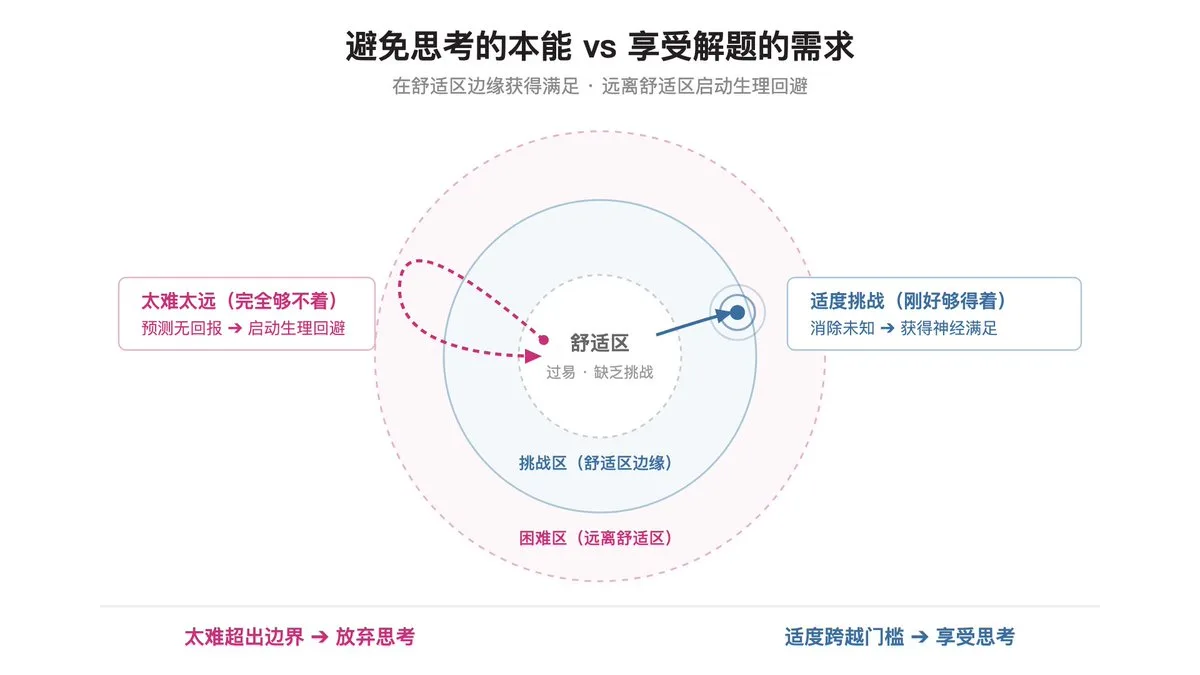
When faced with excessive difficulty—due to a lack of prerequisite knowledge or a reasoning chain that exceeds cognitive load—the brain predicts the probability of success to be near zero. Because the expected cognitive effort yields no dopamine reward, the system triggers a blocking mechanism, manifesting as distraction, procrastination, or giving up. Conversely, when the difficulty is too low, results can be reached without any need for information reorganization. The cognitive system encounters no uncertainty and thus no information gain, resulting in boredom. Only when a task is moderately challenging—providing some resistance in derivation while the necessary prerequisite knowledge is already in place—does the individual perceive a high probability of a breakthrough after exerting cognitive effort. At this point, the dopamine prediction error mechanism operates effectively, allowing attention to be sustained over a long period.
Therefore, the idea that “humans avoid thinking” does not conflict with the fact that “humans possess exploratory curiosity.” Curiosity drives an individual toward new stimuli, while the assessment of difficulty determines whether this behavior continues or is abruptly terminated. If a learner is long exposed to tasks that exceed their capacity boundaries, the brain will inevitably exhibit avoidance as a physiological defense mechanism.
The Physical Model of Thinking: Environment, Working Memory, and Long-term Memory
Having clarified the brain’s default state and the triggers for thinking, cognitive deduction must move deeper into specific micro-operations: how does the brain actually operate and what limits it physically when attention is mobilized and thinking begins under the incentive of a moderate challenge? This requires an understanding of the basic architectural model of information processing. The cognitive system consists of three fundamental elements: the external environment, working memory, and long-term memory.
We can understand the physical division of labor among these three through daily perceptual experience. Working memory can be thought of as your current space of consciousness, maintaining what you are focusing on and thinking about at this moment. The pathway from the environment to working memory shows that you can perceive things in your surroundings at any time: a beam of light hitting a dusty table, a dog barking in the distance, or a problem on the exam paper in front of you. These sensory stimuli from the external environment only enter working memory and become conscious information after being captured by attention.
Long-term memory, on the other hand, is a vast knowledge repository where massive amounts of data usually remain static outside of consciousness. The fact that leopards have spots, that your favorite ice cream is chocolate, or that a triangle is a closed figure consisting of three sides—all this knowledge sleeps quietly in long-term memory until evoked by a specific cue. If someone suddenly asks, “What color are polar bears?”, you will almost immediately blurt out “white.” Before the question was asked, this fact resided in long-term memory; only when the question linked it to your current thought was it retrieved into working memory, allowing you to perceive it consciously.
The essence of thinking is defined as: In the limited capacity of working memory, taking immediate perceptual information from the external environment (the problem at hand, conditions in a chart) and existing knowledge retrieved from long-term memory (the color of polar bears, multiplication tables, operational procedures), and recombining and restructuring them in new ways.
【Caption: Topological combination of the external environment, long-term memory, and working memory】
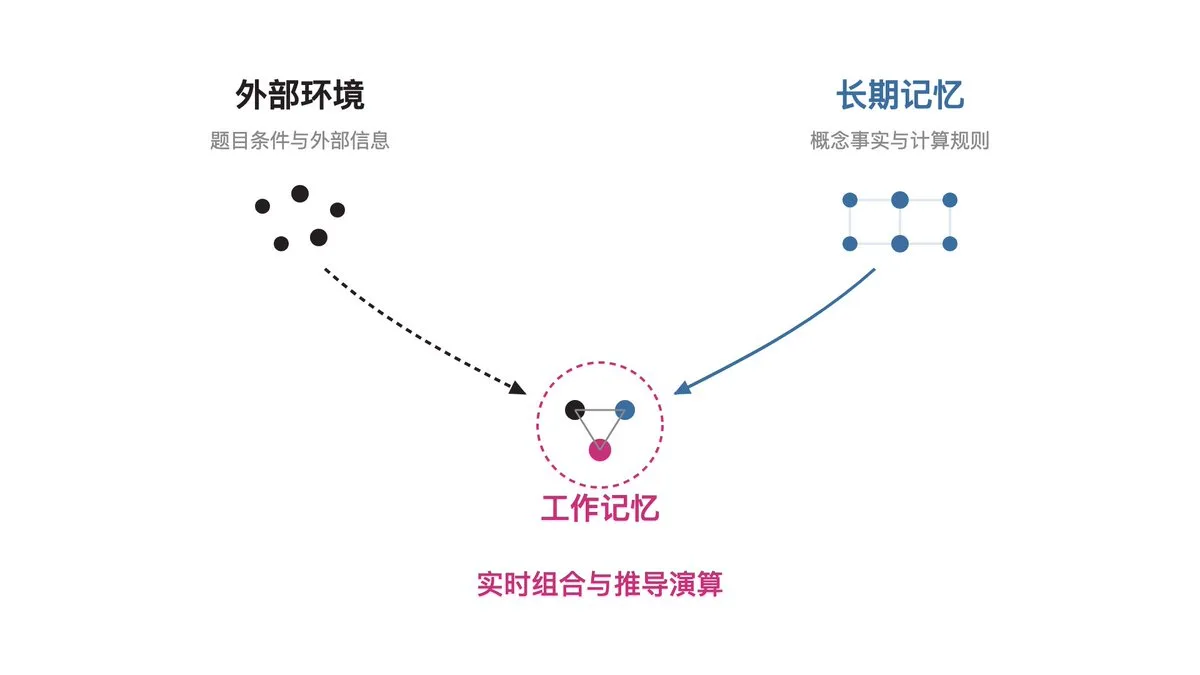
The physical model of thinking establishes four core cognitive laws. First, thinking does not emerge from a vacuum; it is a physical reorganization process completed by the synergy of the external environment, working memory, and long-term memory. Second, the external environment is not only the source of the problem to be solved, but its visual diagrams and physical presentation can also serve as an external cognitive scaffold, directly reducing the maintenance load on the brain. Third, working memory is the only physical site where thinking occurs, but it has a strict physical capacity limit, maintaining only three to four independent chunks when facing unrelated information. Finally, long-term memory acts as a necessary foundation for high-level thinking by solidifying scattered facts and algorithms into compact chunks, thereby greatly compressing information for working memory.
1. External Environment: Perceptual Input and External Scaffolding
The external environment is the source of information for the thinking system. In the cognitive architecture, the environment encompasses all objective things within an individual’s perception, including the problem text, geometric diagrams, and scratch paper within sight, as well as physical learning tools, verbal instructions from people nearby, and background physical noise. The initiation of thinking depends on the sensory organs capturing stimuli from the environment and sending relevant data into working memory through attentional filtering. The environment not only defines what the problem to be solved is but also determines the initial known conditions available for derivation.
The accuracy of thinking depends directly on the quality of the input data entering working memory. During problem-solving, if the information presented by the external environment is incomplete, the semantic expression is ambiguous, or the solver’s attention is interrupted by irrelevant stimuli (such as sudden external noise or frequent instructions from a tutor), the input information entering working memory will be deficient or distorted. Cognitive deduction is built upon the foundation of input data; if the initial data is biased—for example, misreading a constraint in the problem or seeing a key value incorrectly—then no matter how hard the logical operations in working memory proceed, the derivation process has failed at its logical starting point. Therefore, eliminating perceptual interference and ensuring that external problem information enters consciousness completely and accurately is a prerequisite for thinking to unfold normally.
Beyond providing information, the external environment also serves as an external cognitive scaffold. When information is presented as intuitive spatial images in the environment, the human visual perception system—which has a wide bandwidth—can directly share the brain’s data maintenance task; the solver only needs to glance at the external entity to confirm the state at any time. Conversely, if the external environment lacks intuitive image support and all conditions are presented as abstract symbols or lengthy text, the environment cannot share the maintenance load. The system must then use all its attentional resources to rigidly maintain rules internally, which easily induces cognitive overload.
【Caption: Dual physical attributes of the external environment: Perceptual input (attention filtering) vs. External cognitive scaffold (visual offloading)】

2. Working Memory: A Conscious Processing Space with Limited Capacity
Working memory is equivalent to an individual’s current space of consciousness and is the only physical location where thinking occurs. Perceptual inputs from the external environment and existing knowledge retrieved from long-term memory converge and undergo real-time processing in working memory. However, compared to the external environment, which contains massive stimuli, and long-term memory, which has a huge capacity, working memory has strict physical capacity limits.
In the “three-ring nail” deduction mentioned at the beginning of the article, the obvious mental resistance felt by the solver is an objective manifestation of the limited capacity of working memory. When first facing an unfamiliar problem, there are no ready-made solving patterns in the solver’s long-term memory to retrieve. The spatial coordinates of the rings, the constraints of the movement rules, and the multi-step forward-looking deductions must all be squeezed into the narrow working memory for real-time calculation. At this point, the number of information items that need to be maintained and processed simultaneously quickly reaches the physiological limit of three to four, causing the working memory channel to congest immediately, which manifests as mental stalls and the forgetting of previous steps.
The extreme sensitivity of working memory to the form of information presentation and load overload is most centrally evidenced in the famous “Himalayan Tea Ceremony Problem” of cognitive psychology. The full statement of the problem is as follows:
In some village inns in the Himalayas, people perform an elaborate tea ceremony. This ceremony involves one host and two guests, no more and no less. When the guests arrive and sit at the table, the host provides them with three services. The rank of these services in the minds of the locals is: lighting the fire, fanning the flames, and brewing the tea. During the ceremony, anyone present may ask another: “Respected sir, may I perform this arduous task for you?” However, a person can only ask another to perform the less prestigious of the remaining two services. Furthermore, if a person is already performing any service, they cannot ask for a task more prestigious than the one they are currently fulfilling. According to custom, by the end of the ceremony, all tasks should have transferred from the host to the guest of higher status. How can this be achieved?
Most people, upon first reading this prompt, cannot even get through the meaning of the text in one go, let alone begin to derive a solution. However, from a mathematical structure perspective, the Tea Ceremony problem is completely isomorphic to the three-ring nail problem mentioned earlier: the host and two guests correspond to the three vertical nails, the three services (fire, fanning, tea) correspond to the three rings from largest to smallest, and the complex etiquette transfer rules are identical to the constraint that a larger ring cannot be placed over a smaller one. The final goal is likewise to transfer all three tasks to the target person.
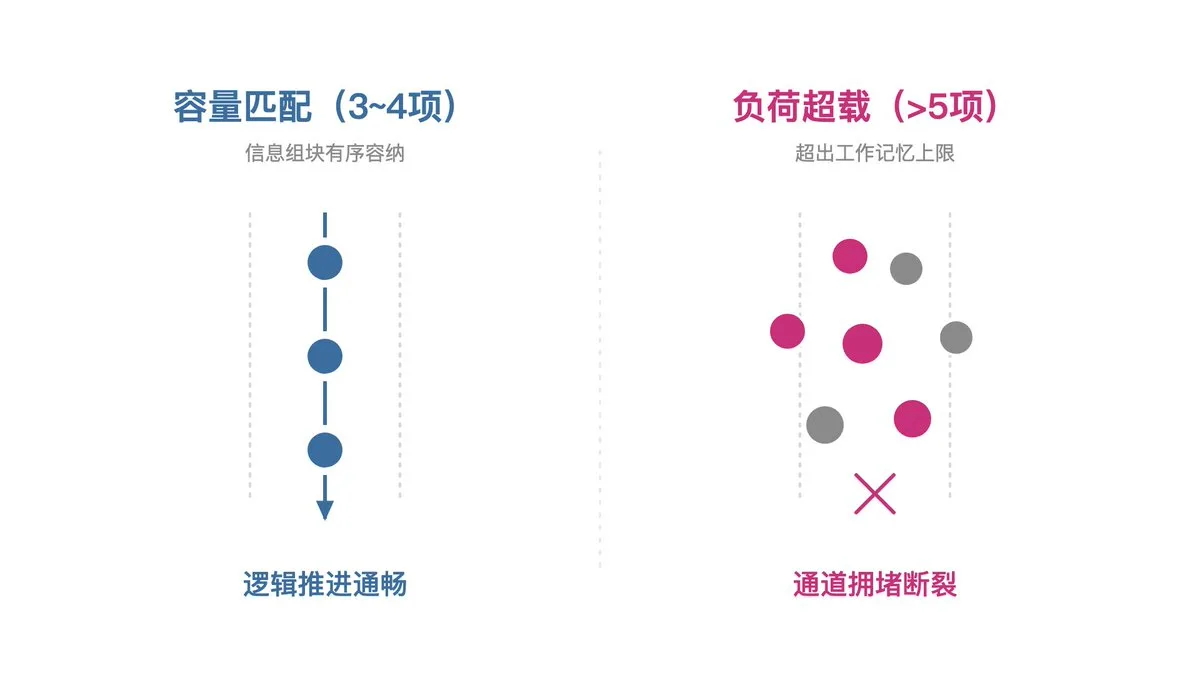
Since they are logically identical, why is the three-ring nail problem solvable while the Tea Ceremony problem causes an immediate mental standstill? The physical reason is that the way external information occupies working memory is entirely different. The three-ring nail problem has intuitive spatial geometric images; size and position are obvious at a glance, allowing the brain to use external visual representations to maintain information. The Tea Ceremony problem, however, consists entirely of lengthy, abstract, and convoluted language. While the reader is struggling just to distinguish in their mind “who is the host, which service is lower rank, who can transfer a task to whom,” the three to four information slots of working memory are already completely filled by the text of the rules. Once working memory is saturated by the task of maintaining information, the system has no remaining attentional resources to plan specific transfer steps, and the deduction is interrupted. This phenomenon shows that when the form of external information exceeds the load threshold of working memory, thinking cannot physically occur, even if the logical structure is not complex.
【Caption: Information chunk matching (3-4 items) vs. Channel blockage caused by load overload】
【Cognitive Science Supplement: The Neural Nature and Capacity Limits of Working Memory】
Working memory is not a physical container within the brain, but rather a “top-down attentional maintenance” by the prefrontal cortex over specific neuronal populations in the posterior perceptual cortex. Early cognitive psychology, such as Miller’s Law, suggested a capacity of 7±2 items. However, modern cognitive neuroscience, after strictly controlling for semantic association, has determined that when facing entirely new, unrelated information, the upper limit of human working memory capacity is only 3-4 independent information chunks.
When the information processed exceeds four chunks, the synchrony of neuronal firing becomes disordered, and old information is either directly erased or severely decayed by new incoming information.
3. Long-term Memory’s Support for Thinking: Information Compression and Foundation Supply
Long-term memory is the knowledge storage area outside of consciousness, containing factual knowledge and procedural knowledge. Factual knowledge is the cognition of concepts, definitions, and specific data, while procedural knowledge refers to the methods and steps for executing specific cognitive operations. All information in long-term memory remains in a dormant state until it is evoked and retrieved into working memory when relevant to the current task.
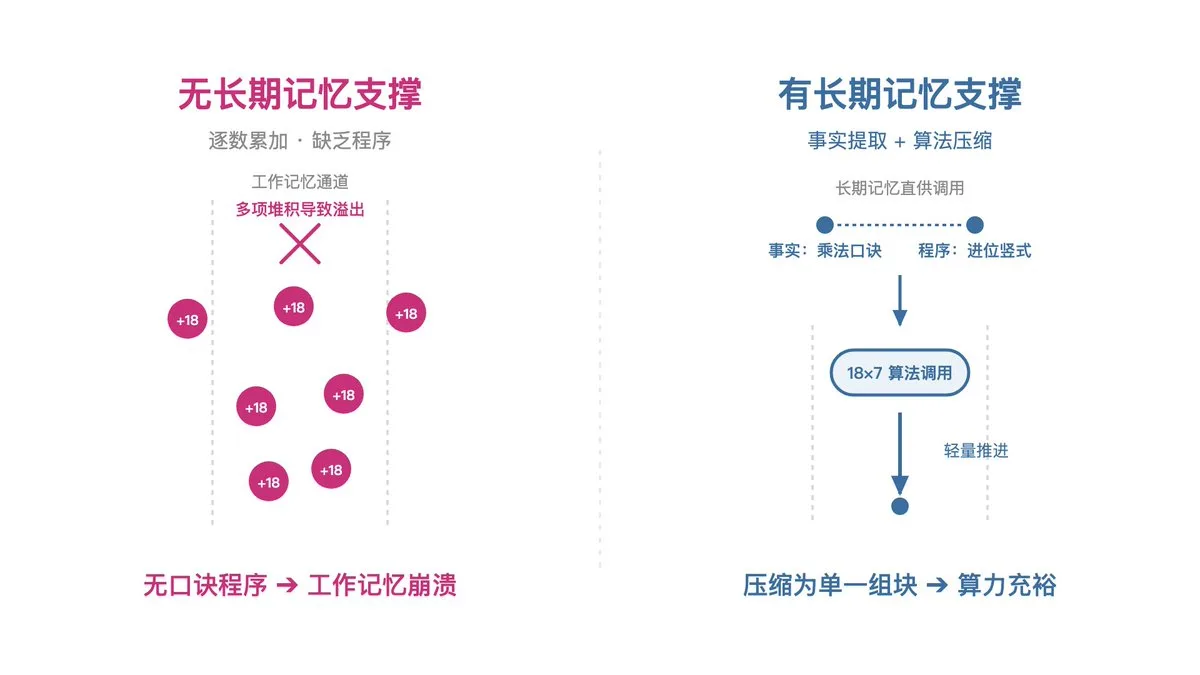
Long-term memory plays a core role in reducing the burden on working memory during the thinking process. Take multi-digit multiplication as an example: the calculation process requires the simultaneous retrieval of two types of memory. One is factual knowledge, such as the correspondence of values in the multiplication table; the other is procedural knowledge, namely the specific operational steps of calculating from the ones place, carrying over when reaching ten, aligning digits, and performing cumulative addition.
If the multiplication table is lacking in long-term memory, the calculator must break down multiplication into multiple sets of consecutive additions, and working memory will overflow and crash due to the need to maintain too many intermediate numbers. By solidifying scattered facts and algorithms into compact conceptual chunks, long-term memory allows working memory to directly call upon ready-made results, avoiding the high metabolic cost of deriving them from scratch. This demonstrates that: without the information compression and foundation supply provided by long-term memory, high-level logical reasoning cannot physically unfold.
【Caption: No Long-Term Memory (Working memory collapse due to sequential addition) vs. With Long-Term Memory (Facts and algorithms compressed into a single chunk)】
Applying the Principles: Using a Word Problem to Connect All Underlying Cognitive Laws
Before applying the cognitive science principles discussed previously to actual tutoring scenarios, it is necessary to systematically synthesize and integrate the underlying physical mechanisms established in the first three chapters.
When facing a cognitive task, the human brain is always governed by three progressive objective laws:
- At the hardware level, the brain operates on a physiological baseline of minimizing energy consumption. Active thinking is slow, effortful, and error-prone; therefore, the brain’s default strategy is to rely on existing programs in long-term memory to maintain automated operation with extremely low energy expenditure.
- In terms of motivation, the brain resists effortful thinking yet craves moderate challenges. When task difficulty is at the edge of the comfort zone, the prefrontal cortex mobilizes attention to overcome the resistance of derivation. Once uncertainty is eliminated through autonomous cognition, the midbrain dopamine circuit is activated, providing an endogenous sense of satisfaction. However, once a task exceeds the boundaries of ability and the predicted reward approaches zero, the brain physiologically triggers an avoidance response to prevent wasting energy.
- In terms of operational architecture, thinking must unfold within the working memory, which has a capacity of only three to four independent chunks. The system relies heavily on the external environment to provide intuitive visual cognitive scaffolding to share the maintenance load, and on long-term memory to compress scattered information into compact chunks to provide a computational base.
【Caption: Comfort Zone (Memory automation) vs. Challenge Zone (Moderate challenge and dopamine reward) vs. Panic Zone (Overload and physiological avoidance)】
These three laws form a complete cognitive causal chain, providing an objective physical scale for troubleshooting “mental blocks” during problem-solving. In actual tutoring, a child’s cognitive stagnation is no longer an abstract issue of “attitude,” but is inevitably caused by a mechanical blockage at some point within this physical architecture. Using a common two-step word problem for primary school students as an example, let’s place these underlying laws into a real tutoring context to derive actionable intervention methods:
Typical Problem: A book has 96 pages. Xiaoyu has already read 36 pages and plans to finish the rest in 3 days. On average, how many pages should be read per day?
1. Adults Retrieve Long-Term Memory, Children Perform Live Derivation: The Real Difference in Facing the Same Problem
When facing this problem, the most common friction in tutoring is the adult blurting out: “This is such a simple problem, why don’t you get it?”
Looking at how the brain processes information, the internal processes for the adult and the child are entirely different. The adult’s long-term memory already contains the procedural knowledge for two-step word problems. After reading the question, the brain directly retrieves an automated program from long-term memory: “First calculate how many pages are left, then calculate the average per day.” This process requires no effortful derivation and occupies almost no working memory attention. What the adult calls “simple” is actually the low-energy experience of retrieving an existing program.
A child doing this type of problem for the first time is completely different. They have not yet established a procedural circuit for solving such problems in their long-term memory. They must organize the conditions live within their limited working memory: Which is the total page count? Which is the number of pages read? Why can’t I just divide 96 by 3? Additionally, they must temporarily hold the intermediate result from the first step for use in the second. This process relies heavily on the active computation of the prefrontal cortex—it is energy-intensive, slow, and prone to error.
Adults often mistakenly believe they are “thinking,” when they are actually just retrieving a ready-made program from long-term memory at low energy cost; meanwhile, the child is performing high-energy live derivation from scratch without any ready-made memories. The prerequisite for tutoring is to recognize the physiological difference between these two modes of information processing, avoiding the tendency to demand a child undergoing high-load live derivation to match the ease of an adult retrieving existing experience.
2. Three Specific Reasons Why a Child Gets Stuck
When a child says “I don’t know” while facing this problem, the adult’s first reaction is usually to urge them to “think harder” or to read the problem aloud again. However, from the physical architecture of information processing, thinking consists of three elements: input from the external environment, storage in long-term memory, and processing in working memory. When a child gets stuck, it is never a general or abstract issue of attitude, but a physical blockage occurring in one of these three stages.
The first reason is a blockage in external information input. In a real-world scenario, this often manifests as the child blindly combining numbers from the problem—for example, writing 96 ÷ 3 = 32. This indicates that the conditions of the problem were not accurately absorbed into the working memory; the child missed the critical qualifier that “the 3 days are for reading the remaining pages, not the whole book.” The essence of thinking is processing environmental information in working memory. If the raw materials entering working memory are incomplete or wrong, urging “thinking” is meaningless. The correct response is not to demand they “use their brain,” but to pause the derivation and guide the child to verify the text, asking them to identify whether the 3 days are for the whole book or the remaining part, correcting the input of external information at the source.
The second reason is a lack of basic concepts in long-term memory. Specifically, the child might successfully calculate that 60 pages remain, but stop and stare blankly at the phrase “average per day,” not knowing whether to add, subtract, multiply, or divide. This shows that the mathematical definition of “averaging” and the division operation program have not yet been established in the child’s long-term memory. Long-term memory provides the components and algorithms for working memory. Without these basic concepts, working memory cannot derive an unfamiliar mathematical operation out of thin air. Applying pressure to “think harder” only leads to anxiety. The correct approach is to temporarily leave the abstract equation and use physical objects (e.g., dividing 6 chess pieces into 3 equal groups) to first fill the concept of “using division to split a total into equal parts” in long-term memory, then return to the calculation.
The third reason is an overload of working memory’s physical capacity. In this problem, the child can do subtraction alone and division alone, but becomes confused when they are in the same problem. They often calculate 96 – 36 = 60 and then go blank, forgetting what the final question was. This is not due to low computational power, but because the initial conditions (96 and 36), the intermediate value (60 pages), the time frame (3 days), and the final goal are all crowding the narrow channel of working memory. The number of items exceeds the physiological limit of 3 to 4 unrelated information chunks. Too much simultaneous information causes disordered neuronal firing, where new data simply washes away the hard-won intermediate result.
3. Solution 1 (External Environment): Point-Reading and Circling to Calibrate Input, Physical Silence to Block Distractions
The external environment is the source of perception for the thinking system. If the raw materials entering working memory are incomplete or biased, subsequent logical operations fail at the starting point. When a child blindly writes 96 ÷ 3, it is because visual attention missed the key qualifier “the remaining.” Furthermore, during serial reasoning, external audio signals unconditionally occupy limited attention; a tutor’s continuous prompting or corrections will forcibly interrupt the original derivation circuit.
Scientific tutoring for the external environment focuses on leveraging the high-bandwidth advantage of visual perception to ensure complete and accurate input of problem data, while blocking environmental noise from occupying the attention channel. Tutors should not vaguely urge children to “use their brains,” but should assist perception through physical actions: guide the child to read the prompt word-for-word with their finger and circle core qualifiers like “the remaining.” Using the physical trajectory of the finger forces the visual focus to freeze, ensuring that constraints fully enter consciousness. Meanwhile, the tutor must maintain absolute physical silence, strictly avoiding frequent hints, corrections, or urging, thereby cutting off irrelevant audio signals and providing a pure, stable perceptual environment for the child’s prefrontal cortex.
【Caption: Two physical interventions for the external environment: Point-reading and circling key qualifiers (Visual Calibration) vs. Maintaining physical silence to avoid noise pollution (Auditory Blocking)】

4. Solution 2 (Working Memory): Externalizing via Scratch Paper to Release Load, Using Minimal Clues to Drive Autonomous Closing
Working memory is the only physical site where thinking occurs, but it has a physiological limit of three to four chunks for unrelated information. In a two-step calculation, if a child relies solely on their brain to simultaneously hold the initial numbers (96 and 36), the intermediate result (60), the time frame (3 days), and the final goal, the prefrontal cortex must expend massive metabolic energy to keep these neurons active. The narrow channel of working memory immediately becomes congested, resulting in a “blank brain” and cognitive stagnation.
Since the physical capacity of working memory has an insurmountable physiological limit, the only way to prevent the logical derivation from breaking is to transfer the cognitive load to the external environment—converting intermediate data that would normally require energy to maintain in the brain into stable visual signals on paper. In practical tutoring, the use of scratch paper is not a formatting requirement, but a physical aid to reduce neural load. Tutors should guide children to clearly write down the total pages (96) and pages read (36) on scratch paper; after calculating the first subtraction, immediately record “60 pages remaining.” Once “60” becomes an objective ink mark on paper, the brain no longer needs to allocate attention to remember it; the visual system can scan the data at zero derivation cost. All slots in the working memory are thus released to focus entirely on the subsequent division operation.
[Caption: Overload and interruption caused by relying solely on mental memorization vs. smooth derivation by offloading cognitive load onto scratch paper]

During the process of derivation in working memory, the dopamine reward mechanism and difficulty prediction mechanism established in Chapter 2 play a decisive regulatory role. When a child hits a wall during derivation, providing the full explanation or the direct equation is destructive. This is because being told the answer externally robs the child’s brain of the cognitive closure experienced when eliminating the unknown; the dopamine pathway cannot be activated, which inevitably leads to a neural dependency on external prompts over time. Therefore, the physiologically viable path for scientific tutoring is to provide the minimum necessary “step-sized” external clues. The tutor’s intervention should only serve to remove one layer of prior resistance, pulling a problem that was in the “avoidance zone” back to the edge of the “comfort zone” as a moderate challenge, thereby awakening the brain’s predicted probability of success. More importantly, the final step of the derivation chain must be strictly left to the child’s own neural circuitry to close the loop, ensuring the dopamine reward circuit is successfully triggered.
In a real-world problem-solving scenario, when a child stops writing while facing a word problem, the tutor should not directly say, “Use 96 minus 36.” Instead, they should ask a minimum necessary question pointing toward the prior logic: “To figure out how many pages are read per day, which part of the page count do we need to know first?” When the child thinks and says, “I need to know how many pages are left,” the brain’s prediction probability is reset, and the task returns to the moderate challenge zone. At this moment, the tutor must immediately stop speaking and step back to observe, firmly refusing to provide further hints, leaving the formulation of the equation, the subtraction, and the subsequent division entirely to the child. As the child completes the final derivation using their own neural circuits and eliminates the unknown variables, the midbrain dopamine circuit releases neurotransmitters, creating a sense of satisfaction. This neural positive feedback, gained through independent derivation, is the material foundation for maintaining the motivation for autonomous problem-solving.
5. Approach Three (Long-term Memory): Isolate Underlying Breakpoints for Targeted Practice to Solidify into Automated Chunks via Neuroplasticity
Long-term memory functions as information compression and a foundational supply in the thinking process. When a tutor identifies that a child is stuck due to a lack of basic concepts or sub-operations in their long-term memory, a common mistake is to have the child continue working through complex, integrated application problems. Tutors often believe that “doing more big problems will naturally lead to mastery.” However, at the level of neural information processing, this approach is highly likely to accelerate the collapse of the cognitive channel.
Composite word problems require working memory to simultaneously handle the analysis of the problem’s meaning, the organization of quantitative relationships, and specific numerical calculations. If, at the level of neuroplasticity and automation described in Chapter 1, the child has not solidified basic sub-steps (such as two-digit subtraction or single-step division) into low-energy circuits in long-term memory, then that non-automated operation will forcibly occupy two or three of the few available information slots in working memory. When limited computing power is consumed by low-level arithmetic derivation, the prefrontal cortex has no remaining resources to manage high-level planning, leaving the child in a blocked state where they can neither calculate correctly nor reason through the logic.
Based on the principle of neuroplasticity established in Chapter 1, the automation of a skill relies on high-frequency experiential repetition to cause adaptive changes in the connection patterns of neural synapses. When breakpoints are found in the basic circuits of long-term memory, the scientific approach must be to isolate that basic sub-skill from the composite context. Through targeted, single-point practice, neuroplasticity is used to achieve automated solidification. Once the skill is compressed into an information “chunk” requiring minimal computing power, the child can return to the derivation of composite problems.
In practical tutoring, if a child frequently gets stuck on the single-step division of 60 ÷ 3 while calculating the average pages read per day, the tutor should immediately pause the progress of the current composite problem and stop struggling with the complex task. The correct action is to design 5 to 10 sets of targeted exercises specifically for “tens divided by a single digit,” allowing the child to repeatedly activate the division circuit in an environment free from the interference of the word problem’s language. Through focused and high-frequency practice, the neural circuits for this type of operation are rapidly consolidated and transformed into an automated program supported by long-term memory. When the child returns to the two-step word problem, the division operation no longer consumes expensive working memory resources, allowing the brain to allocate all attentional resources to the derivation of quantitative relationships.
[Caption: Targeted reinforcement mechanism for long-term memory breakpoints: Grinding through composite problems vs. Isolate single-point training]

Conclusion: The First Principles of Tutoring Homework
If the cognitive neuroscience laws of this entire text were condensed into one sentence, the first principle of tutoring children with homework would be: The brain biologically instinctively avoids high-energy thinking; thinking is a chunk-recombination operation limited by the narrow physical channel of working memory. The essence of all scientific tutoring is to use external environmental scaffolds and long-term memory automation to offload working memory, while strictly leaving the final step of derivation to the child’s own autonomous closure within a range of moderate challenge.
Combining the physiological mechanisms and specific scenarios mentioned above, this set of first principles manifests as four objective facts in a tutoring session.
First, recognize the gap between memory and derivation. Adults find problems obvious because mature algorithmic programs already exist in their long-term memory; reading the problem is simply a matter of retrieving existing memories. Children find it slow and laborious because they have no ready-made patterns and must derive everything from scratch within their limited attention. The first step of tutoring is not to rush them, but to understand this physiological difference in information processing and give the child time to organize the conditions from zero.
Second, eliminate perceptual interference from the external environment. The raw materials for thinking come directly from the environment; children are often “careless” because they skip words or are distracted by ambient noise. Tutoring should guide the child to read word-by-word with a finger and circle key limiting conditions, while the tutor remains quiet to ensure that input information enters the brain accurately and completely.
Third, use scratch paper and minimal clues to manage working memory. When children freeze or forget during multi-step problems, it is often not due to a bad attitude or lack of intelligence, but because the problem conditions, intermediate numbers, and the final goal flood the prefrontal cortex simultaneously, exceeding the working memory’s limit of three to four items. The most direct physical solution is using scratch paper to write down known conditions and intermediate results, sharing the memory load and freeing up computing power for derivation. Provide only the minimal clue at the point of cognitive blockage, and firmly leave the final step to the child to protect the neural reward of the midbrain dopamine circuit.
Finally, rely on neuroplasticity to achieve skill automation. For bottlenecks in multi-step problems caused by a lack of mastery of basic operations or concepts, the issue cannot be solved by repeating complex problems. The scientific approach is to isolate the non-automated sub-skill, conduct short and fast targeted exercises to reshape neural synapses, and solidify them into low-energy long-term memory chunks before returning to multi-step composite problems. Truly effective tutoring always remains restrained: identify the physical blockage, follow the laws of the brain, and leave the loop of growth for the child to complete on their own.
(function(){function ready(f){if(document.readyState!==’loading’)f();else document.addEventListener(‘DOMContentLoaded’,f);}ready(function(){var seen={};function track(e,d){if(window.umami)window.umami.track(e,d);}var hs=document.querySelectorAll(‘.tfa h2’);if(‘IntersectionObserver’ in window&&hs.length){var io=new IntersectionObserver(function(es){es.forEach(function(e){if(e.isIntersecting){var t=e.target.textContent.trim().slice(0,60);if(!seen[t]){seen[t]=1;track(‘section-view’,{title:t});}io.unobserve(e.target);}});},{rootMargin:’0px 0px -55% 0px’});hs.forEach(function(h){io.observe(h);});}var marks=[25,50,75,100],done={};window.addEventListener(‘scroll’,function(){var h=document.documentElement,p=h.scrollTop/(h.scrollHeight-h.clientHeight)*100;marks.forEach(function(m){if(p>=m&&!done[m]){done[m]=1;track(‘scroll-depth’,{percent:m});}});},{passive:true});});})();