Xi'an · Ancient Towns & Old Streets
Grand Tang Everbright City
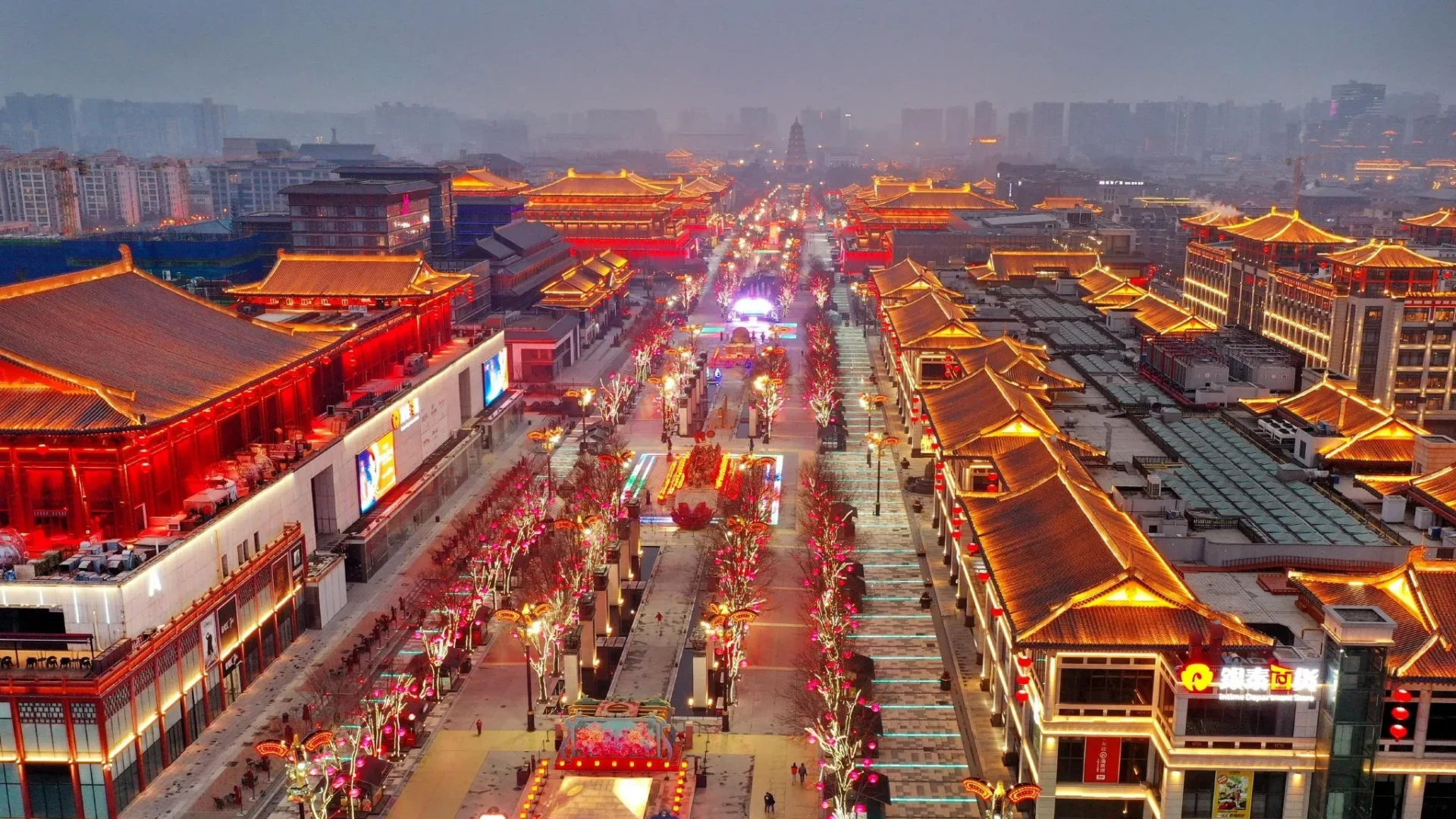
At seven in the evening, the moment the lights along the entire street ignite almost simultaneously, the sculptures lining Zhengguan Boulevard seem like figures stepping straight out of Tang poetry. I follow the crowd south from the North Plaza; a long queue has already formed for the “Tumbler Lady,” and the laughter from the “Great Tang Mystery Box” can be heard from half a street away. Tanghulu snacks and the hems of Hanfu robes flutter under the glow—this is where the night in Xi’an truly begins.
1. Location Overview: Grand Tang Everbright City is located in the Qujiang New District of Yanta District, Xi’an. Stretching north-to-south along Yanta South Road, it begins at the Big Wild Goose Pagoda North Plaza and ends at the Tang City Wall Ruins Park. Spanning approximately 2.1 kilometers, it is an open-air, wall-less Tang-style cultural pedestrian street. The northern end connects to the Big Wild Goose Pagoda South Plaza, where the bronze statue of Monk Xuanzang stands at the entrance. Along the street are key nodes such as Zhengguan Plaza and Kaiyuan Plaza, as well as indoor spaces including a 24-hour bookstore, art galleries, and cultural creative zones. It is a short two-to-three-minute walk from Exits B and C of the Big Wild Goose Pagoda Station (Metro Lines 3 and 4) to the north entrance. The Qujiang Pool Ruins Park and the branch of the Shaanxi History Museum are also within walking distance or one metro stop away, making this street the central axis of the Qujiang night tour route.
2. Cultural Context: The essence of Grand Tang Everbright City comes from the land it sits upon: the Qujiang Pool and Da Ci’en Temple of the Tang Dynasty’s Chang’an were located right here. From Xuanzang’s translation of scriptures to the banquets of successful imperial examinees and the spring outings of commoners, the most elegant scenes of the High Tang era unfolded in this area. Today’s district is built upon the cultural resources of the Big Wild Goose Pagoda and Qujiang, using the “Governance of Zhenguan” and the “Kaiyuan Prosperity” as its narrative threads. The street is adorned with themed sculpture groups and relief culture columns, including the “Gallery of Tang Heroes,” the “Governance of Zhenguan,” and the Tang music and dance of Kaiyuan Plaza. Historical figures like Li Bai, Du Fu, Xuanzang, and Emperor Taizong (Li Shimin) stand as statues along the way, transforming a commercial pedestrian street into a walkable gallery of Tang history. Since its comprehensive renovation and reopening around 2019, interactive performances like the “Tang Rhyme Tumbler” and the “Great Tang Mystery Box” have gone viral, making this the most recognizable calling card for Xi’an’s night economy and Tang culture IP. The sculpture groups on the two main plazas are the street’s most profound chapters: the center of Zhengguan Plaza features the “Governance of Zhenguan” monument, with Emperor Taizong on horseback leading a 24-person honor guard of buglers, flag-bearers, and drummers, with a list of key officials from the Zhenguan era carved on the back. At the southern end, Kaiyuan Plaza hosts the “Kaiyuan Prosperity” group sculpture, where Emperor Xuanzong stands before a massive circular dragon wall, surrounded by eight coiled dragon columns, foreign envoys, and musicians with instruments, symbolizing global harmony. The street also houses official venues such as the Xi’an Concert Hall, Shaanxi Grand Theatre, and Xi’an Art Museum, which serve as quiet exhibition spaces by day and, together with the street performances, support the vibrancy of Qujiang by night.
3. Highlights: The core attraction is the density of free outdoor performances. Every night, dozens of short shows—including the Tang Rhyme Tumbler, Great Tang Mystery Box, Flower Carriage Parade, Tang-style Processions, and music and dance performances—take place in rotation along the main street, mostly between 19:00 and 22:30. Among them, the “Great Tang Mystery Box,” where two actors portray Fang Xuanling and Du Ruhui, is the most interactive; they randomly pick audience members to answer questions for small gifts, while wrong answers bring laughter to the crowd. The grace and fluidity of the “Tumbler Lady” provide a contrasting elegance; these two are the most popular shows. To avoid missing them, remember their locations: the Mystery Box is in the northern section of the main street, the Tumbler Lady is concentrated around Kaiyuan Plaza, and the Tuanhua Plaza hosts rotating court music and dance. The Flower Carriage parade moves slowly along the main street, so there is no need to stay in one spot, though crowds often gather several layers deep. The scenery itself is a performance: once the Tang-style architecture lights up, the flying eaves and LED strips create a continuous golden skyline, with the Big Wild Goose Pagoda anchoring the north end—every intersection is a cinematic photo op. The street also features poetry-themed ground lights, creative markets, and Hanfu rental shops; renting a set of Hanfu and blending into the crowd is the most immersive way to experience the area. The indoor show “Return to Chang’an” is a permanent resident in theaters around the district, providing a static contrast to the dynamic street performances.
4. Visitor Information: The district is open for free all day with no tickets or reservations required; outdoor performances are free to watch. Indoor theater shows like “Return to Chang’an” require separate tickets, with prices based on official channels. Outdoor performances are concentrated from 19:00 to 22:30; it is recommended to arrive 20-30 minutes early to secure a spot at popular locations. Specific schedules and times are subject to daily announcements, and some performances may be canceled during rain or snow. Transportation: Take Metro Line 3 or 4 to Big Wild Goose Pagoda Station and exit via B or C. Roads around the area are heavily congested on weekends and holidays, making ride-hailing difficult; the metro is strongly recommended. Reminder: One-way pedestrian flow control is often implemented; please follow the signs and do not walk against the flow. Visitors with children should agree on a meeting point in advance, as crowds become very dense when popular shows end.
5. Travel Tips: The standard itinerary is to arrive at the North Plaza around 18:30 to secure a spot for the musical fountain. Once the fountain ends at 19:00, follow the flow of people into the street and visit the performance spots from north to south: start with the Great Tang Mystery Box, then head toward Kaiyuan Plaza for the Tumbler Lady and the Flower Carriage parade, with breaks at creative shops and tea houses in between. The entire walk takes about two and a half hours; those with high stamina can walk all the way to the Tang City Wall Ruins Park and back. Families with elderly members or children can stick to the highlights of the northern section, as the most exciting shows are concentrated in the first half. For photographers seeking “empty” shots, there are two windows: early morning when the street is silent and the architecture looks most textured, or after 23:00 when the lights are still on but the crowds have dissipated, perfect for long-exposure night shots. For Hanfu, it is suggested to rent and get your makeup done at shops on the periphery of the district before entering for better prices and a more relaxed selection. Plan your energy: the main street is 2.1km one way; with stops for shows, you will easily exceed 10,000 steps—flat shoes are a must. For families with young children, note that the “walls of people” at popular spots will block a child’s view; to see the Tumbler Lady clearly, either arrive 40 minutes early or make it the first stop of your trip while crowds are thinner. When leaving, don’t just crowd into Big Wild Goose Pagoda Station: walk to the southern end near the Tang City Wall Ruins Park and walk to Qujiangchi West Station (Metro Line 4) to avoid the heaviest crowds.
6. Best Time to Visit: Since the main attraction is the night view, any season works. Spring and autumn offer the most comfortable temperatures, making it easy to watch outdoor shows for several hours. Summer has the highest frequency of performances and activities, but also the largest crowds; prepare for the heat and try to enter after 20:00 to avoid the peak. Winter is the most atmospheric during the lantern festivals, where colorful lights complement the Tang architecture; dress warmly, as many performance spots are in windy areas—scarves and gloves are essential. During holidays and winter/summer break weekends, crowds often reach saturation. For a more relaxed experience, choose a weekday evening; if you must visit during a peak period, check the daily schedule and lock in two or three “must-see” spots rather than simply drifting with the crowd.