Qingdao · City Landmarks
May Fourth Square
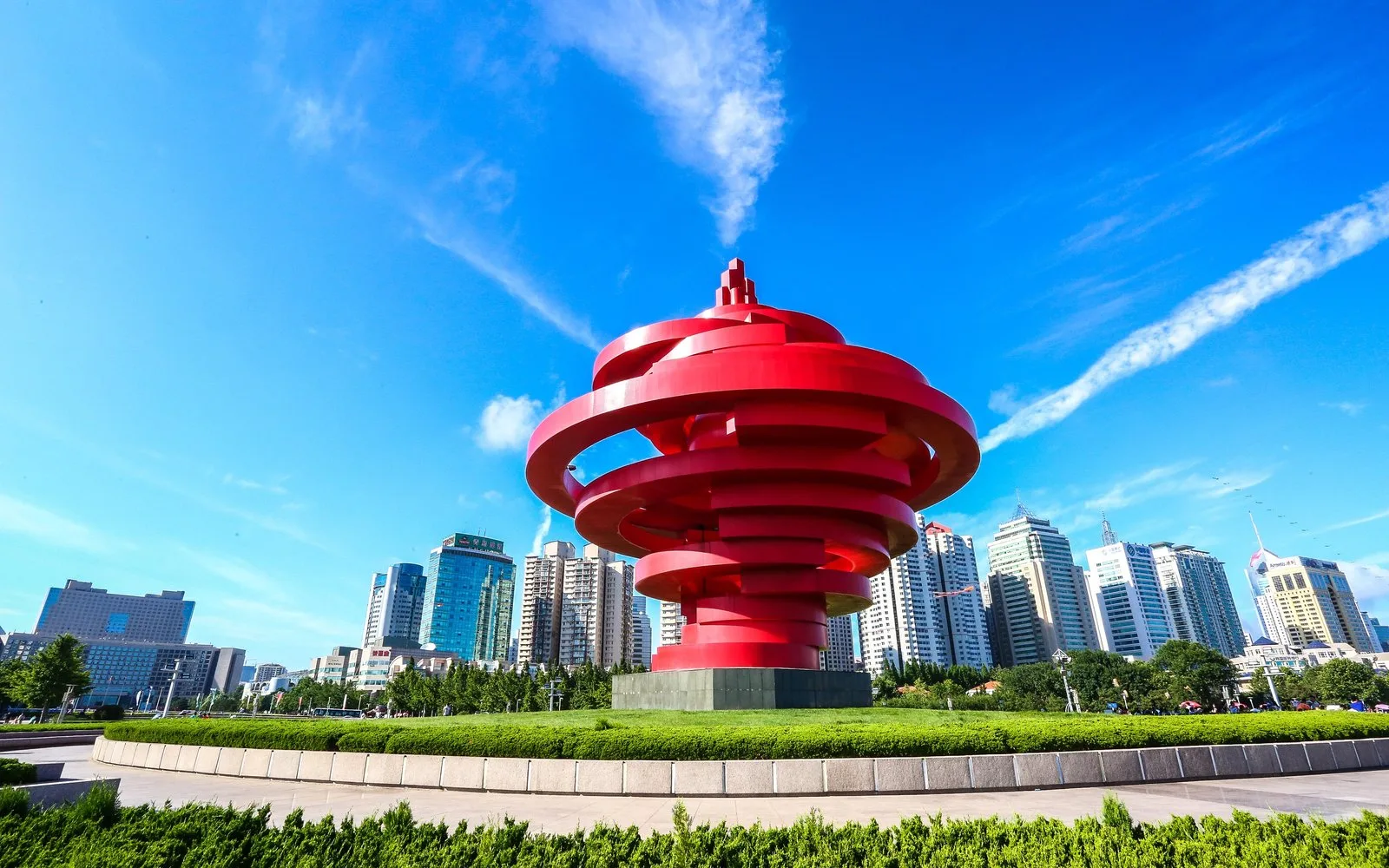
I always love visiting May Fourth Square in the early evening. The salt-tinged sea breeze blows in from Fushan Bay, the clouds on the horizon slowly burn into a deep orange, and the silhouette of the Municipal Government building behind me begins to light up. On the lawn, kite-flyers slowly reel in their lines, and the morning flocks of pigeons are replaced by seagulls returning for the night. When darkness fully descends and the lights across the entire bay ignite simultaneously, a low murmur of awe always ripples through the crowd. This square is the primary calling card that Qingdao presents to the world.
1. Location Overview:May Fourth Square is located on Donghai West Road in the Shinan District of Qingdao. Bordered by the Qingdao Municipal People’s Government to the north and Fushan Bay to the south, it covers a total area of approximately 10 hectares. The square is divided by Donghai Road into north and south sections: the north is a municipal plaza consisting of lawns, hedges, and a central fountain, while the south is a seaside leisure and sightseeing belt. Surrounded by towering skyscrapers, the square is adjacent to the Hong Kong Middle Road business district, with large commercial complexes like MixC within walking distance. Walking a few hundred meters east along the coastal promenade leads to the Olympic Sailing Center and Lovers’ Dam. Positioned at the heart of Qingdao’s Eastern New City, it is the origin point where the city’s modern skyline meets the coastline. Qingdao’s urban layout has always been an embrace of “mountains, sea, bay, and city,” and May Fourth Square sits exactly at the seam between the bay and the city. Regardless of how you arrive in Qingdao, this is often the first stop for travelers to get to know the city. The north side of the square connects underground to the metro station and shopping malls, while above ground, there are open sea-view platforms and sloping lawns. Visitors arriving in Qingdao can stop here to get an overall impression of the city’s sea, bay, and architecture before deciding on their subsequent itinerary.
2. Cultural Context:The square is named after the May Fourth Movement. In 1919, when the Paris Peace Conference decided to transfer Germany’s rights in Shandong to Japan, the news sparked a patriotic movement led by students in Beijing that changed the course of Chinese history. The catalyst for this movement was precisely the issue of Qingdao and Shandong, and various sectors of Qingdao society responded in support. Consequently, Qingdao shares an innate blood bond with the May Fourth Movement. Since its completion in 1996, the square has served as the city’s “living room” where Qingdao residents commemorate that history and express their love for their country. In 2008, when the Olympic Sailing Regatta was held in Fushan Bay, May Fourth Square became a global focal point for spectators and celebrations. Following the 2018 SCO Qingdao Summit, the Fushan Bay light show became an overnight sensation. In this way, the prosperity of the new city and a century of history have passed the torch on this plaza. Both the name of the square and the title of its sculpture derive from this history. For the people of Qingdao, it is more than just a tourist attraction; it is a memorial etched into the city’s memory. On important anniversaries, crowds often gather here spontaneously to pay their respects and celebrate.
3. Highlights:The sculpture “Wind of May” at the southern end of the square is Qingdao’s most recognizable landmark. This steel sculpture, standing 30 meters high with a diameter of 27 meters, was designed by artist Huang Zhen. Shaped like a spiraling wind carrying a fiery red flame, its crimson hue symbolizes the flame-like patriotic passion of the May Fourth Movement. As one of China’s largest steel urban sculptures, it is the most popular spot for photos regardless of the weather. The north section features a spacious, flat lawn with a central fountain that dances to a rhythm; in spring, locals often fly kites or pitch tents here. The southern seaside area features an open-air stage, a matrix fountain, and a moon-viewing platform. Hidden 160 meters offshore is a marine fountain—the highest in China—which sends towering plumes of water into the sky. In winter, flocks of black-headed gulls circle the shore, and after dark, the Fushan Bay light show illuminates the entire waterfront, making the square the best vantage point for the spectacle. On weekends, street performers often gather around the north lawn, while children chase bubbles and adults sit on the steps chatting and watching the sea—a perfect blend of local life and iconic landmark status.
4. Travel Tips:May Fourth Square is an open public space, open 24 hours a day, free of charge, and requires no reservation. Transportation is very convenient: take Metro Line 2 or 3 to May Fourth Square Station, and you will emerge at the north side of the square. Many bus lines stop at the Municipal Government or May Fourth Square stops. Those driving can park in nearby malls or public parking lots, though spaces are limited during holidays, so the metro is recommended. Dining and accommodation options are plentiful nearby, ranging from seafood stalls to chain hotels. Please note that the dates and times of the Fushan Bay light show are adjusted based on seasons and festivals, with extra shows often added during major holidays; please refer to official announcements before your visit. There is limited shade in the summer, so use sunscreen at noon. The seaside wind is strong, so bring a jacket in spring and autumn. The coastal promenade can be slippery when raining, so please walk carefully. There are visitor service points and numerous benches throughout the square, and the seaside area is equipped with barrier-free access, ensuring smooth passage for strollers and wheelchairs.
5. Itinerary Suggestions:We suggest a rhythm of “sculptures by day, sunset at dusk, and the light show by night.” In the early morning, the square belongs to those exercising; Tai Chi, brisk walking, and seagulls create a serene scene for early risers. In the afternoon, take photos with “Wind of May” on the north lawn—for a panoramic shot, move back to the higher ground at the northern edge of the lawn. Then, stroll east along the southern coastal promenade toward the Lovers’ Dam and lighthouse at the Olympic Sailing Center, as this is one of Qingdao’s most classic seaside walks. If traveling with children, the matrix fountains in the south are a natural water park; remember to bring a change of clothes. For the light show, arrive half an hour early to secure a spot; the seaside steps on the south side offer the widest view. Don’t rush to leave after the show—once the crowds disperse, the quiet square, the sound of the waves, and the distant city lights create a unique atmosphere. If time permits, walk west toward Music Square to take in the full nocturnal beauty of Fushan Bay. On weekends, you can browse seafood souvenirs at the market stalls around the lawn—a pro tip for seaside travel is to confirm the price before ordering. The entire slow-paced tour takes about two to three hours.
6. Best Time to Visit:From late April to October is the most pleasant season to visit May Fourth Square. In late spring and early summer, the sea breeze is gentle, the greenery of Laoshan is lush, and the lawns turn vibrant green—perfect for kite flying and picnics. Although midsummer is hot, the evening breeze and light show are refreshing. During the Qingdao International Beer Festival in August, this is the most popular spot for night views. Late autumn brings high, clear skies and excellent visibility, ideal for photographing the skyline. In winter, the sea breeze is biting and tourists are few, but this is when the seagulls are most friendly; feeding the black-headed gulls is a delight. The New Year’s Eve light show is the grandest of the year, though warm clothing is essential. It is best to avoid days with heavy sea fog in spring; when advection fog rolls in, the distant mountains and skyscrapers vanish, and only half of “Wind of May” remains visible. Check the weather forecast before heading out. Conversely, if the sky clears after a fog, the sea and sky are crystal clear—a prime time for photography. Additionally, the outskirts of typhoons occasionally affect the area in summer, creating a magnificent sight of waves and lights, but always follow safety warnings from the weather bureau and scenic area staff; do not venture too close to the reefs or breakwaters.