Chengdu · Historical Sites
Wuhou Shrine
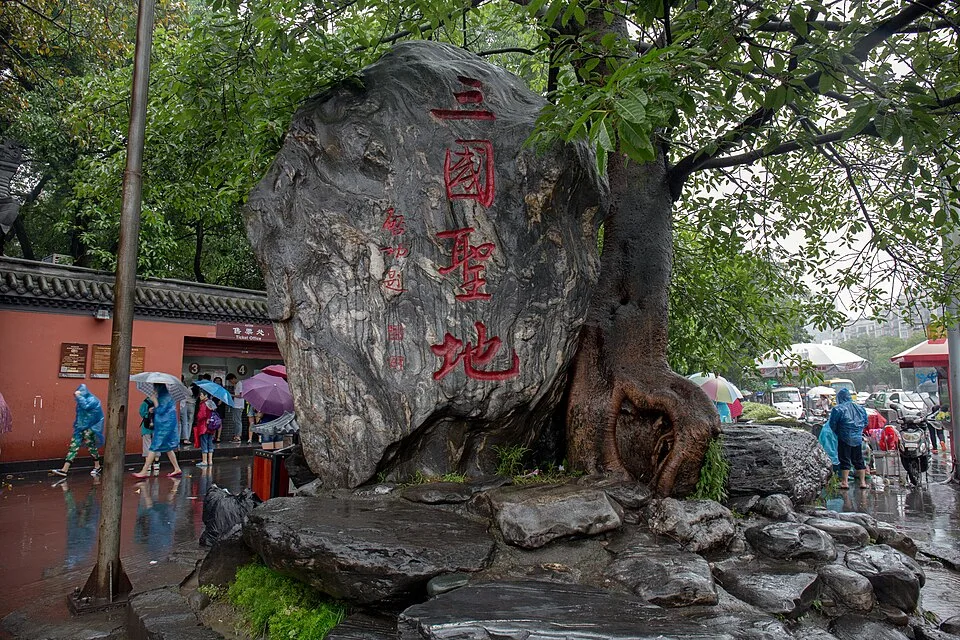
Wuhou Shrine is the only temple in China dedicated to both a monarch and his minister—where Liu Bei and Zhuge Liang are venerated together. Walking between the red walls and emerald bamboo, reading the couplets and stone inscriptions, you will feel that the “Three Kingdoms” period is not just a novel, but a cultural memory etched into the very soul of Chengdu’s people.
1. Location Overview: Located at No. 231 Wuhouci Avenue, Wuhou District, Chengdu, Sichuan Province, the Wuhou Shrine stands within a secluded grove in the southern suburbs by the Jin River. Situated about 3 km from Tianfu Square, this shrine commemorates Zhuge Liang, the Prime Minister of Shu Han, and Emperor Liu Bei (Emperor Zhaolie), making it the only existing shrine in China where a monarch and his minister are enshrined together. It neighbors Jinli Ancient Street to the east, connects to the former South Suburb Park (now the West Zone of the Wuhou Shrine Museum) to the west, and faces the Du Fu Thatched Cottage to the northwest, placing it at the heart of the cultural district in southwest central Chengdu. In Chengdu’s tourism landscape, Wuhou Shrine and Jinli form a themed Three Kingdoms cultural area, serving as the premier landmark for domestic and international visitors seeking the spirit of the Three Kingdoms and Zhuge Liang’s legendary devotion. It is one of Chengdu’s most recognizable cultural icons, attracting millions of visitors annually. Although named after the “Marquis Wuhou” (Zhuge Liang), the shrine of Emperor Liu Bei occupies the central position, reflecting the historical narrative of Shu Han’s legitimacy. This unique layout is unparalleled in China. Whether you are a fan of the Three Kingdoms era or a casual traveler, stepping past the red walls feels like traveling back a thousand years to encounter an age of heroes.
2. Cultural Context: The origins of Wuhou Shrine date back to the late Western Jin and early Eastern Jin dynasties, when Li Xiong built a shrine to Zhuge Liang within the Small City of Chengdu. Around 500 AD, during the Northern and Southern Dynasties, it was moved next to the Temple of Emperor Zhaolie and Huiling Mausoleum. In the early Ming Dynasty (Hongwu era), it merged with the Temple of Emperor Zhaolie to form the current joint layout. Most of the main buildings were reconstructed during the Kangxi reign of the Qing Dynasty. The current structures face south, with the main gate, second gate, Temple of Emperor Zhaolie, transition hall, and the Main Hall of Wuhou Shrine arranged along a central axis, flanked by red walls and ancient cypresses in a solemn, rigorous architectural style. The shrine is home to numerous stele, the most precious being the Tang Dynasty stele (known as the “Three Excellences Stele” for its superb text, calligraphy, and engraving) and the Ming Dynasty stele. In the corridor behind the second gate, there is a stone carving of the “Chu Shi Biao” (Memorial on the Case for War) handwritten by the general Yue Fei, which possesses a powerful and solemn aura. By the Tang and Song dynasties, it was already a famous sight; the poet Du Fu’s timeless question—”Where can I find the Prime Minister’s shrine? Outside the city of Jinguan, the cypresses are thick”—refers specifically to this place. In 1961, Wuhou Shrine was listed among the first batch of Major Historical and Cultural Site Protected at the National Level; it was rated a National 4A Tourist Attraction in 2006 and became one of the first National First-Class Museums in 2008.
3. Highlights: The attractions of Wuhou Shrine are deeply intertwined with the stories of the Three Kingdoms. First is Huiling, the joint tomb of Liu Bei and his wives, Lady Gan and Lady Mi. With its towering mound and surrounding ancient trees, it is a solemn place of rest for the spirit of Shu Han. Second is the Temple of Emperor Zhaolie, which houses the statue of Liu Bei, with the statues of Guan Yu and Zhang Fei in the east and west side halls. The side corridors display 14 seated statues of civil and military officials of Shu Han, creating a miniature version of the Shu Han court. Third is the Main Hall of Wuhou Shrine, where a serene statue of Zhuge Liang holds a feather fan, accompanied by his son Zhuge Zhan and grandson Zhuge Shang. The “Heart-Attacking Couplet” in front of the hall (“To win the hearts of men is to make the enemy dissolve from within; since ancient times, we know that the art of war is not to love war”) is widely celebrated for its wisdom on governance and warfare. Fourth is the path of red walls and bamboo shadows leading to Huiling—a classic, must-photograph scene. Fifth is the gallery of the Three Excellences Stele and Yue Fei’s calligraphy, where art and history converge. Sixth are the Three Kingdoms-themed paintings, calligraphy, and pottery figurines. The charm of the red walls and bamboo lies in how they transform a solemn sacrificial space into an approachable garden, blending ancient ritual with modern leisure.
4. Visitor Information: Wuhou Shrine requires real-name ticketing. Full price: 50 RMB; Half price: 25 RMB (minors aged 6–18 and full-time undergraduate students aged 19–23); Free: Seniors 60+, active military, persons with disabilities, and retired officials. Annual pass: 100 RMB/year. Standard opening hours are 9:00 AM – 6:00 PM (ticket sales stop at 5:00 PM), open year-round with no fixed closing days. Extended hours may be implemented during summer or major events (e.g., May 1 to Oct 7, 2025); please check official notices for updates. Book tickets via the “Chengdu Wuhou Shrine Museum” official WeChat account. Official guides, audio tours, and study courses are available; free audio guides can be accessed via QR codes. A visit typically takes 2 to 3 hours. Please purchase only through official channels, as the museum does not authorize third-party online ticket or guide sales. Facilities include nursing rooms, resting areas, and accessible ramps. Night tours and immersive performances are held during major festivals. Families with children can collect a study handbook at the visitor center and “check in” at six key nodes using a travel permit. Transport: Take Metro Line 10 to Wuhou Shrine (Jinli) Station, Exit A2 (3-minute walk), or Line 3/5 to Gaoshengqiao Station, Exit A (10-minute walk). Buses 1, 57, 82, 334, and 335 also stop at Wuhou Shrine. For those driving, the South Suburb Underground Parking Lot (approx. 865 spaces) is available, though it gets crowded on holidays; metro is recommended.
5. Travel Tips: Recommended route: Main Gate $\rightarrow$ Tang and Ming Steles $\rightarrow$ Second Gate $\rightarrow$ Temple of Emperor Zhaolie $\rightarrow$ Transition Hall $\rightarrow$ Main Hall of Wuhou Shrine $\rightarrow$ Sanyi Temple $\rightarrow$ Red Wall and Bamboo Path $\rightarrow$ Huiling $\rightarrow$ Exit east to Jinli. The best photo spots are the red wall corridors and the ancient cypress courtyards. Early morning or after rain provides the best lighting, especially backlighting against the red walls. Wide-angle lenses are recommended to capture the depth of the alleys. Key points for guides include the unique “monarch and minister” layout, the history of the Three Excellences Stele, and the tragedy and devotion of Zhuge Liang. Families can enjoy snacks and “card-collecting” activities at Jinli; study groups should focus on the “Chu Shi Biao” and historical figures. Seniors may enjoy quiet reflection under the cypresses. Combining the shrine with Jinli Ancient Street makes for a perfect half-day Three Kingdoms cultural tour. To avoid crowds, arrive at opening time on weekdays or visit an hour before closing. Self-guided tours are easy thanks to the ubiquitous QR code explanations.
6. Best Time to Visit: Wuhou Shrine is beautiful in all seasons: new green cypresses in spring, deep shade in summer, golden ginkgo leaves in autumn, and red walls against white snow in winter. It is separated from Jinli Ancient Street by only a wall, making them a natural pair for a half-day trip. You can further expand your itinerary to include Du Fu Thatched Cottage, Qingyang Palace, Kuanzhai Alley, and People’s Park for a full “Old Chengdu” experience. During the Spring Festival, the Chengdu Grand Temple Fair at Wuhou Shrine and Jinli is a vibrant spot to experience traditional lunar new year atmosphere. Nearby dining is abundant: Sichuan restaurants on Wuhouci Avenue, “Three Cannon” snacks and beef tofu skin in Jinli, the Shuadu food area, and famous local snacks like Zhong Dumplings and Long Chao Shou. For souvenirs, consider Shu embroidery, Three Kingdoms-themed creative products, Sichuan Opera masks, or Gaiwan tea sets. The West Zone (former South Suburb Park) is lush and popular with locals for morning exercises; further north, the Jinjiang Greenway is ideal for cycling. Chengdu’s slow pace of life flows between these shrines and tea houses—it is well worth slowing down to pack both history and leisure into your journey.