Chengdu · Historical Sites
Dujiangyan
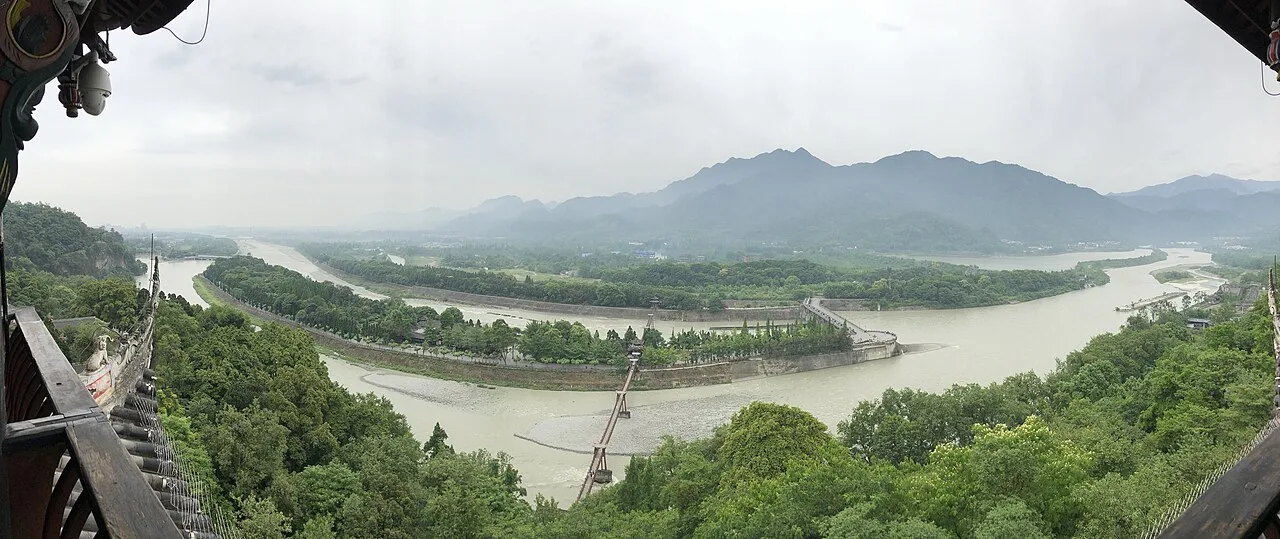
Standing at the Yuzui water-dividing point and watching the Minjiang River split in two by a single embankment, it is hard to believe that this was the work of Li Bing and his son over 2,000 years ago—taming a river without the use of a single dam. Dujiangyan is not merely a place for sightseeing; it is a masterclass in how the Chinese philosophy of “working with nature” was inscribed into hydraulic engineering.
1. Location Overview: Dujiangyan is located at the foot of Yulei Mountain at the outlet of the Minjiang River in Dujiangyan City, Chengdu, Sichuan Province. Situated on the northwestern edge of the Chengdu Plain, it sits at the critical throat where the Minjiang flows from high mountain gorges into the alluvial plain, approximately 50 kilometers from downtown Chengdu. It is a massive damless irrigation system commissioned by Li Bing, the Governor of Shu Commandery during the Warring States period. Upon its completion, the Chengdu Plain became free from the threats of flood and drought, earning the region its reputation as the “Land of Abundance.” The system has operated continuously for over 2,200 years, making it the oldest large-scale irrigation project in the world that still provides comprehensive benefits, continuing to irrigate millions of acres of farmland in the Chengdu Plain and surrounding areas. Together with Mount Qingcheng, Dujiangyan is a UNESCO World Heritage site, a National 5A Tourist Attraction, a Major Historical and Cultural Site Protected at the National Level, and a National Scenic Area, serving as a must-visit landmark on any Western Sichuan itinerary.
2. Cultural Context: Around 256 BC, during the late reign of King Zhaoxiang of Qin, Li Bing was appointed Governor of Shu Commandery. Drawing on the water-management experiences of his predecessors, he led the construction of Dujiangyan. Based on the philosophy of guiding the flow and adapting to the seasons, the project utilized damless water division and automatic sand discharge, a unique approach in the history of global hydraulics. Over the next two millennia, the project underwent continuous maintenance—including tunneling during the Qin and Han dynasties, embankment repairs in the Tang and Song, and annual maintenance during the Ming and Qing—forming a collaborative governance system between the state and the people. This legacy left behind hydraulic maxims such as “dredge the channel deep, keep the embankment low” and “cut corners at bends, extract the core at straights.” During annual maintenance, the depth of the Inner River bed was measured by the exposure of “sleeping irons” (iron markers) buried at the Fengxiwo area by the riverbank; the phrase “dredge the channel deep” was literally measured shovel by shovel over 2,000 years. Local folklore tells tales of Li Bing and his son capturing the “Evil Dragon,” while the poetry of Du Fu, such as “The spring colors of the Jinjiang bring heaven and earth together,” is closely tied to this land. In 2000, Dujiangyan was inscribed on the UNESCO World Heritage List as part of “Mount Qingcheng and Dujiangyan,” gaining global recognition for its scientific value and cultural significance.
3. Highlights: The three primary components of Dujiangyan hold the greatest scientific value. The Yuzui (Fish Mouth) Levee is shaped like a fish’s mouth and uses the curvature of the river to divide the Minjiang into the Inner and Outer Rivers; it automatically regulates the flow, directing more water into the Inner River during the dry season and diverting more floodwater to the Outer River during the rainy season. The Feishayan (Flying Sand Weir) acts as an overflow spillway during floods, using centrifugal force to throw massive amounts of sediment back into the Outer River to prevent the Inner River from silting up. Baopingkou ( preciouse Bottle Neck) is the artificial throat of the system, carved through Yulei Mountain by Li Bing’s team using the method of heating rock with fire and cooling it with water to control the volume of water entering the Chengdu Plain; the adjacent Lidui is an isolated hill separated from the mountain, a miracle of ancient rock engineering. Inside Fulong Temple, stone statues of Li Bing and the irrigation workers from the Eastern Han Dynasty are on display, featuring detailed drapery and solemn expressions. The Erwang Temple, built against the mountainside, is dedicated to Li Bing and his son and houses Ming and Qing dynasty steles praising their virtue. The Anlan Suspension Bridge, traditionally known as the “Husband and Wife Bridge,” spans the Minjiang and offers a spectacular view of the water division. Lidui Park blends ancient trees with traditional garden landscapes. At night, the “Blue Tears” lighting effect at Nan Bridge reflects on the river surface, making it a popular modern photo spot.
4. Visitor Information: Opening Hours: March 2 to October 31, 8:00–18:00 (ticket sales stop at 17:30); November 1 to March 1, 8:00–17:30 (ticket sales stop at 17:00). Open year-round with no closing days. Ticket Prices: Full price 80 RMB; Half price 40 RMB for minors aged 6 (exclusive) to 18 (inclusive) and full-time undergraduate students or below with valid ID; Free for children aged 6 and under (or under 1.3m tall) and seniors aged 65 and above with ID; Seniors aged 60 to 64 are free on non-holidays and half price on legal holidays. The scenic area implements a real-name online reservation system; there are no ticket windows on-site. Please book in advance via the “Mount Qingcheng & Dujiangyan” official WeChat account and use your ID card for entry. Sightseeing buses run between the Stele Pavilion and Yuzui (10 RMB one way, 15 RMB round trip); the Buyun Corridor escalator is 20 RMB one way and 40 RMB round trip (both are separate from the admission ticket and paid on-site). Transportation: From Chengdu, take Metro Line 2 to Xipu Station, transfer to the Chengdu-Guangyuan Intercity Railway to Lidui Park Station (approx. 30 mins), then walk 10 minutes to the Lidui Gate. Alternatively, travel to Dujiangyan Station and transfer to a bus or scenic area shuttle. Direct buses are available from Chengdu Chadianzi Bus Station. By car, it is about 1 hour via the Cheng-guan Expressway; parking is available, with a 5-to-10 minute walk to the entrance. Tourist service hotline: 028-96526. Recommended visit time is approximately 3 hours. Guide services, official audio tours, accessible pathways, nursing rooms, and drinking fountains are available.
5. Travel Tips: A classic half-day itinerary is: Enter via Lidui Gate $\rightarrow$ visit the Li Bing statues at Fulong Temple $\rightarrow$ Baopingkou $\rightarrow$ Feishayan $\rightarrow$ Anlan Suspension Bridge $\rightarrow$ Yuzui Levee $\rightarrow$ Erwang Temple $\rightarrow$ Nan Bridge for night views. Those with more time can take the sightseeing bus or escalator up Yulei Mountain for a panoramic view of the Inner and Outer Rivers to intuitively understand the relationship between the engineering and the terrain. Visiting the Qinyan Tower is highly recommended, as it is the best vantage point to see the spatial relationship between Yuzui, Feishayan, and Baopingkou; understanding the big picture first makes the detailed walk-through far more rewarding. Energetic visitors can descend the mountain via the Songmao Ancient Road from the side of Yulei Pavilion, visiting Yulei Pass and Erwang Temple along the way to avoid backtracking. The best photo spots are at Yuzui and Anlan Suspension Bridge, especially in the early morning mist or evening glow; Nan Bridge is ideal for “Blue Tears” night photography. Families with children should focus on the hydraulic science, using the numerous signs and educational boards for a self-guided tour. Study groups should focus on the engineering wisdom and the annual maintenance system. Senior visitors are advised to avoid the midday heat and use the sightseeing buses and escalators to minimize walking. The Dujiangyan Water Release Festival, held annually around the Qingming Festival, is a National Intangible Cultural Heritage event that reenacts ancient maintenance and water-release rituals with drumming and traditional chants—well worth a special trip.
6. Best Time to Visit: Dujiangyan is suitable for all seasons. Spring (March to May) features golden rapeseed flowers in the irrigation district contrasting with the river water; Autumn (September to November) offers clear skies and the most comfortable temperatures. Summer is a great time to escape the heat by the cool river, and Winter sees fewer tourists, with the ancient works taking on a unique charm after snowfall. The site is adjacent to Mount Qingcheng, allowing for a combined day trip: the Front Mountain is known for its deep Taoist temples, and the Back Mountain for its secluded valleys and waterfalls. You can also add Panda Valley, Guan County Ancient City, and Hongkou Rafting to your itinerary. Local delicacies not to be missed include Qingcheng smoked pork, ginkgo chicken stew, Congcong rolls, Zhang’s fermented glutinous rice, and Zhao’s noodles. Local specialties include Qingcheng tea, Dongtian milk liquor, Chuanxiong (Ligusticum), and handmade bamboo weaving. Today, the Dujiangyan irrigation area covers seven cities and prefectures in Western Sichuan, irrigating over ten million acres. An ancient weir from 2,000 years ago still provides the lifeblood for the entire Chengdu Plain—this is what fundamentally distinguishes it from any other “ruin.”