Chengdu · Museums & Academia
Jinsha Site Museum
At the heart of the Jinsha Site Museum lies a delicate gold ornament known as the “Sun and Immortal Birds”—four divine birds circling a sun, which has since become the official symbol of Chengdu. Standing beside the sacrificial pits of the site and gazing at the original spot where this artifact was unearthed, you will suddenly realize that the “Ancient Shu Civilization” is not as distant as it seems.
1. Location Overview: The Jinsha Site Museum is located at No. 2 Jinsha Yizhi Road, Qingyang District, Chengdu, Sichuan Province. Situated in the heart of the Chengdu Plain along the banks of the Modi River and approximately 5 kilometers from Tianfu Square, it is a massive Ancient Shu culture site from the Shang and Zhou dynasties, accidentally discovered in February 2001 during construction at the Shufeng Garden City site. Dating from approximately the 12th to 7th century BC, the site served as the political and religious center of the Ancient Shu Kingdom during its rise on the Chengdu Plain following the Sanxingdui civilization, filling a critical gap in the timeline of Ancient Shu civilization from Sanxingdui to the Warring States period. The Jinsha Site was listed as a Major Historical and Cultural Site Protected at the National Level in 2006. Within Chengdu’s cultural landscape, Jinsha, along with Sanxingdui and Baodun, forms the three pillars of the Ancient Shu civilization. It is a vital cultural coordinate marking the origin of Chengdu and, together with the Du Fu Thatched Cottage, Qingyang Palace, and Kuanzhai Alley, forms the cultural and leisure belt of western Chengdu. It is an essential stop for anyone wishing to understand the 3,000-year history of the city. Since the Jinsha era, settlements have flourished here without the city center ever shifting or the civilization breaking, making Jinsha the oldest root of the city. The Modi River winding through the museum area evokes images of the ancient Shu people living by the water and performing rituals to pray for the year.
2. Cultural Context: The discovery of Jinsha resulted from a construction accident: on February 8, 2001, workers unearthed gold, jade, bronze objects, and a vast amount of ivory. Archaeologists responded immediately to conduct salvage excavations, revealing a sacrificial area, a palace area, a burial area, and a residential area. Over ten thousand artifacts were recovered, including gold, jade, bronze, stone, ivory, and oracle bones, spanning from the late Shang Dynasty to the Spring and Autumn period. The most renowned piece, the Sun and Immortal Birds gold ornament, measures 12.53 cm in outer diameter, 5.29 cm in inner diameter, and is only 0.02 cm thick. Using openwork techniques, it depicts four birds circling the sun, symbolizing the ancient Shu people’s worship of the sun and their longing for flight; in 2005, this motif was selected by the National Cultural Heritage Administration as the official logo for China’s cultural heritage. Archaeologists believe Jinsha was likely the capital of the Ancient Shu Kingdom from the late Shang to the Western Zhou period (though there is academic debate over which specific dynasty among the Five Ancestors of Shu it corresponds to). Its ritual vessels share a lineage with Sanxingdui but show clear evolution, proving the continuity and transformation of the Ancient Shu civilization. Tons of ivory, thousands of wild boar tusks, deer antlers, and over 20 oracle bones (the largest nearly half a meter long) found in the sacrificial area indicate that this was once a religious center of unprecedented scale. Among the jade artifacts, Liangzhu-style ritual objects—represented by the ten-section jade cong—suggest long-distance communication between the Ancient Shu and the lower reaches of the Yangtze River, proving that civilizations were never isolated islands.
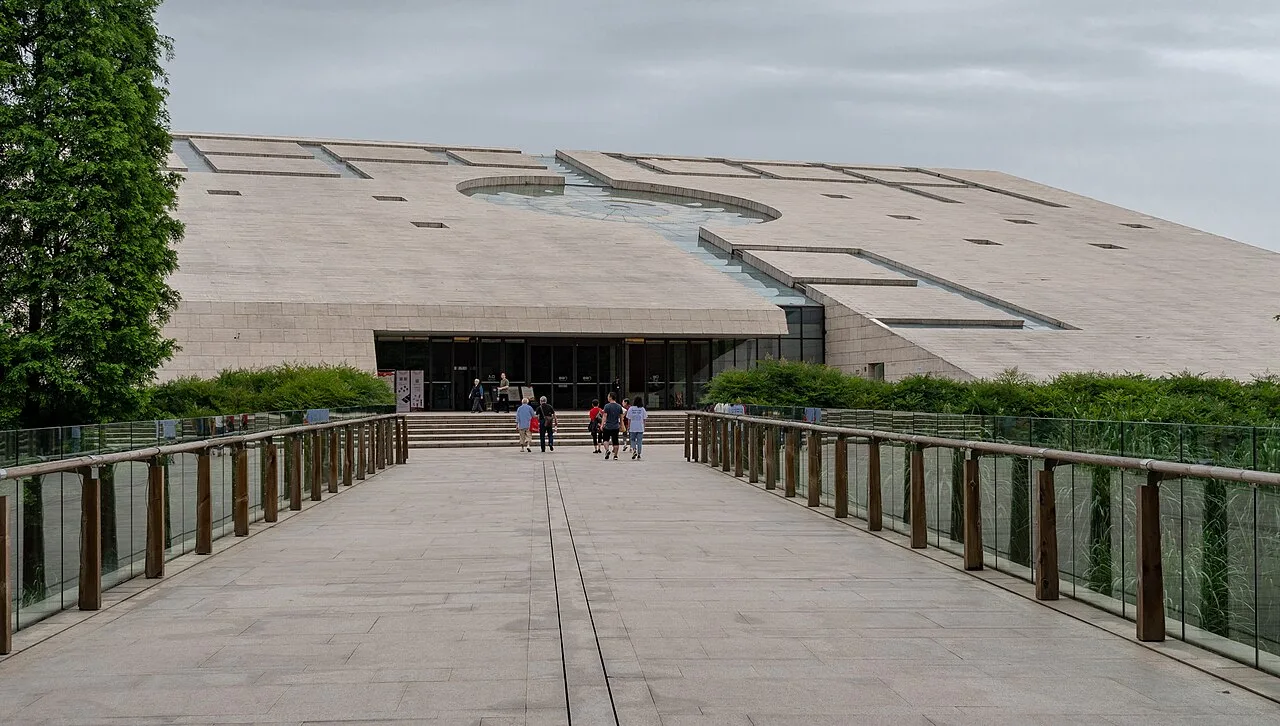
3. Highlights: Officially opened in 2007, the Jinsha Site Museum consists of the Site Hall, the Exhibition Hall, the Visitor Center, the Conservation and Restoration Center, the Jinsha Theater, and a garden area. The Site Hall is built directly over the original sacrificial area; under a massive steel canopy, visitors can still see the archaeological grids, ivory deposits, and the excavation site of jade zhang. It is one of the few museums in China where guests can overlook the actual excavation layers from a close distance, making a walk across the corridor bridge feel like stepping into a ritual scene from 3,000 years ago. The Exhibition Hall is divided into five sections—”Ancient Homeland,” “Silhouette of the Royal Capital,” “Endless Heaven and Earth,” “Treasures of a Millennium,” and “Interpreting Jinsha”—systematically showcasing gold, bronze, jade, and ivory. Masterpieces such as the Sun and Immortal Birds gold ornament, the gold mask, the ten-section jade cong, the standing bronze figure, and the stone snake are displayed here, where the delicacy of the gold contrasts beautifully with the warmth of the jade. The ten-section jade cong is rare in China for its segmented design and is interpreted as a ritual vessel connecting heaven and earth; the gold mask, made of extremely thin gold foil, is hypothesized by scholars to have been applied to a bronze statue or wooden idol to signify royal majesty. The garden area is a lush, quiet oasis in the city, featuring a deer park with Sika deer. The Jinsha Theater long hosted the musical *Jinsha*; please refer to official announcements for performance schedules after reopening.
4. Visitor Information: Important Notice: To systematically protect the site and collection, update the exhibition system, and upgrade facilities, the museum will undergo its first comprehensive renovation since its opening from December 5, 2025, to April 30, 2027. During this period, all areas will be closed to the public. Reopening is expected on May 1, 2027. Closure and reopening dates are subject to the latest official announcements; ticket holders may apply for refunds or extensions according to regulations. During the closure, Jinsha treasures will continue to be exhibited in museums at home and abroad (such as the “Twin Stars: Sanxingdui and Jinsha Ancient Shu Civilization Exhibition” at the National Museum of China in 2026). Visitors can also explore via the digital exhibition halls on the official website and WeChat account. The following is general information for reference once the museum reopens: Opening hours are 9:00–18:00 (last entry at 17:00), closed on Mondays (except for statutory holidays and in Jan, Feb, July, and Aug). Full price tickets are 70 RMB (all-access pass for the park and Exhibition Hall). Half-price tickets (35 RMB) are available for minors aged 6 to 18 and full-time undergraduate students or below. Free entry is provided for children under 6 (or under 1.3m), seniors over 60, active-duty military, veterans, and people with disabilities. All tickets require real-name online reservation via the official Jinsha Site Museum WeChat account; those eligible for free entry must also reserve online. Please enter during your reserved time slot. Transportation: Take Metro Line 7 to the Jinsha Site Museum Station and exit via Exit C; various bus lines also stop at the museum. For those driving, navigate to “Jinsha Site Museum,” where parking is available. Inquiry phone: 028-87303511.
5. Travel Tips: Recommended route during open periods: Enter through the South Gate $\rightarrow$ Site Hall (overlook the sacrificial area) $\rightarrow$ Exhibition Hall (focus on the Sun and Immortal Birds and gold mask) $\rightarrow$ Jinsha Theater exterior $\rightarrow$ stroll through the garden area and deer park. The best photo spots are on the corridor bridge of the Site Hall and in front of the Sun and Immortal Birds sculpture in the garden; the soft morning light is ideal for photography. When listening to guides, focus on the meaning of the Sun and Immortal Birds’ form, the religious significance of the ivory sacrificial pits, and the inheritance relationship between Jinsha and Sanxingdui. Guides often explain the astronomical significance of the four birds circling the sun, blending myth and science in a way that is easy for children to understand. Families can participate in social education activities such as “Archaeology Mobilization” (Little Archaeologist) and “Little Guide” (schedules subject to official announcements upon reopening). Study groups are encouraged to visit both Jinsha and Sanxingdui for comparison. Senior visitors can relax in the garden, which provides benches and drinking fountains. If time permits, walk along the greenways to observe the deer and ancient trees, enjoying the tranquility of the site park. During the closure, the public can still encounter Jinsha treasures in the permanent exhibitions of the Sichuan Museum, Chengdu Museum, and Sanxingdui Museum.
6. Best Time to Visit: Once reopened, Jinsha is beautiful year-round: spring for the fresh greenery of the gardens and autumn for the golden ginkgo leaves. The greenways along the Modi River are perfect for slow walks, offering deep shade in summer and warm sunlight in winter. Located in the west of the city, it can be combined with the Du Fu Thatched Cottage, Qingyang Palace, Kuanzhai Alley, and the Sichuan Museum by the Huanhua Creek for a one-day tour of Ancient Shu and Old Chengdu. Nearby areas like Huangzhong Park and Jinsha Riverside Park (both along the Modi River) are also worth visiting. In terms of local experience, the Sun and Immortal Birds have become a city symbol, appearing at airports, subways, and major events. The Jinsha gift shop’s blind boxes, bird necklaces, and deer-themed merchandise are highly popular. For dining, head to Qingjiang Road or the Tongshan Bridge area to enjoy Chengdu’s famous Gaiwan tea and authentic Sichuan cuisine, blending the ancient civilization with the modern metropolis. Qingyang Palace, a famous Taoist temple in western Sichuan, is a great addition to experience Taoist culture, while the teahouses and snacks of Kuanzhai Alley provide the ultimate Chengdu-style leisure experience.