Xi'an · Gardens & Ancient Architecture
Bell Tower and Drum Tower
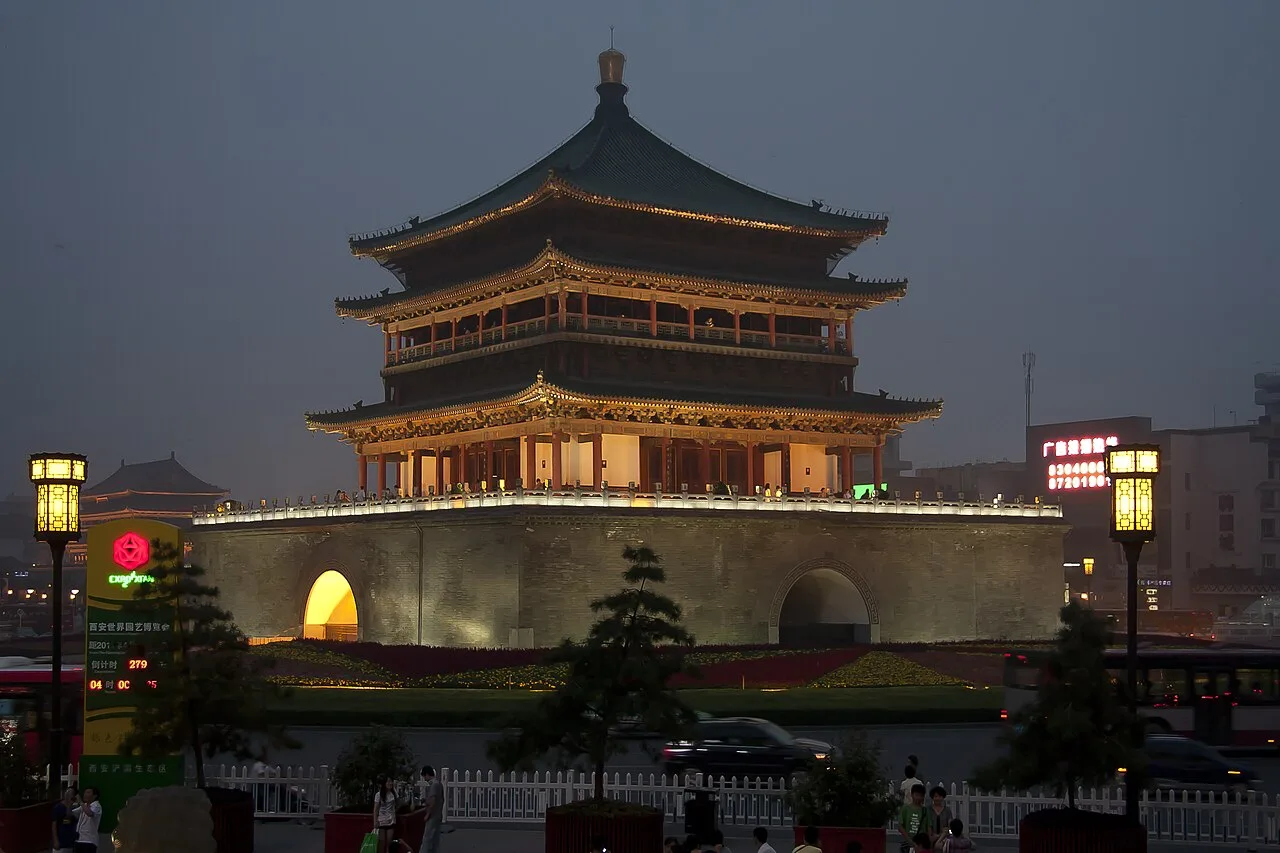
The Bell and Drum Towers are the “heartbeat” of Xi’an—once the city’s timekeeping hubs where the morning bell and evening drum signaled the rhythm of daily life. Today, ascending the Bell Tower places you at the absolute center of the ancient city, where four major avenues stretch out in every direction, offering a panoramic view of Xi’an’s grand, symmetrical urban layout.
1. Location Overview:The Xi’an Bell Tower and Drum Tower are situated in the city center at the intersection of the four main streets. Located only about 200 meters apart, they serve as iconic urban landmarks and National Key Cultural Relics Protection Units, together symbolizing the “morning bell and evening drum” of the ancient capital. The Bell Tower sits on a roundabout at the center of the four streets, while the Drum Tower is located to its northwest, at the southern end of Beiyuanmen and the entrance to the Muslim Quarter; the two echo each other across the Bell and Drum Tower Plaza. Within the city’s layout, the towers sit at the core of the central axis, forming a heritage trail with the City Wall, the plaza, and the Muslim Quarter. This is the best starting point to understand the fabric of Xi’an’s square city and the urban rituals of the Ming and Qing dynasties, as well as the most dazzling vantage point for a night tour of Chang’an. The base of the Bell Tower features arched doorways on all four sides, though these are no longer open to traffic. Cars circle the roundabout while visitors enter via underground pedestrian tunnels—this state of being a “living relic” standing amidst modern traffic is exceptionally precious. Whether by day or night, the towers are the go-to meeting spot for locals; “meet me under the Bell Tower” is perhaps the most universal address in the city.
2. Cultural Context:The Drum Tower was built in 1380 (the 13th year of the Hongwu reign of the Ming Dynasty), slightly earlier than the Bell Tower. The Bell Tower was built in 1384 (the 17th year of Hongwu), originally located at the intersection of Xidajie and Guangji Street, about one kilometer from its current site. In 1582 (the 10th year of the Wanli reign), due to the eastward shift of the city center, the Bell Tower was completely dismantled and relocated to its current position. Each foundation stone, beam, and pillar was numbered and repositioned exactly as before, making it a rare example of the relocation of a large-scale wooden structure in Chinese architectural history. In ancient times, the morning bell announced the dawn and the evening drum signaled the night, making the towers the center of timekeeping and seasonal celebrations. This system continued until the late Qing Dynasty, transforming the pavilions from mere scenery into vessels of memory. Both towers underwent numerous renovations during the Qing Dynasty and were listed as National Key Cultural Relics Protection Units in 1996. Today, they remain the most recognizable silhouettes of Xi’an, witnessing the city’s evolution from an imperial capital to a bustling commercial hub. The original giant drum of the Drum Tower no longer exists and has been replaced by a later reproduction; the original Tang Dynasty Jingyun Bell from the Bell Tower is now housed in the Beilin Museum, with a replica hanging in the tower, creating an invisible thread connecting the sister towers to the museum.
3. Highlights:The primary appeal of the Bell Tower lies in its architectural grandeur: it is the largest and best-preserved bell tower currently existing in China. The square base measures 35.5 meters per side and is 8.6 meters high, topped by a structure with double eaves and a four-sided pyramidal roof, reaching a total height of approximately 36 meters. From the top, the surrounding streets unfold like a chessboard. Inside, the tower displays Ming and Qing dynasty furniture and bell/drum relics, and hosts ancient-style chime bell performances during the day. The Drum Tower features a double-eaved Xieshan-style roof, with a base 52.6 meters long (east-west) and 38 meters wide (north-south), and a total height of about 34 meters. It is one of the largest drum towers in China, featuring exhibits on drum culture and large drums inscribed with the 24 solar terms, accompanied by traditional drumming performances that reflect the agrarian society’s reverence for the seasons. Thirdly, the night view is a must-see: after dark, lights outline the flying eaves and bracket sets (dougong), complementing the musical fountain in the plaza and the glow of the Muslim Quarter. Looking out from the Bell Tower, the four streets radiate outward; the bells hanging from the eaves chime softly in the wind, creating a poetic contrast with the city’s hustle and bustle below.
4. Visitor Information:Opening hours vary by season: From April 1 to October 10, 8:30 AM – 9:30 PM (last entry at 9:00 PM); from October 11 to March 31, 8:30 AM – 6:00 PM (last entry at 5:30 PM). Please refer to official announcements for updates. Tickets: 30 RMB per person for a single tower, or a combined ticket for both towers for 50 RMB. Half-price tickets (15 RMB) are available for minors aged 6 to 17 and full-time undergraduate students or below. Free entry is provided for seniors over 65, children under 6 (or under 1.2m), active military personnel, and people with disabilities upon presentation of valid ID. Tickets can be purchased online via the official WeChat account “Xi’an Bell and Drum Tower Museum” or at the on-site ticket windows. Identification is required for entry. Transportation: Take Metro Line 2 or Line 6 to Bell Tower Station. Use the underground passage to reach the Bell Tower entrance (as the tower is in the center of the roundabout and cannot be accessed directly from the street). Walk west for about 200 meters from the exit to reach the Drum Tower. Many bus lines also stop at Bell Tower Station. A visit to both towers typically takes 1 to 2 hours; it is recommended to pair this with a visit to the Muslim Quarter for a half-day trip. For ticket inquiries, call 029-87276420. Please note that the stairs inside are quite steep; seniors and young children should be accompanied. In the event of rain or snow, the open-air top platform may be temporarily closed.
5. Travel Tips:Recommended route: First, take panoramic photos of the exterior at the Bell and Drum Tower Plaza, enter the Bell Tower via the underground passage to overlook the central axis, then walk to the Drum Tower to see the giant drums and performances, and return to the plaza at dusk to wait for the lights to come on. The best photo spots are the center of the plaza facing the towers, the northwest corner of the Bell Tower, and around the Muslim Quarter archway. The “blue hour” just as the lights turn on is the most photogenic, as the light trails of the traffic contrast sharply with the ancient architecture. Photography enthusiasts may try slow shutter speeds to turn the traffic into streaks of light. When listening to guides, focus on the story of the Bell Tower’s relocation during the Wanli era, the timekeeping system, and the square layout of the city. Families can enjoy the traditional performances, while study groups should focus on Ming and Qing urban rituals. Senior visitors are advised to visit during the day to avoid night crowds. If time is limited, prioritize the Bell Tower, though the combined ticket is better value. For night visits, ensure you enter before the cutoff time. From the towers, you can walk to the South Gate of the City Wall; watching the sunset over the battlements and seeing the lights of the Bell and Drum Towers flicker on is a perfect way to experience the transition between old and new Chang’an.
6. Best Time to Visit:The Bell and Drum Towers are wonderful in every season: spring brings fresh greenery to the plaza, summer nights are perfect for the fountains, autumn offers crisp air for sightseeing from the towers, and winter snow on the eaves is like a painting. During the Spring Festival and major holidays, the lantern festivals are at their peak, and the towers are dressed in colorful lights. Because they are adjacent to the Muslim Quarter, they can be part of a half-day “Old City Center” tour. For a full-day cultural experience, combine them with the City Wall (South Gate), Shuyuanmen, Beilin Museum, Small Wild Goose Pagoda, and the Xi’an Museum. Local delicacies are centered around the Muslim Quarter: try the Beef and Mutton Paomo, Roujiamo (meat burger), Biangbiang noodles, and Persimmon cakes. For souvenirs, look for themed cultural products, shadow puppets, paper cuttings, and Shanshisan ice cream. One pair of towers, one red-lantern alley, and one ancient wall—this is the most beautiful footnote to the blend of ancient and modern Chang’an. Walking this loop is the only way to truly understand why “Chang’an” is so unforgettable and to grasp the city’s character: simultaneously ancient and vibrant.