Huai'an · Historical Sites
Huaian Prefectural Office
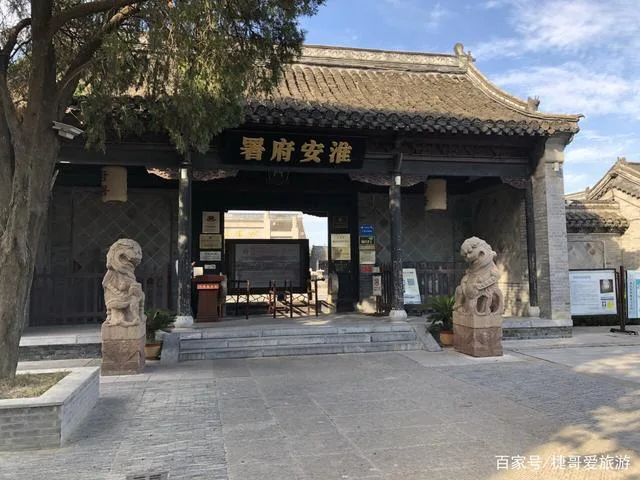
Hidden along the central axis of the ancient city of Huaian lies a genuine ancient “city hall”—the Huaian Prefectural Office. It is one of only two preserved prefectural offices in China, and its main hall, spanning over 500 square meters, is the largest existing prefectural hall in the country. Walking along the central axis from the main gate to the Third Hall, I passed under the “Clear Mirror Hanging High” plaque and read the cautionary mottos for officials on the Warning Stone Archway. Turning toward the West Wing to see the rows of ancient torture instruments, the inner workings of the Ming and Qing dynasty government and the nature of ancient justice suddenly became vivid and concrete.
1. Location Overview: The Huaian Prefectural Office is located at No. 38 Dongmen Street, Huaian District, Huaian City, Jiangsu Province. It dominates the northern end of the ancient city’s central axis, forming a rare complex of ancient government buildings linked to the Zhenhuai Tower and the ruins of the Governor-General of Grain Transport’s Office to the south. This official axis extends for about one kilometer, making it one of the most substantial remnants of its kind in China. A Major Historical and Cultural Site Protected at the National Level and a National 4A-level tourist attraction, the site covers over 50,000 square meters and originally housed more than 50 buildings and 600 rooms, organized into Central, East, and West wings. Since ancient times, Huaian has been a vital hub of the Grand Canal and the center of grain transport, and the Prefectural Office served as the administrative heart of this region. Within Huaian’s cultural landscape, it forms the architectural skeleton of the old city alongside the China Grand Canal Museum, the Former Residence of Zhou Enlai, the Former Residence of Wu Cheng’en, and Hexia Ancient Town. It is the primary site for understanding Huaian’s former political status and the prosperity of the canal; amidst the grey bricks and tiles, the atmosphere of a 600-year-old government office is palpable and commanding.
2. Cultural Context: Built in 1370 (the third year of the Hongwu Emperor’s reign in the Ming Dynasty), the Huaian Prefectural Office was reconstructed by Prefect Yao Bin on the site of a former Yuan Dynasty office. It remained in use from the early Ming until the late Qing Dynasty. During the Republican era, it served as the county government headquarters, which helped preserve main structures like the First and Second Halls. In 2006, it was designated as part of the sixth batch of Major Historical and Cultural Sites Protected at the National Level, and after protective renovations, it reopened to the public in September 2007. After the founding of the People’s Republic of China, part of the site was occupied by a factory, leading to the decay of several annexes, but the preservation of the main halls allowed for the complete restoration seen today. Its grand scale—far exceeding typical prefectural offices—was due to grain transport. During the Ming and Qing dynasties, Huaian was the station of the Governor-General of Grain Transport and the bottleneck for transporting southern grain to the north. The office governed nine counties and two prefectures, acting as the local administrative pivot for this massive logistics system. The Li Yuchang case, which shocked the nation during the Jiaqing era, is tied to the legal disputes of the Huaian Prefecture and Shanyang County, adding a real-life judicial footnote to the site. Deep in the West Wing, the Pichang Temple—legendarily linked to the story of “The Injustice to Dou E”—adds a literary echo to the prison exhibition area. Today, the displays on official culture and integrity ensure the office is not just a relic, but a living classroom for understanding ancient governance and judicial civilization.
3. Highlights: First, the Central Axis Main Hall: Standing about ten meters high and covering over 500 square meters, it is the largest existing prefectural hall in China. Complete with the official desk, the gavel, and ceremonial guards for “Silence” and “Recusal,” it hosts several live courtroom reenactments daily. Second, the clear three-wing layout: The Central Wing contains the administrative spaces (First, Second, and Third Halls); the West Wing’s Military Police Office is the judicial and prison zone, featuring over 30 types of Ming and Qing torture instruments and legal codes; the East Wing is the guest and leisure area, featuring an ancient stage, the Wisteria Hall, Baohan Hall, and the Yule Garden, all embodying traditional garden aesthetics. Third, the sense of ceremony: At 9:10 AM, an “Opening of the Office” ceremony is held in the main plaza, with the Prefect and attendants dressed in Ming and Qing official robes, led by the sound of gongs. Fourth, the intricate details: The Warning Stone Archway bears a weighty inscription: “Your salary and emoluments are the grease and fat of the people; the commoners are easy to oppress, but Heaven is hard to deceive.” The official mottos inside the hall, the couplets on the pillars, and the centuries-old Ming dynasty wisterias and ancient cypresses all reward those who slow their pace. If the site offers night tours, the ancient office takes on an even more storytelling atmosphere under the lights (please check official announcements).
4. Visitor Information: Opening hours: 8:30 AM – 5:30 PM (last entry time is subject to daily announcements). Ticket Prices: Adult 50 RMB (online booking often offers discounts), Student/Discounted 25 RMB. Free entry for children under 6 or under 1.4m, seniors over 70, active-duty military, veterans, and people with disabilities (valid ID required); specific policies are subject to site announcements. Transportation: Located at No. 38 Dongmen Street, Huaian District. You can take a bus to the “Huaian Prefectural Office” stop, or take Route 62 or 63 to the Fuqian Road stop and walk. For self-driving, navigate to “Huaian Prefectural Office”; there is a parking lot, but spaces are limited, so public transport or taxis are recommended for the ancient city. Suggested visit time: approximately 2 hours. The grounds are flat with no steep slopes, and facilities including nursing rooms and stroller rentals are available. For a deeper experience, it is recommended to hire a professional guide to explain the stories behind the hall couplets and the judicial system associated with the torture instruments.
5. Travel Tips: For a half-day trip, arrive in the morning to catch the 9:10 AM opening ceremony. Follow the central axis through the Main Gate, Ritual Gate, Warning Stone Archway, and the First, Second, and Third Halls, stopping at the main hall for a courtroom performance. Then, head to the West Wing’s Military Police Office to view the instruments and legal codes (those who are squeamish may wish to skim this area). Finally, conclude your visit in the East Wing: listen to a piece of Huai Opera by the ancient stage, relax in the Wisteria Hall, and enjoy the breeze in the Yule Garden. The best photo spots are the moon platform of the main hall, the Warning Stone Archway, the ancient cypress corridor, and the wisteria trellises of the Wisteria Hall. On rainy days, the view of rain under the eaves and the lush green cypresses are particularly photogenic. The Wisteria Hall is a favorite for Hanfu enthusiasts; in spring and summer, when the purple flowers hang low, sitting at a stone table with a cup of tea feels like stepping into an ancient painting. Focus your guide’s explanations on Ming/Qing governance, the role of grain transport in Huaian’s status, and the evolution of ancient justice. Families with children can use this as a situational history lesson, while seniors are encouraged to walk slowly and take frequent breaks. From the office, it is a short walk to Zhenhuai Tower and then further south to the China Grand Canal Museum; visiting these three in a line is the best way to understand how the canal built Huaian. For lunch, heading to Hexia Ancient Town is the most convenient route. If traveling with children or the elderly, you may wish to shorten the time spent in the West Wing’s prison area due to its heavy atmosphere, using the flat gardens of the East Wing as a place to recover.
6. Best Time to Visit: All seasons are suitable. Spring and autumn offer pleasant weather and blooming flora, making them ideal for exploring antiquity. In summer, arrive early to avoid the heat; the Wisteria Hall and corridors provide ample shade. Winter sees fewer crowds, and the grey bricks and tiles appear more solemn in the cold air; if it snows, the office takes on a unique, serene beauty. You can combine this visit with Zhenhuai Tower, the China Grand Canal Museum, the Former Residence of Wu Cheng’en, and Hexia Ancient Town for a one-day tour of the ancient city, or extend it to include the Zhou Enlai Memorial Hall and his former residence. For local flavors, highly recommended are Huaian Soft-shell Eel, Pingqiao Tofu, Wenlou Soup Dumplings, Cha-zhao (fried dough twists), and Huaian Braised Dishes; the time-honored shops in Hexia Ancient Town are the most authentic. Before traveling, check the official “Huaian Prefectural Office” updates for opening hours, ticket prices, and performance schedules to fully appreciate the solemnity and stories of this 650-year-old government office.