Hangzhou · Mountains & Scenic Wonders
Feilaifeng Peak
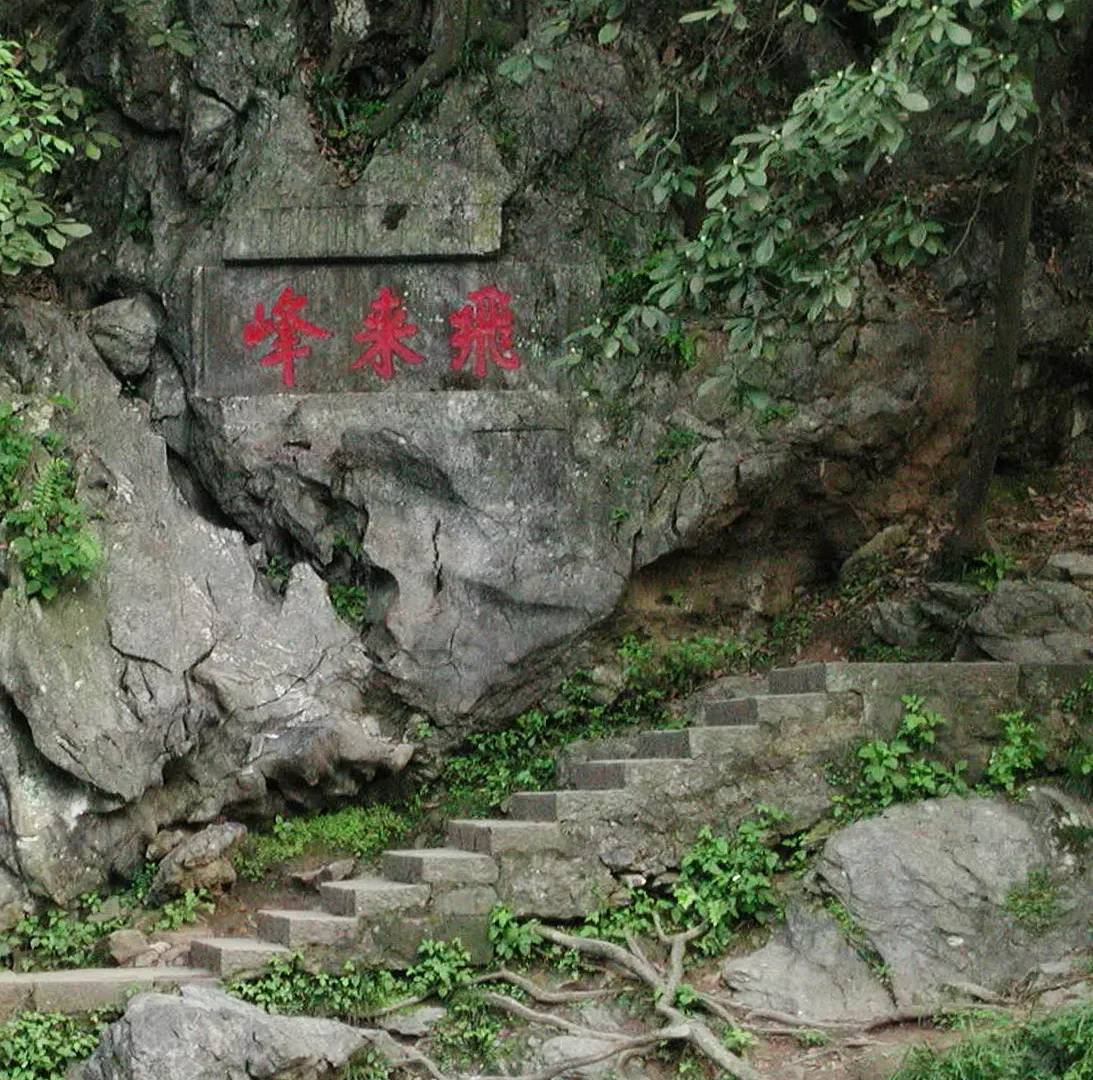
The magic of Feilaifeng lies in the belief that “a mountain need not be high; it is the presence of the Buddha that makes it sacred.” Though this small peak stands only about 168 meters tall, its cliffs are adorned with over 300 grotto sculptures carved from the Five Dynasties to the Yuan Dynasty, representing a pinnacle of grotto art in the Jiangnan region. The most famous is the charming “Smiling Maitreya,” whose joyful expression inevitably brings a smile to the face of every visitor.
1. Location Overview: Feilaifeng is located at Fayun Long, Lingyin Road, Xihu District, Hangzhou, Zhejiang Province. Situated across the Lengquan Stream from Lingyin Temple, it is a limestone (karst) peak among the mountains west of West Lake, reaching an altitude of 168 meters; it is also known as Lingjiu Peak. Bordered by Beigao Peak to the north and Lengquan Stream to the south, it forms the Lingyin-Feilaifeng Scenic Area together with Lingyin Temple, Yongfu Temple, and Taoguang Temple. Note that while the Feilaifeng sculptures and Lingyin Temple were historically managed separately, they are now part of the same scenic area with unified free-entry reservations. These sculptures are a vital component of the “West Lake Cultural Landscape” World Heritage site. Coexisting with Lingyin Temple, they serve as physical evidence of the eastward transmission of Buddhism and a peak of Jiangnan sculpture art, with a value far exceeding that of the mountain itself. As a treasure trove of Buddhist grotto art, Feilaifeng, the waters of West Lake, and the halls of Lingyin Temple form a trinity, creating the most profound chapter of Hangzhou’s cultural landscape and serving as a key witness to the extension of Chinese grotto art from the Northwest to the South.
2. Cultural Context: The name “Feilaifeng” (Peak Flown From Afar) originates from an exclamation by the Eastern Jin Dynasty monk Huili. Legend has it that upon seeing the peak’s jagged rocks, which resembled the Vulture Peak (Gridhrakuta) in India, he remarked that this small ridge must have flown from the Vulture Peak of Central India. Since the Wuyue Kingdom of the Five Dynasties period, monks began carving Buddhist figures into the cliffs, a practice that continued through the Song and Yuan Dynasties, turning the entire peak into an open-air gallery of Buddhist art. The construction of these sculptures was directly linked to the Buddhist devotion of the Wuyue Kingdom; three generations of the Qian family maintained peace and built numerous temples, allowing Jiangnan Buddhism to flourish even during the chaos of the Five Dynasties. Many of the inscriptions seen today are stone archives of that era. In 1982, the Feilaifeng sculptures were listed as a Major Historical and Cultural Site Protected at the National Level. As of December 1, 2025, the Lingyin-Feilaifeng Scenic Area has implemented free admission, allowing these national treasures to be more accessible to the public while better balancing preservation and sharing.
3. Highlights: Feilaifeng currently preserves 345 cliff sculptures from the Five Dynasties to the Yuan Dynasty, along with numerous inscriptions, distributed across Qinglin Cave, Yuru Cave, Longhong Cave, and the cliffs along the stream. Among the dated sculptures, the earliest is the triad of the Western Saints (Amitabha, Avalokitesvara, and Mahasthamaprapta) at the entrance of Qinglin Cave, dating back to the first year of the Guangshun era of the Later Zhou (951 AD). The Song Dynasty produced the largest number of sculptures, with 232 remaining; among these, the Big-bellied Maitreya (Budai) and the group of Eighteen Arhats are particularly endearing. The Big-bellied Maitreya is one of the earliest known images of this type in China and has become the prototype for Maitreya sculptures nationwide (traditionally dated to the Southern Song, though recent research suggests the early Yuan). The Yuan Dynasty sculptures are especially precious, with 67 niches and 116 figures remaining. Many were influenced by Tibetan Buddhism and commissioned by figures like Yanglian Zhenjia, blending Indian and Chinese styles with themes including multi-armed Bodhisattvas and Buddhist Mothers. This is one of the largest extant groups of Yuan Dynasty stone carvings, filling a chronological gap in Chinese grotto art. The Buddhist history reliefs at the entrance of Longhong Cave (depicting the White Horse carrying scriptures, Xuanzang’s journey to India, and Zhu Shixing’s quest for the Dharma), as well as the Yuan Dynasty Sanskrit Dharani carvings on the peak, are essential physical records for studying Jiangnan Buddhist art and Yuan Dynasty Sino-Tibetan exchange.
4. Visitor Information: Opening Hours: The Lingyin-Feilaifeng Scenic Area is open daily from 7:30 to 17:30, with last entry at 17:00. Ticket Prices: Since December 1, 2025, entry is free. Feilaifeng, Lingyin Temple, Yongfu Temple, and Taoguang Temple are all part of one area and share a unified reservation system. Reservation Rules: Real-name registration and timed entry are required. Search for the “Hangzhou Lingyin Feilaifeng” mini-program on WeChat or Alipay to book up to seven days in advance. Slots are divided into morning (7:30–12:00, entry until 13:00) and afternoon (12:00–17:00, entry from 11:00). Starting February 1, 2026, on-site registration will be replaced by an online waiting list. Cancellations must be made by 17:00 the day before the visit; no-shows will be suspended from booking for 30 days, with extensions for repeated offenses. The area contains many stone steps and caves, some of which are slippery; non-slip shoes are recommended. Key sculpture areas have information boards and audio guides. Cave steps can be steep, so please proceed with caution. Transportation: There is no direct subway to the scenic area. Take Metro Line 3 to Huanglong Dong Station (Exit B) and transfer to Bus 505; or to Dongyue Station (Exit D) and transfer to the Chengxi Park to Lingyin Shuttle; or to Huanglong Sports Center Station (Exit C) and transfer to Bus 278M. Alternatively, take Bus 7, 103, 121, or 319 directly to Lingyin Station. Parking is very limited; it is recommended to park at the Chengxi Leisure Park parking lot (approx. 500 spaces) and take the shuttle bus into the area.
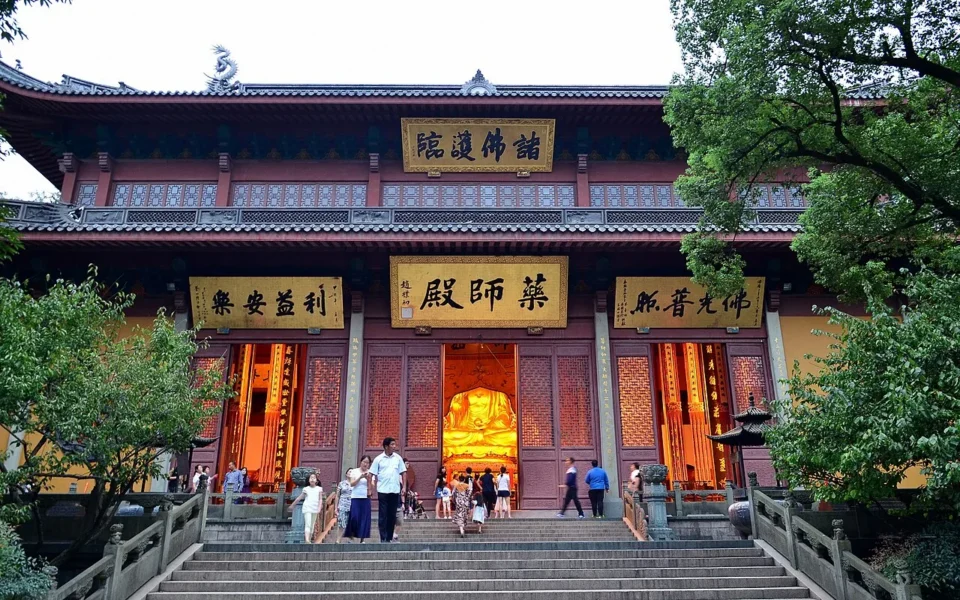
5. Travel Tips: The recommended route is to enter the scenic area, cross Hejian Bridge and Lengquan Pavilion, and head north along the stream to visit the sculptures of Qinglin Cave, Yuru Cave, and Longhong Cave. Focus on the Big-bellied Maitreya and the Yuan Dynasty Indian-style niches, then climb to the top of Feilaifeng (if able) for a panoramic view of Lingyin. As both are part of the same free reservation area, we suggest combining them into a one-day itinerary: pray at Lingyin Temple in the morning and explore the Feilaifeng sculptures in the afternoon. From late afternoon until closing, the slanted light hits the cliffs and crowds thin out, making the expressions and drapery of the sculptures most vivid. The best photo spots include the cliff sculptures reflected in the Lengquan Stream, close-ups of the Big-bellied Maitreya, and the view from the summit. Inscriptions in Qinglin and Longhong caves require light to be seen clearly; you may use a phone light, but please do not touch the stone walls. Guides should highlight the chronological sequence, the blend of Han and Tibetan art, and the history of the Wuyue Kingdom. Families with children should stick to the flat riverside path; students of art history should focus on identifying sculpture styles; seniors should walk slowly, avoid steep steps, and focus on the lower-altitude niches. After rain, the mossy walls and flowing water enhance the ancient atmosphere, but caves become slippery, so please use handrails and protect your equipment.
6. Best Time to Visit: Spring brings fresh greenery and azaleas blooming in the rock crevices; summer offers cool shade and streams, making it a refreshing escape from the heat; autumn is best for the vibrant foliage and long-distance views from the peak; winter is quiet and secluded, offering a Zen-like atmosphere. You can connect your visit with Lingyin Temple, Yongfu Temple, Taoguang Temple, and Beigao Peak. To the east lies Yanggong Causeway and Maojiabu by West Lake; to the north is Xixi Wetland; to the south are the Three Temples of Tianzhu (Faxi, Fajing, and Fajing, which are less crowded than Lingyin but just as ancient) and the Longjing tea villages. If time permits, you can also visit Yuquan and the Botanical Garden. This northwestern route is much quieter than the eastern shore of West Lake, ideal for slow travelers wanting to avoid crowds. For local experiences, Lingyin vegetarian meals and Zen tea are highly recommended; simple vegetarian noodles and Longjing tea houses by the stream are affordable and authentic. The preservation of the grottoes is a delicate science, as acid rain and weathering threaten the stone; hence, the area has flow limits and barriers. Every instance of not touching or scratching the stone is a genuine act of protection for this national treasure. There is no need to see everything at once—leaving a bit of mystery for the next visit only adds to its charm. With stone as history and caves as museums, the free admission makes it even more suitable for a slow visit. Lighten your step, broaden your gaze, and you will hear the thousand-year silence and devotion held within the stone.