Xi'an · Museums & Academia
Beilin Museum
The Beilin Museum is the “Mecca for calligraphy enthusiasts”—home to over 3,000 stone steles. From Wang Xizhi to Yan Zhenqing and Liu Gongquan, the stone carvings of history’s greatest masters stand right before your eyes. Even those unfamiliar with calligraphy can feel the power of Chinese characters transcending a millennium simply by gazing upon these inscriptions.
1. Location Overview: The Xi’an Beilin Museum is located at No. 15 Sanxue Street, Beilin District, Xi’an, Shaanxi Province. Situated inside the Wenchang Gate of the Ming City Wall, this specialized museum was expanded based on the 900-year-old Beilin (Forest of Steles) and integrated with the ancient architectural complex of the Xi’an Confucian Temple. Facing the Bell Tower to the north and bordering the City Wall to the south, it occupies the cultural heart of the old city’s southeast, blending seamlessly with the Shuyuanmen Cultural Street and Guanzhong Academy to create Xi’an’s most scholarly destination. As one of China’s earliest and largest collections of stone steles, it is a National First-Class Museum and a 5A-rated tourist attraction, hailed as the “fountainhead of stone inscriptions and the ancestral home of calligraphic art.” Sanxue Street derives its name from its historical proximity to the prefectural school, county school, and educational office, sustaining a scholarly atmosphere for a thousand years. Nestled within, the Beilin offers a quiet retreat amidst the bustle, forming a captivating cross-section of the ancient city alongside the adjacent wall and moat. For practitioners of calligraphy, this is a place of pilgrimage; although many of the famous steles by Yan, Liu, Ou, and Chu are later copies, they remain the primary models for studying ancient techniques.
2. Cultural Context: The origin of the Beilin is the Kaicheng Stone Classics carved during the Tang Dynasty. Begun in 833 AD and completed in 837 AD, these classics record the twelve Confucian canons and represent the most complete surviving set of stone-carved scriptures. After being moved several times during the turmoil of the late Tang Dynasty, they were relocated to the current site in 1087 AD under the direction of Lyu Dafang, laying the foundation for the Beilin. Subsequent dynasties continued to add to the collection, with renovations during the Yuan, Ming, and Qing dynasties resulting in a vast “forest” of stone. The Confucian Temple complex preserves Ming and Qing ritual architecture, including screen walls, memorial arches (paifang), the Pan pond, Lingxing Gate, and Ji Gate, with every brick and tile reflecting the tradition of honoring Confucius and valuing education. In 1944, a museum was established using the Beilin and Confucian Temple (originally the Shaanxi Provincial Museum, renamed the Xi’an Beilin Museum in 1993). In 1961, it was listed as the first of China’s key national cultural relic protection units for stone carvings. On May 12, 2025, a multi-year expansion project was completed, and the new North Gallery opened, significantly expanding the exhibition area and breathing new life into the ancient forest. The Beilin preserves more than just calligraphy; it is a historical archive. The inscriptions record personnel changes, water conservancy projects, and the spread of religion. The “Nestorian Stele” of the Tang Dynasty is a unique primary source for studying cultural exchange between China and the West; a single stone often reveals a significant portion of transportation and diplomatic history.
3. Highlights: The museum houses over 3,000 steles and epitaphs from the Han Dynasty to modern times, with a total collection of over 11,000 items. First is the Kaicheng Stone Classics: 114 steles containing approximately 650,000 characters, acting as a “library on stone.” Second is the collection of masterpiece steles: the elegant and flowing Cao Quan Stele; the bold and dignified “Pagoda Stele” and “Yan Qinli Stele” by Yan Zhenqing; the powerful “Xuanmi Tower Stele” and “Shence Army Stele” by Liu Gongquan; the strictly structured “Huangfu Dan Stele” by Ouyang Xun; and the “Great Tang Sacred Teachings of the Three Tripitakas” by Huairen, which preserved the work of Wang Xizhi through collective characters. From seal and clerical scripts to regular, running, and cursive scripts, the evolution of Chinese characters is vividly displayed here. Third is the Stone Carving Art Gallery: featuring Han and Tang stone sculptures, including four of the “Six Steeds of Zhaoling” and the Li Shou Sarcophagus, showcasing exquisite ancient craftsmanship. Fourth is the North Gallery opened in 2025: providing significantly expanded space for premium carvings and special collections, integrated with digital displays that make static stones accessible to a younger generation. Walking through, one can clearly see the transition of Chinese characters from the solemnity of seal and clerical scripts to the fluidity of regular and running scripts—the history of calligraphy written on blue stone, more intuitive than any textbook.
4. Visitor Information: Opening hours are 9:00 AM – 6:30 PM (last entry at 5:00 PM). Open year-round with no fixed closing days; extended hours during peak summer may be announced officially. Starting May 12, 2025, a flat ticket price is implemented regardless of season: Full price 85 RMB/person, Half price 42 RMB/person. Half-price eligibility: Minors aged 6 to 18, full-time undergraduate students and below, and veterans with valid certificates. Free admission: Children 6 and under, seniors 65 and over, active-duty military, fire and rescue personnel, people with disabilities, police officers, and eligible family members of martyrs/service members with valid ID. The museum requires real-name reservation. Tickets can be booked 5 days in advance via the official website or the “Xi’an Beilin Museum” official WeChat account; entry is by ID card or QR code. Special certificate holders can visit the ticket window. Transportation: The museum is located inside the Wenchang Gate of the City Wall. Take several bus lines to Wenchangmen Station or Nanmen Station and walk to the entrance. From the subway, take Line 2 to Yongningmen Station or Line 4 to Dachashi Station, then walk for about 15 minutes. Parking nearby is difficult; public transport is highly recommended. Ticket inquiries: 029-87253331. One ticket covers both the old gallery and the new North Gallery; we suggest allocating two to three hours.
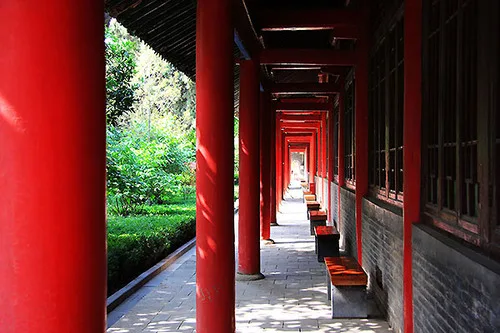
5. Travel Tips: Recommended route: Enter through the Confucian Temple complex (Screen Wall, Pan Pond, Lingxing Gate, Ji Gate), visit Beilin Galleries 1 through 7 (focus on the Kaicheng Stone Classics, Cao Quan Stele, and works by Yan and Liu), the Stone Carving Art Gallery, the new North Gallery, and finally the gift shop. The best photo spots are at the Ji Gate of the Confucian Temple, among the ancient cypresses, and along the red walls and stone steles of the pavilion corridors, where the lighting is primitive and the composition serene. Focus your guided tour on the evolution of Chinese scripts, the background of the Kaicheng Stone Classics, and the stylistic difference between “Yan’s muscles and Liu’s bones.” Families and students can participate in stone rubbing experiences, allowing children to trace masterpieces with brushes as a writing initiation. Allow ample time for the North Gallery, while Gallery 7 of the old section is very dense; a guide or audio tour is recommended. Flash photography is prohibited in some halls, and please do not touch the original steles. If time permits, combine the visit with the City Wall: enter via Wenchang Gate and walk along the South Wall to Yongningmen, comparing the bricks of the wall with the stones of the Beilin. Popular cultural products like rubbing sets and calligraphy copies often have queues; we suggest visiting the shop first or shopping during off-peak hours.
6. Best Time to Visit: The indoor galleries are suitable for all seasons, providing a refuge from summer heat and winter cold. Spring and autumn are most pleasant for the courtyards, where the greenery of ancient cypresses complements the scent of ink. Located next to the Wenchang Gate, the museum can be linked with Shuyuanmen Cultural Street (for calligraphy and the Four Treasures of the Study), Guanzhong Academy, and the South Gate area, and further connected to the Bell and Drum Towers, Muslim Quarter, Small Wild Goose Pagoda, and Xi’an Museum for a full day of cultural exploration. Nearby, you can try quiet teahouses in Shuyuanmen, the famous “Hulutou” at Chunfasheng on Nanyuanmen, or Zhang’s Roujiamo on Ziwu Road. Local specialties include stone rubbings, the Four Treasures of the Study, and Beilin-themed calligraphy sets. Taking a favorite rubbing home or purchasing an inkstone from Shuyuanmen is the best way to extend this ink-scented journey into your daily life.