Tianjin · City Landmarks
The Century Clock
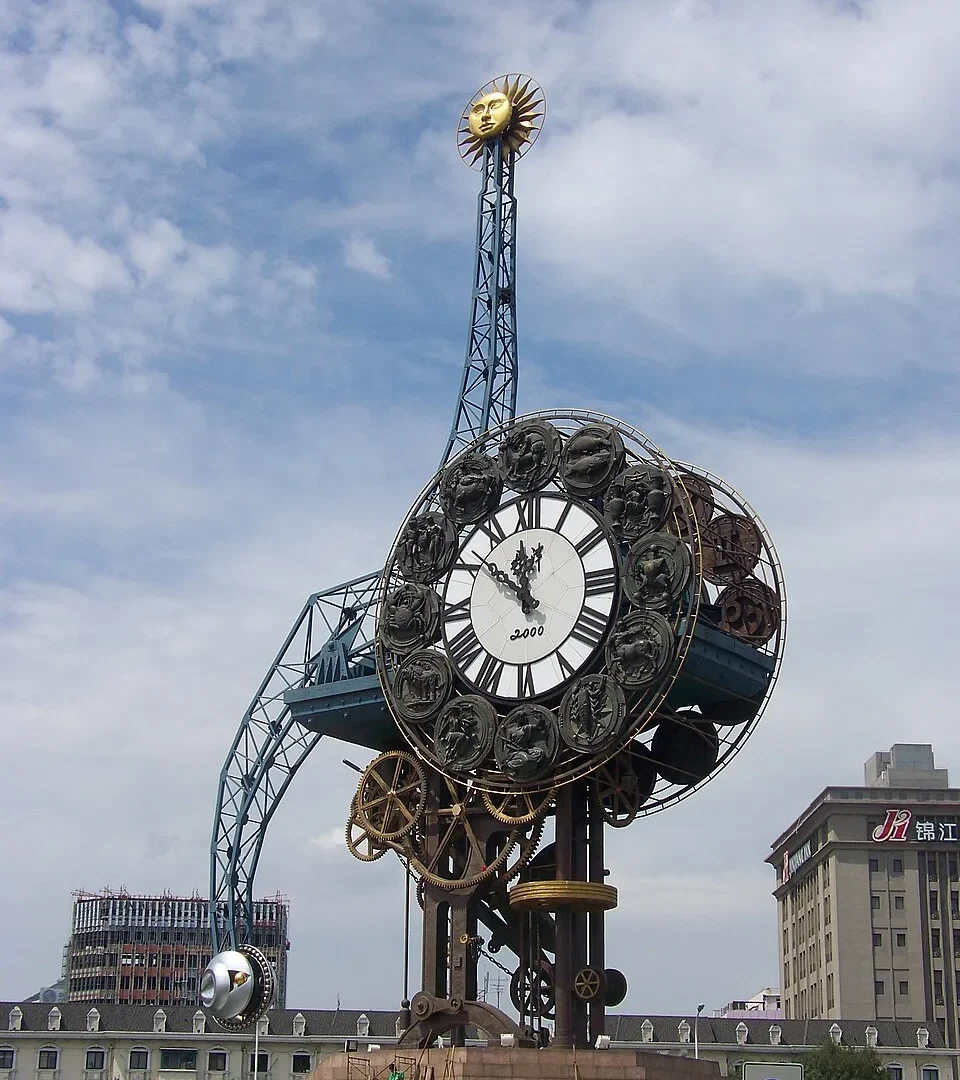
The Century Clock stands proudly before Tianjin Station, keeping watch over the confluence of the Haihe River and the Jiefang Bridge. With no walls and no admission fee, it feels more like a gift from Tianjin to every passerby. I prefer visiting in the early morning to watch the sun and moon wheels rotate slowly while seagulls circle overhead. As the city gradually awakens to the sound of the chimes, you can feel a sense of steady composure—the very temperament of Tianjin.
1. Location Overview: The Century Clock is located at Century Clock Square on Haihe East Road in the Hebei District of Tianjin. It sits on a green space west of Tianjin Station and within the Jiefang Bridge roundabout, adjacent to the three-way confluence of the Haihe River. The square is an open public space with no enclosures, allowing anyone passing by to stop and admire it. Neighboring the Jiefang Bridge and Jinwan Plaza, and facing the Italian Style Town across the river, it is the most prominent urban landmark in front of Tianjin Station. Travelers exiting the station can see this 40-meter-tall giant clock immediately, making it an instant symbol of arrival in Tianjin. It also serves as a core node on the Haihe tourism axis; whether walking along the river from the Ancient Culture Street or crossing the bridge from Jinwan Plaza, you will naturally encounter it. For years, it has served as the first impression for visitors and a daily “living room” for locals to jog, cool off, and take photos. Here, a gateway landmark merges with everyday city life; though over twenty years have passed, its significance has only grown. As the gateway for the Beijing-Tianjin Intercity Railway with massive daily foot traffic, the Century Clock has become one of Tianjin’s most recognized symbols. Heading south along the Haihe, the Dagu Bridge and Bei’an Bridge follow, forming the famous “Bridge Museum” section of the river, with the Century Clock standing guard at the start of this aquatic exhibition.
2. Cultural Context: Built to welcome the 21st century, construction began in 1999, and it was completed on December 25, 2000. At the stroke of midnight on January 1, 2001, the clock chimed to welcome the new millennium. Its design blends Tianjin’s industrial memory with its watchmaking tradition: the structure is filled with mechanical elements like gears, chains, and rivets, echoing Tianjin’s status as a modern industrial hub and the hometown of “Sea-Gull” watches (the Sea-Gull Group has provided long-term maintenance). Below the clock face hangs an S-shaped pendulum inspired by the Taiji curve, with the sun at the top and the moon at the bottom, symbolizing the flow of time through the alternation of Yin and Yang. The clock face features bronze reliefs of the twelve zodiac signs, representing the stars and the cycle of time. On the eve of the 2024 Spring Festival, the Sea-Gull Group restored its chiming function, bringing the sun and moon wheels back to life after years of stillness. In August of the same year, it underwent repainting and renovation. In 2025, further upgrades restored the mechanical structure of the sun and moon discs and introduced intelligent light projections, allowing this old landmark to shine anew in the modern era. From announcing the hour to lighting up the night, and from welcoming the new century to welcoming guests from afar, it has become more than just a clock—it is a shared temporal coordinate for the people of Tianjin.
3. Highlights: Standing 40 meters tall and weighing over 170 tons, the Century Clock has been known as the largest vertical clock in China since its completion in 2000. The sculpture consists of three parts: the clock face, the pendulum, and the base (which covers 74.4 square meters). The clock face has a diameter of 14.6 meters, with twelve bronze reliefs of the zodiac signs (each 2.6 meters in diameter) embedded between the inner and outer rings, gleaming in the daylight. Its precision is legendary, claimed to have an error of only one second every 100,000 years, a testament to the watchmaking craftsmanship behind it. The suspended sun and moon wheels rotate slowly, turning the abstract concept of “the rotation of sun and moon” into a visible kinetic installation. Following its restoration, the hourly chimes have returned, adding a powerful sense of ritual during New Year’s Day and the Spring Festival. At night, the newly upgraded lighting reflects off the steel structure of Jiefang Bridge and the ripples of the Haihe River, blending with the lights of Jinwan Plaza to create the most impressive night scene in front of Tianjin Station—a favorite spot for photographers. In the early morning, it offers a different charm: the low-angle sunlight gives the zodiac reliefs a three-dimensional depth, and the silhouette of the night transforms back into a metallic structure with distinct industrial textures.
4. Travel Tips: The Century Clock is an open urban sculpture and is free and open 24/7 year-round. The square is accessible at all times, though entering or climbing the clock structure is prohibited. For specific chiming and lighting schedules, please refer to official management announcements. Transportation: Metro Lines 2, 3, and 9 all stop at Tianjin Station. The clock is reachable immediately upon exiting the station, making it a perfect stop for those arriving in or departing from the city. Numerous bus lines also stop at Tianjin Station; simply cross the street to reach the square. Those driving can park at the Tianjin Station or Jinwan Plaza parking lots and walk. Due to heavy crowds and limited parking around the station, public transport is highly recommended. If you are transferring at Tianjin Station, you can store large luggage at the station lockers and take a light five-minute stroll around the clock before heading to Jiefang Bridge for a view of the Haihe River—this is the most relaxed way to experience the landmark.
5. Sightseeing Guide: For a grand shot, frame your photo from the central axis of the Tianjin Station South Square to capture the clock together with the station’s dome and the Haihe skyline. Looking back from the head of Jiefang Bridge provides a classic shot of the clock and the river. At the Jinwan Plaza side, you can capture the reflection of the clock on the water. Early morning is the quietest time, before the commuters arrive, making it ideal for studying the zodiac reliefs and the curves of the pendulum. In terms of itinerary, the Century Clock, Jiefang Bridge, Jinwan Plaza, Italian Style Town, and Ancient Culture Street are all along the main Haihe axis and can be covered in half a day via walking and cycling: start from Tianjin Station, cross Jiefang Bridge to explore Jinwan and the Italian Style Town, follow the river to Ancient Culture Street, and finally ascend the Tianjin Eye for a panoramic view. During New Year’s Eve and the Spring Festival, this is the city’s center of celebration. The atmosphere at midnight is electric with thousands of people gathering, but it is extremely crowded; be sure to arrive early, dress warmly, and follow safety orders. For those with more energy, you can follow the cycling path south along Haihe East Road, incorporating the Century Clock, Jiefang Bridge, Jinwan Plaza, and Dagu Bridge into a leisurely route, returning in the evening just as the clock lights up.
6. Best Time to Visit: Spring and autumn offer mild weather, perfect for lingering in the square and walking along both banks of the Haihe. In summer, an evening visit is recommended; the river breeze is cool in the early morning and late night, while the midday heat can be avoided by relaxing in the cafes and bistros of the Italian Style Town before returning to the bridge for the lights. In winter, the square is open and windy, but the New Year’s Eve chiming ceremony is a unique experience and a collective memory for the people of Tianjin. For routing, you can head north to the Ancient Culture Street and Tianjin Eye, or west across the river to the Italian Style Town. Tianjin Station itself makes it a convenient stop. For a deeper experience, the Haihe night cruises depart from Jinwan, offering a different perspective of the clock from the water. Dining options are concentrated in the Italian Style Town and Ancient Culture Street, where traditional local snacks coexist with international restaurants. Whether you are visiting specifically or just passing through, spending ten minutes under the clock to hear the city’s heartbeat is well worth the trip.