Yangzhou · Ancient Towns & Old Streets
Dongguan Street
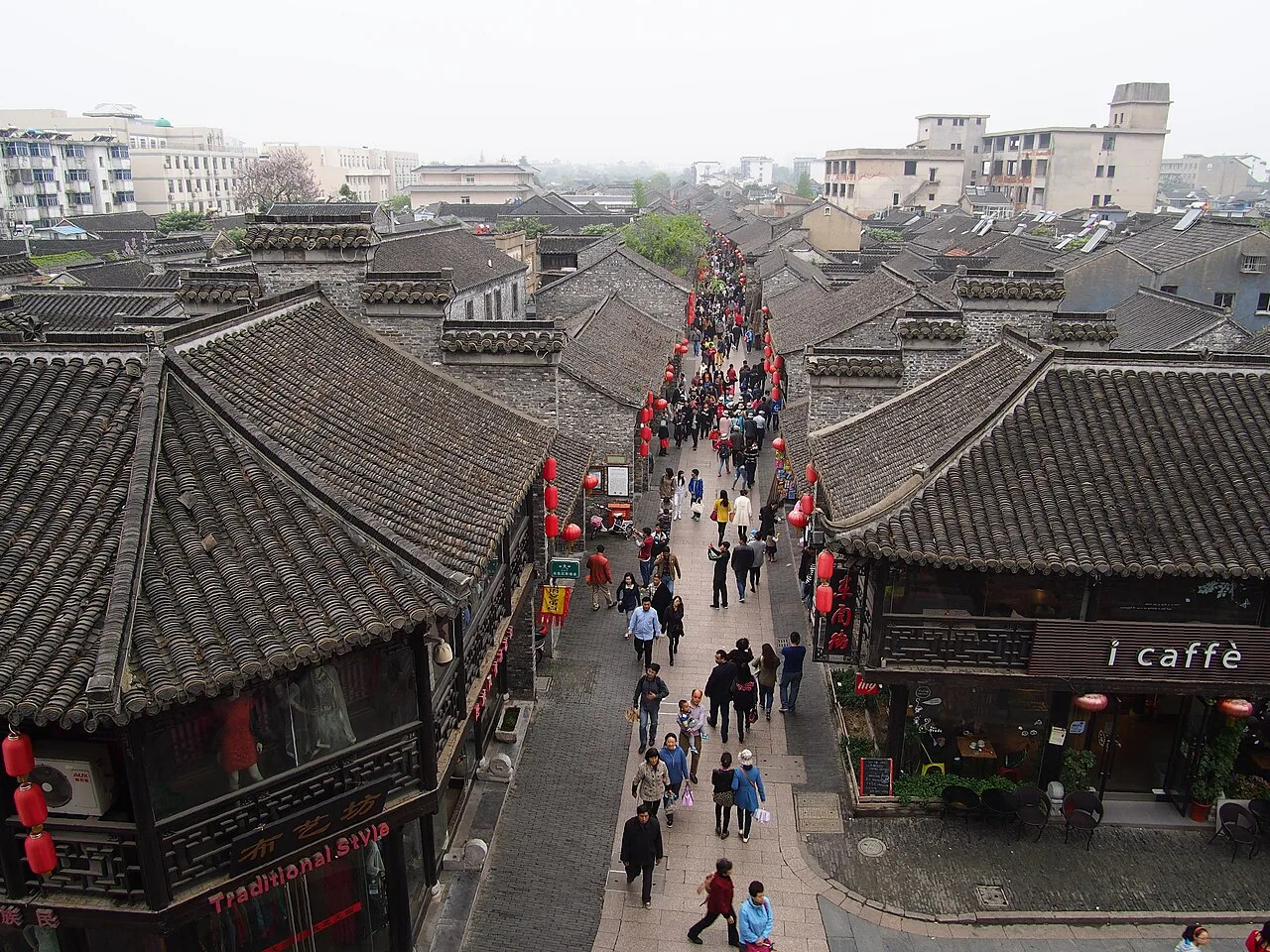
Dongguan Street is the most iconic historic street in Yangzhou. Lining the blue stone pavements are a dense array of time-honored brands, teahouses, pickle gardens, and the fragrant powder shops of Xie Fuchun. Here, you can find the “Three Knives of Yangzhou,” lacquerware, and paper-cutting. Strolling slowly westward from the Dongguan Ancient Ferry, the scents of pickled vegetables, tea, and cosmetics intertwine in the alleys. A trip through Dongguan Street is like exploring the very essence of old Yangzhou.
1. Location Overview: The Dongguan Street Historic District is located in the Guangling District of Yangzhou, Jiangsu Province. Stretching approximately 1,122 meters from the Dongguan Ancient Ferry by the ancient canal in the east to Guoqing Road in the west, it is one of the best-preserved commercial streets from the Ming and Qing dynasties and a national 4A-level tourist attraction. Situated in the eastern part of the ancient city on the west bank of the ancient canal, it neighbors Ge Garden to the north and He Garden and Pishi Street to the south, placing it in a prime location where the canal, the ancient city, and the salt merchant gardens converge. The district retains the architectural fabric of the ancient city with its grey bricks, black tiles, horse-head walls, and stone pavements, interspersed with over fifty Ming and Qing dynasty buildings and several protected cultural heritage sites. As the most representative old street in Yangzhou, it serves as a living specimen of the “slow life” of Yangzhou—characterized by the saying “skin wrapped in water in the morning, water wrapped in skin at night”—and the continuity of marketplace culture since the Sui and Tang dynasties. The street is only a few meters wide, with shops standing shoulder to shoulder in Ming and Qing styles. Walking here is like stepping through layers of the Tang, Song, Ming, and Qing dynasties; the site of Yangzhou has remained largely unchanged for over two thousand years, and the texture of the old street is living evidence of this. One step inside is a step into a millennium of daily life.
2. Cultural Context: The history of Dongguan Street dates back to the Tang Dynasty, and it earned the name “Dongguan” (East Gate) during the Yuan Dynasty. Since the completion of the Grand Canal during the Sui and Tang dynasties, it has been a vital hub for salt and grain transport. During the peak of the salt merchants in the Ming and Qing dynasties, the market grew even more bustling, attracting a concentration of commercial firms and guild halls. Many of the “time-honored brands” here are authentic legacies: Xie Fuchun, founded during the Daoguang era of the Qing Dynasty, is a living fossil of the Chinese cosmetics industry; Sanhe Sime Pickles has operated at its original site for a century; and the tea snacks of Da Qilin Ge and the tea leaves of Lvyangchun have been passed down through generations. Historic sites such as the Former Residence of Hu Zhonghan, Wudang Temple, Yi Garden, and the Wang Family Small Garden are scattered throughout the alleys, many of which are named after salt merchant families. Following renovations, the street reopened in 2009, and in 2010, it was selected as one of the “Top Ten Historic and Cultural Streets in China.” According to official Yangzhou records, it is also one of the best-preserved examples of the Tang Dynasty’s “Lifang” (ward) street layout in China, with a main street acting as a fishbone and branch alleys extending in all directions. Understanding this transforms Dongguan Street from a mere snack street into a “tastable” brief history of Yangzhou’s industry and commerce, where every flavor carries a legacy. Many travelers call it “one street, half the history of Yangzhou,” a title well-deserved.
3. Highlights: The attraction of the district lies in the dense presence of time-honored brands and intangible cultural heritage—Xie Fuchun’s traditional fragrant powders, Sanhe Sime’s pickles, Da Qilin Ge’s tea snacks, as well as Yangzhou lacquerware, jade, and paper-cutting, all of which serve as portable memories of Yangzhou. The area gathers multiple national-level intangible cultural heritages, including Yangzhou Pinghua (storytelling), Yangzhou Qingqu (singing), paper-cutting, lacquer art, and jade carving. Here, heritage is not a specimen in a display case, but the fragrance of pickles and rouge wafting from a storefront. In terms of gardens and relics, Ge Garden to the north is famous for its “Four Seasons Rockery,” which uses bamboo stone, Taihu stone, yellow stone, and Xuan stone to masterfully recreate spring, summer, autumn, and winter. The Wang Family Small Garden is a well-preserved salt merchant residence from the Qing Dynasty, while Yi Garden and the Wudang Temple each offer their own unique charm. At the eastern end, the Dongguan Ancient Ferry connects directly to the ancient canal, serving as a nexus for Ming and Qing transport and today’s river cruises; one can almost hear the boat songs of old on the stone steps of the wharf. The street is filled with teahouses, opera stages, Qingqu music, and a dazzling array of snacks. Visitors can experience “hidden” activities such as traditional back-scrubbing, listening to Qingqu, or collecting stamps while searching for ancient wells, where the vibrancy of daily life blends with scholarly elegance.
4. Visitor Information: Opening Hours: The street is open 24 hours a day with free entry. Most shops operate from approximately 8:00 or 9:00 AM to 10:00 PM. Individual attractions within the street have their own opening hours and closing days. Ticket Prices: The street itself is free, but individual attractions charge separate admission—Ge Garden is approximately 45 RMB in peak season and 30 RMB in off-peak; Wang Family Small Garden is approximately 25 RMB (subject to official pricing). Check the difference between combo tickets and single tickets at the entrance. For souvenirs, look for official time-honored brand stores to ensure quality and fair pricing. Transportation: Take bus lines You 1, 25, 45, or 52 and get off at the Dongguan Ancient Ferry stop. Walking or cycling is best within the ancient city as roads are narrow; several paid parking lots are available nearby. The street surface is flat, and there are ample public restrooms and rest areas. Hanfu rentals and multi-language audio guides are available. It is recommended to reserve half a day to a full day to visit Ge Garden and nearby gardens; combining snacking with history makes the experience more flavorful. Crowds are heavy during holidays; the street has quieter corners in the early morning and late at night.
5. Travel Strategy: The recommended route is to enter via the Dongguan Ancient Ferry and head west toward Guoqing Road. Along the way, visit Ge Garden to see the Four Seasons Rockery, turn into a side alley to visit Xie Fuchun to experience powder making, and enter the Wang Family Small Garden to take traditional-style photos in Hanfu. In the evening, return to the street for snacks and a performance of Yangzhou Qingqu, and at night, take a boat from the Dongguan Ancient Ferry wharf for a night cruise on the ancient canal. The best photo spots are the Dongguan City Gate, the signboards of time-honored brands, and the play of light and shadow on the ancient canal, which feels most cinematic at dusk. Focus your guide on the history of the canal transport and salt merchant culture to treat the street as a city history book. Families can try clay sculpting or ride a rickshaw; students can study the rock stacking at Ge Garden and visit the nearby Former Residence of Zhu Ziqing. Seniors will find it most relaxing to listen to Qingqu and get a traditional back-scrub in an old teahouse. To avoid crowds, visit on weekday mornings or rainy days; the wet blue stones and newly opened shops reveal the street’s true essence. Nearby alleys like Caiyi Street and Renfeng Li are more niche and artistic, just a few minutes’ walk away, serving as “slow travel” alternatives for seasoned visitors. Seasonal activities are also abundant, with Lantern Festivals, heritage markets, and opera flash mobs often appearing at street corners, especially on weekends.
6. Best Time to Visit: Spring and autumn are ideal, with pleasant temperatures and lush greenery, though these are peak tourist seasons. In summer, the evening and night markets are recommended, complemented by a night cruise on the ancient canal to beat the heat. Winter offers a solemn beauty, especially if the ancient city is dusted with snow. You can link Dongguan Street with Ge Garden, He Garden, Pishi Street, and the Former Residence of Zhu Ziqing, and head north to Slender West Lake and Daming Temple for a deep one-to-two day tour of the ancient city. Dongguan Street, Pishi Street, and Wanzi Street form a “slow travel triangle” in the southeast of the city, all reachable by foot. Local delicacies and specialties are abundant: Crab Roe Soup Dumplings, Huangqiao Sesame Cakes, Sime Pickles, and Da Qilin Ge tea snacks, as well as Xie Fuchun duck egg powder, Yangzhou lacquerware, and Zhang Yongshou paper-cutting—all perfect for bringing a piece of Yangzhou’s slow life home. The charm of Dongguan Street lies in the fact that it is both a museum and a breakfast, a melody of Qingqu. Only by slowing your pace can you taste the true flavor of this old street and take the spirit of Yangzhou’s slow life back with you.