Chengdu · Lakes & Waterfront
Huanglong
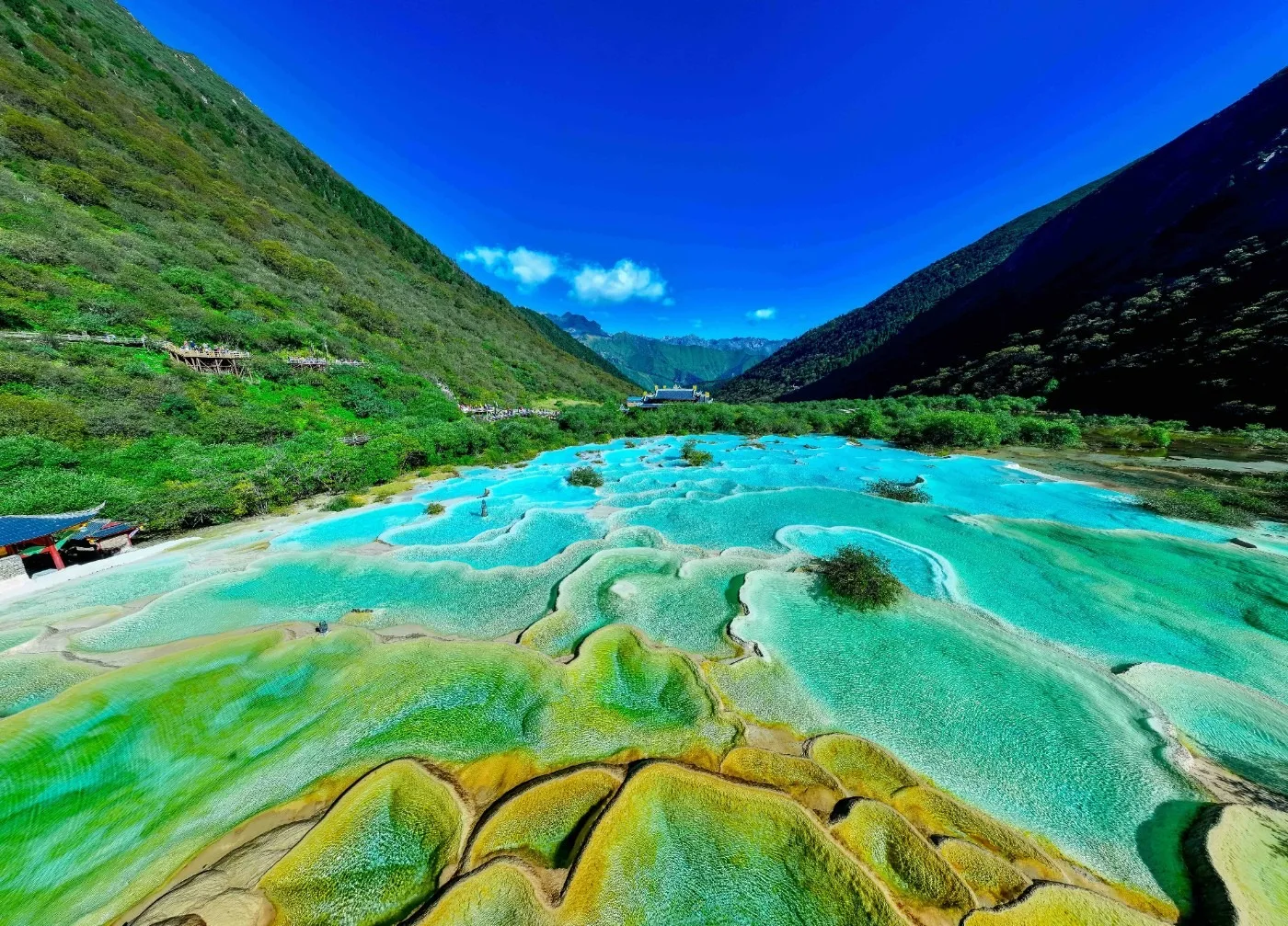
Take the cable car up to Wanglongping and walk along the boardwalk to the edge of the Five-Color Pond, and it is hard not to catch your breath at first sight—over six hundred travertine pools cascade down the mountain slope, looking as if someone has spilled a painter’s palette at the foot of a snow-capped peak. The waters shift from milky blue to emerald green and honey yellow, frame by frame. Located in Songpan County, Aba Prefecture, Sichuan Province, Huanglong is a World Natural Heritage site and a National 5A Tourist Attraction. Long known as the “Fairyland on Earth,” you only realize that this title is an understatement once you arrive in person.
1. Location Overview: Huanglong is located within Songpan County of the Aba Tibetan and Qiang Autonomous Prefecture in Sichuan Province, situated on the eastern foothills of Xuebaoding, the main peak of the Minshan Mountain range. The Huanglong Scenic and Historic Interest Area consists of several parts, including the main Huanglong valley, Munigou, and Danyun Gorge. The core landscapes are concentrated within the Huanglong valley: the valley is approximately 7.5 kilometers long, with the travertine landscape stretching for about 3.6 kilometers, making it one of the world’s rarest open-air travertine belts. The overall altitude of the scenic area is above 3,000 meters, with the valley entrance at about 3,100 meters and the highest point, the Five-Color Pond, at 3,576 meters. From there, you can look up to see the year-round snows of Xuebaoding, which stands at 5,588 meters. Huanglong is about 100 kilometers from Jiuzhaigou, and both belong to the Western Sichuan Plateau scenic route. The two World Natural Heritage sites offer a contrast of “motion and stillness”: Jiuzhaigou is celebrated for the color of its waters, while Huanglong is praised for the form of its pools. Most travelers include both in a single itinerary, often using Songpan Ancient City or Chuanzhusi as a stopover. Travelers with more time may also visit Munigou, home to the Zhaga Waterfall and Erdaohai; beyond the travertine, it offers waterfalls and primeval forests, providing a style completely different from the main valley.
2. Cultural Context: Huanglong’s colorful pools are the work of glacial meltwater and mountain springs: meltwater from the Xuebaoding area flows through strata rich in calcium carbonate, depositing minerals along the way. Over countless years, these deposits have built travertine embankments, creating terrace-like pool groups that display interlaced shades of yellow, green, blue, and brown under the influence of sunlight and algae. This deposition process has continued for tens of thousands of years and is still slowly growing today. Because the travertine layers are both spectacular and fragile, the entire route is built on elevated boardwalks; visitors may look but must not step on the formations. Beyond the scenery lie legends and faith: it is said that the Great Yu received help from a Yellow Dragon (Huanglong) to control the floods, with the dragon carrying Yu to dredge the riverbeds, leading later generations to build a temple here in commemoration. The Huanglong Ancient Temple in the valley was first built during the Ming Dynasty, serving as a crossroads for Tibetan, Qiang, and Han cultures, where customs such as incense burning (Wei Sang), mountain circling (Kora), and temple fairs continue to this day. In 1992, Huanglong was inscribed on the World Heritage List and is also a World Biosphere Reserve and a National Geopark. Its reputation as the “Fairyland on Earth”—the legendary bathing pool of the Queen Mother of the West—has since spread worldwide. The Huanglong Ancient Temple, located below the Five-Color Pond, remains the most important cultural landmark of the area, with its yellow tiles and red walls set against the backdrop of the colorful pools.
3. Highlights: The Five-Color Pond is the symbol of Huanglong, part of 693 colorful pools that form the world’s most structurally complete open-air travertine group. Overlooking the area from the high viewing platform, the pools unfold along the mountain terrain down to the foot of the ancient temple; the colors are most transparent on sunny days. “Golden Sands Paving the Ground” (Jinsha Pudie) is another wonder: a travertine beach about 1.3 kilometers long stretches across the forest. Its surface is a brilliant golden yellow, appearing like flowing crushed gold when the water is shallow, glowing under the sunlight. On the descent, you will encounter the Competing Colors Pools, Huanglong Ancient Temple, the Body-Washing Cave, and the Lotus Platform Waterfall in sequence: the Competing Colors Pools are exquisitely shaped with vivid hues; further down are the Bonsai Pool and the Mirror Reflection Pool—the former resembles a bonsai landscape with pine trees and rocks, while the latter’s surface is so still it reflects the snow-capped mountains. Huanglong Ancient Temple is nestled between the colorful pools and the primeval forest, the only man-made structure in the valley. The Welcome Pool is located at the valley entrance, where dozens of pools are arranged artfully, serving as the overture to the entire journey. The boardwalks follow the travertine closely, allowing visitors to observe the texture of the water up close without damaging the fragile layers. The Competing Colors Pools area has the highest density of pools, with colors changing based on depth and viewing angle. The Body-Washing Cave is the coolest stop on the way down, featuring a waterfall like a curtain at the entrance of a travertine cave; legend says bathing here can dispel illness and disaster, making it a favorite spot for visitors to pause.
4. Travel Tips: Tickets vary by season: High Season (June 1 to December 15) is 170 RMB/person; Low Season (December 16 to May 31) is 60 RMB/person. Real-name reservations are required through official channels such as the Aba Tourism website; high-season tickets often sell out in advance, so early booking is recommended. Opening hours are adjusted seasonally; during the high season, the park generally opens at 8:00 and closes at 18:00 (entry stops earlier in the afternoon). Low-season opening times are later; please refer to official announcements. Cable car fees are 80 RMB/person for ascent and 40 RMB/person for descent, generally operating from April 1 to December 15 (may be suspended or adjusted in low season). There is a shuttle bus from the top cable car station to the Five-Color Pond for about 20 RMB/person. Transportation: Huanglong Jiuzhai Station on the Sichuan-Qinghai Railway is about 27 km from Huanglong (approx. 35 mins drive), with shuttle buses available. You can also arrive via Jiuzhai Huanglong Airport. Driving or chartering a car from Jiuzhaigou involves about 100 km of mountain roads. Special Warning: The altitude is high and there is significant climbing; altitude sickness varies by person. Be sure to slow your pace, stay hydrated, and bring warm clothing and rain gear. Those with poor cardiopulmonary function should exercise caution. Oxygen and warm gear are available for rent or sale at the valley entrance, but prices are high; it is recommended to prepare these in Chengdu or Songpan. The scenic area implements crowd control; it is best to complete reservations at least one or two days in advance during the high season.
5. Itinerary Guide: The most effortless and classic route is “Cable Car Up, Walk Down”: take the cable car up, transfer to the shuttle bus to the Five-Color Pond to see the highlights first, and then walk down the boardwalk through the Huanglong Ancient Temple, Competing Colors Pools, Golden Sands Paving the Ground, and Body-Washing Cave back to the entrance. This takes about 3 to 4 hours, offers better viewing angles on the descent, and saves energy for photography. If the cable car queue is too long or you wish to challenge yourself, you can hike the entire way round-trip; the section from Welcome Pool to Lotus Platform Waterfall is scenic at every step, but the total climb is significant, taking about 5 to 6 hours. In high season, enter the park as early as possible to avoid long lines for the cable car and secure a good spot at the Five-Color Pond viewing platform. When pairing with Jiuzhaigou, a common arrangement is to visit Jiuzhaigou first and leave half a day to a full day for Huanglong, or vice versa. The drive between the two is about 2 to 3 hours; check your schedules or consider staying a night in Songpan Ancient City. For photography, the Five-Color Pond platform is best for panoramic shots with the sun behind you in the morning, while the Golden Sands area is most vibrant in the afternoon sun. UV rays are strong in the valley, so sunscreen and sunglasses are essential. If staying in Songpan, you can stroll along the ancient city walls and old streets in the evening. For photographers, a polarizing filter is the most useful tool to reduce reflections on the water and deepen the colors of the travertine.
6. Best Time to Visit: June to October is the best season for Huanglong. During the rainy season, the pools are full and the colors are saturated, with wildflowers and primeval forests at their greenest. Autumn (late September to October) is the preferred time for photographers, as the colorful forests surround the pools, framing reds, yellows, greens, and blues together; however, crowds peak around the National Day holiday, so visiting off-peak is suggested. Winter and early spring are the low season, with lower prices and fewer crowds. After snowfall, the pools covered in thin ice and white snow offer a stark, cold beauty, though water levels are lower and some pools may be empty, and the cable car may be suspended. Spring water levels are not yet full, and the travertine colors are relatively muted; if your schedule is flexible, prioritize summer and autumn. Regardless of the season, plateau weather changes rapidly—it is not uncommon to experience both sun and rain in one day. The safest approach is to dress in layers. Raincoats are preferable to umbrellas, as umbrellas are inconvenient on the boardwalks. In recent years, the park has remained open in winter, but the boardwalks around the Five-Color Pond can be icy and slippery; anti-slip shoes are essential for winter visits.