Wuxi · Gardens & Ancient Architecture
Lingshan Sacred Scenic Area
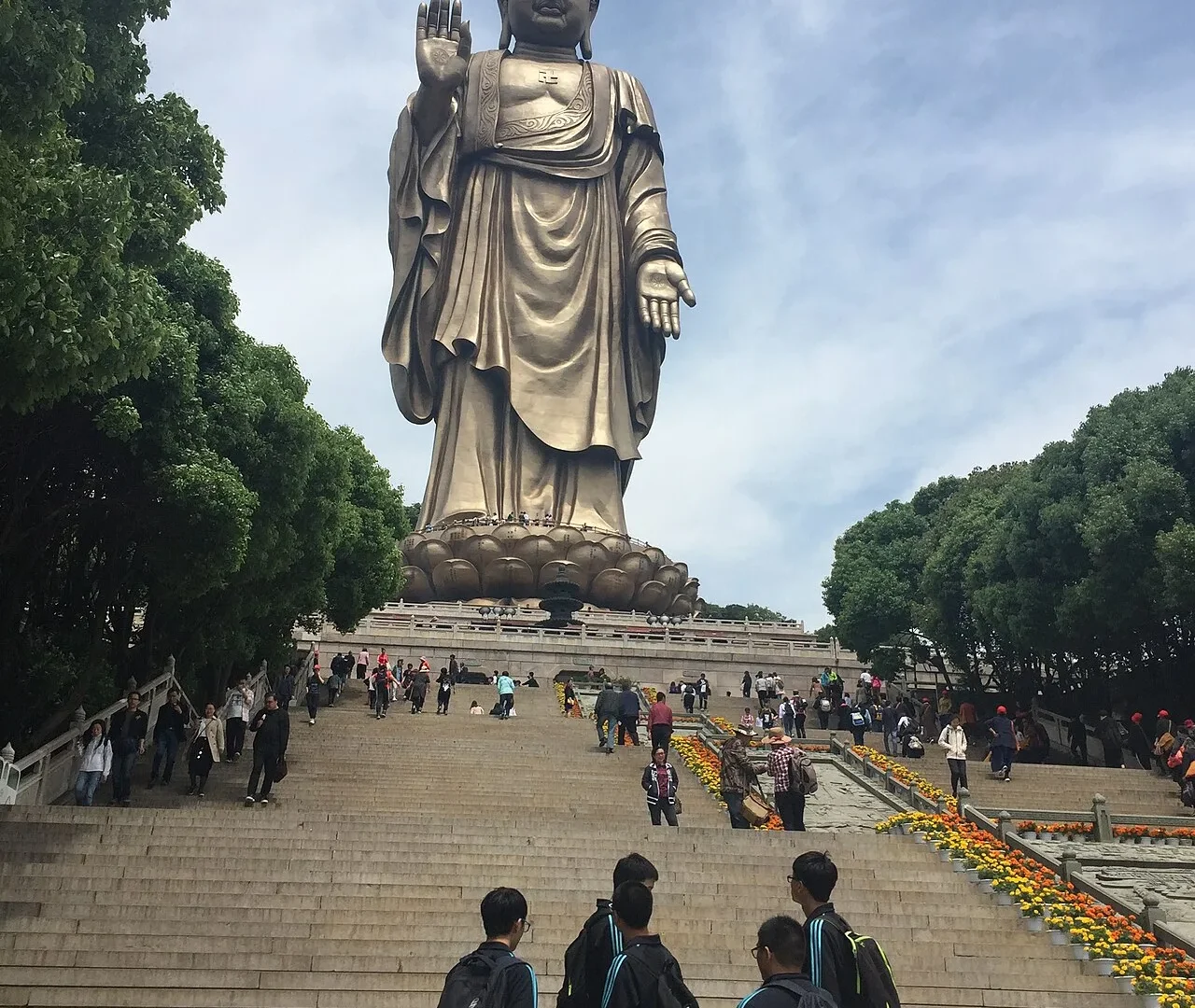
Standing 88 meters tall, the Grand Buddha of Lingshan requires you to tilt your head far back just to see its face. But what truly moved me was the “Nine Dragons Bathing the Buddha”—the slow blooming of the lotus, the spraying water from nine dragons, and the ascent of the infant Buddha. Accompanied by Sanskrit chants, that moment of solemnity silenced the bustling crowds. It is a ritual of Oriental Zen, and a scene I am happy to experience every time I bring friends to Wuxi.
1. Location Overview: Lingshan Sacred Scenic Area is located at No. 1 Lingshan Road, Mashan Town, Binhu District, Wuxi. Situated on the Mashan Peninsula by the shores of Lake Tai, this National 5A-level tourist attraction blends natural landscapes with Buddhist culture. It brings together landmarks such as the Grand Buddha, the Brahma Palace, the Nine Dragons Bathing the Buddha, the Five Seals Altar City (Wuyin Tancheng), the Manfeilong Pagoda, and the World’s First Palm. With Mashan surrounded by the lake on three sides like a lotus island, the Grand Buddha faces Lake Tai with green mountains at its back, combining natural beauty with divine majesty. Within the local tourism landscape, it forms a “golden line” of landscape and culture alongside Yuantouzhu, Meiyuan, and the Ancient Canal districts, serving as the most religiously artistic landmark along Lake Tai and a renowned destination for blessings in the Yangtze River Delta. The spatial sequence of the scenic area is meticulously planned: entering through the mountain gate, your sight and steps are guided toward the Grand Buddha. The performances, archways, and halls unfold in layers, leading visitors from the external scenery into an internal state of peace. This attention to the visitor’s emotional journey distinguishes it from an ordinary theme park.
2. Cultural Context: There is a long-standing legend regarding the name “Lingshan.” It is said that during the Tang Dynasty, the Monk Xuanzang passed through this area and found the mountain’s shape strikingly similar to Vulture Peak (Grdhrakuta) in India, thus naming it “Little Lingshan.” His disciple, Kui Ji, later became the first abbot of the Little Lingshan Temple. During the Dazhong Xiangfu era of the Northern Song Dynasty, the temple was renamed Xiangfu Zen Temple, which serves as the origin of today’s Sacred Scenic Area. The current site was developed in the 1990s. The centerpiece, the Grand Buddha, is a bronze standing statue of Shakyamuni Buddha. Standing 88 meters tall (79 meters for the body and 9 meters for the lotus pedestal), it was consecrated in 1997 and is one of the five great Buddhas in China. Since then, the area has expanded with the completion of the Brahma Palace, Five Seals Altar City, and Manfeilong Pagoda. Lingshan has evolved from a single statue into a grand sanctuary integrating Han, Tibetan, and Theravada Buddhist art, serving as a platform for cultural exchange through forums, dharma assemblies, and art exhibitions. The location and scale of the Buddha were carefully calculated to ensure that its 88-meter frame appears majestic yet gentle against the backdrop of the lake and sky.
3. Highlights: The first highlight is the Grand Buddha; the 88-meter bronze statue wears a compassionate smile with the right hand in the *Abhaya Mudra* (gesture of fearlessness). From the pedestal platform, you can overlook the misty waters of Lake Tai. The second highlight is the Nine Dragons Bathing the Buddha. According to Buddhist scriptures, nine dragons sprayed water to bathe Prince Siddhartha at his birth. The scenic area recreates this moment with a massive bronze lotus and musical fountains: the petals slowly open, the golden infant Buddha rises, and nine columns of water leap upward to the sound of Sanskrit music. The third highlight is the Lingshan Brahma Palace, a magnificent hall of Buddhist art that showcases the pinnacle of Dongyang woodcarving, Dunhuang murals, and Yangzhou lacquerware, featuring the “Ode to Auspiciousness” performance. The fourth highlight is the Five Seals Altar City, which brings Tibetan architectural styles and snowy-region Buddhist art into a diverse dialogue with Han Buddhist traditions. Nearby, the Manfeilong Pagoda introduces the essence of Theravada Buddhism. Visitors also flock to the “World’s First Palm,” shaped like the Grand Buddha’s right hand, for photos. The coexistence of Han, Tibetan, and Theravada Buddhist arts within one mountain is a defining characteristic of Lingshan. Climbing to pay respects and strolling around the lake brings purity to both body and mind.
4. Visitor Information: Opening hours vary by season: Summer (May 1 to Oct 31) 7:00–17:30; Winter (Nov 1 to Apr 30) 7:00–17:00. The Brahma Palace is open 9:00–18:00 in summer and 9:00–17:30 in winter. Ticket prices will be adjusted starting February 2026: On-site adult tickets are 160 RMB, online advance adult tickets are 150 RMB (valid from the following day), and concession tickets are 80 RMB. Concessions are available for minors aged 6–18, full-time undergraduate students and below, and seniors aged 60–69 with valid ID. Free entry is provided for children under 6 (or under 1.4m), seniors over 70, active military personnel, and people with disabilities. The “Ode to Auspiciousness” is currently undergoing upgrades; please check daily announcements for performance schedules. Transportation: Within the city, take bus 88 (Fast 88), 89, or Leyou Line 2 to the Lingshan Sacred Scenic Area stop. From Su Fang Airport, take Metro Line 3 and transfer to a connecting bus. For those driving, navigate to “Lingshan Sacred Scenic Area Parking Lot” (15 RMB for small cars, 20 RMB for large cars, 30 RMB during Golden Week). Internal shuttle buses are 40 RMB for unlimited rides per day. As there are many steps to the Buddha, comfortable shoes and a light jacket are recommended. Please reserve at least half a day for a leisurely visit.
5. Travel Tips: A recommended one-day itinerary is to start with the Nine Dragons Bathing the Buddha, then ascend to the Grand Buddha and visit the Five Seals Altar City, followed by the Brahma Palace in the afternoon for the crafts and performance. The Nine Dragons show runs several times daily, typically around 10:00, 11:30, 14:45, and 16:45. The “Ode to Auspiciousness” usually runs at 10:35, 11:30, 14:00, and 16:00 on weekdays, with an additional 13:00 show on weekends; however, due to upgrades, please check the daily notice upon entry and plan your route backward from the performance times. The best photo spots are the Buddha platform overlooking Lake Tai, the moment the lotus blooms during the Nine Dragons show, and the dome inside the Brahma Palace. Focus your guide’s explanation on the construction of the Buddha, the story of Buddha’s birth, and the craftsmanship of the Brahma Palace. Families with children should focus on performances and interactive sections, while seniors are encouraged to use the shuttle buses. To avoid crowds during holidays, arrive early. If traveling with seniors and children, climb to the Buddha in the morning when energy is highest, and save the shows for the afternoon. Do not rush the steps to the Buddha; the shifting views of Lake Tai as you ascend are part of the journey. The vegetarian cuisine of the Mashan area is famous; the temple-style meals in and around the Brahma Palace feature soy products and wild mushrooms that satisfy both faith and palate.
6. Best Time to Visit: Spring and autumn offer pleasant weather and clear lake waters, making them the best times for climbing and strolling. Summer brings lotus breezes but high heat, so early visits are advised. Winter is quiet with fewer tourists and a vast, open lake view. Lingshan is the perfect anchor for a “West Wuxi” tour: pray and explore art at Lingshan in the morning, then head to Yuantouzhu or Meiyuan in the afternoon. If you have more time, spending a full day at Lingshan to appreciate the Buddha and Brahma Palace in detail is more rewarding than rushing through multiple sites. You can combine it with Yuantouzhu, Meiyuan, and Liyuan for a one- or two-day tour, or visit the farmhouses and Zen towns around Mashan. Local food recommendations include Mashan vegetarian cuisine, Wuxi Braised Pork Ribs, and the “Taihu Sanbai” (three white fish of Lake Tai). Lingshan also has a different charm at night: as the crowds disperse and the lights flicker on, the Grand Buddha appears even more solemn in the twilight. The lake breeze carries the scent of incense and greenery, and only after the noise fades does the true serenity of the sanctuary emerge. Pilgrims and tourists coexist harmoniously here—some come for blessings, some for the scenery, and some just to daydream in the breeze. This sense of balance is why Lingshan remains so beloved.