Wuxi · Gardens & Ancient Architecture
Plum Garden (Meiyuan)
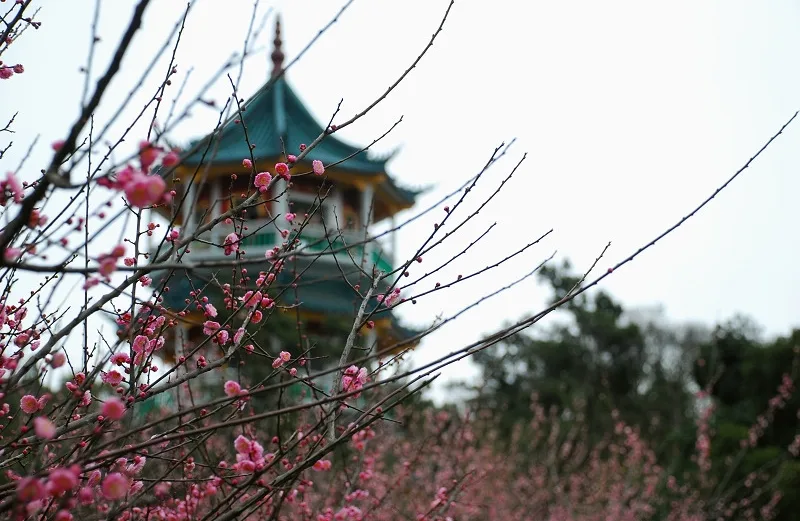
Plum Garden is the private estate of the Rong family in Wuxi and one of the most renowned spots for plum blossom viewing in the Jiangnan region. Every early spring, thousands of plum trees bloom in succession, filling the air with a delicate fragrance as red, white, and green-calyx blossoms blanket the hillsides. Standing atop the Nianqu Pagoda and looking down over the sea of blossoms, the “Sea of Fragrant Snow” creates a breathtaking scene. For the people of Wuxi, the arrival of spring is often heralded by the first scent of these blossoms.
1. Location Overview: The Rong Family Plum Garden is located at No. 13 Bianjiawan, Liangxi West Road, Binhu District, Wuxi. Bordered by Lake Taihu to the south and Hengshan to the north, it is situated close to the city center. A National 4A-level tourist attraction, it is one of the most famous plum blossom destinations in Jiangnan. After expanding eastward toward Hengshan in 1960, the garden grew to over 860 mu (approx. 57 hectares), comprising three main scenic areas: Hengshan, Huaxi, and the Ancient Plum and Rare Stone Garden. Along with Dengwei Mountain in Suzhou (Guangfu) and Chao Mountain in Hangzhou, it is recognized as one of the three great plum-viewing sites of the region. In the local cultural tourism landscape, it sits alongside Yuantouzhu and Li Garden along the Lake Taihu shoreline in southwestern Wuxi, serving as the early spring overture to this scenic corridor and the top choice for locals and tourists alike to welcome spring. The garden also serves as a specimen of a modern industrialist’s estate and was listed as a Major Historical and Cultural Site Protected at the National Level in 2006.
2. Cultural Heritage: Established in 1912, the garden was created when brothers Rong Zongjing and Rong Desheng, prominent national industrialists, purchased the land with the vision of “spreading fragrance throughout the world.” They initially planted 3,000 plum trees, naming the site Plum Garden. The Rong brothers built their fortune in flour and textiles and represented the pinnacle of China’s modern national industry; they used their wealth to promote education and cultivate this garden. From its inception, the garden had no walls and was open to the public for free—a rare gesture of openness for a private estate. In 1955, Rong Yiren donated the garden to the state (excluding the Lenong Villa), transforming it into a public city park. Buildings such as the Songbin Hall and Lenong Villa are named after agricultural work and frugality, reflecting the values of the industrialists. The bronze statue of Rong Desheng and the Nianqu Pagoda blend the aesthetic pleasure of plum viewing with a deep sense of patriotism. In China, plum blossoms are more than just floral displays; ancients used their winter-hardiness as a metaphor for the integrity of a gentleman. Appreciating, composing poetry about, and painting plums are spiritual exercises for the scholar. Understanding the relationship between the Rong family and the plum blossoms is to understand the spirit of modern national entrepreneurs who sought to benefit society. The bond between the garden and the family is a microcosm of modern Wuxi: the city’s industrial strength and the garden’s elegant temperament merge here into a single urban identity.
3. Highlights: The first highlight is the “Sea of Fragrant Snow.” Thousands of plum trees of nearly 400 varieties are planted along the mountainside. From “Bone Red” and “Jade Butterfly” to “Green Calyx” and “Palace Pink,” the blossoms open in sequence from early to late season. At peak bloom, the hills are draped in pale pink and the fragrance carries for miles, creating a classic Jiangnan scene. The garden is divided by terrain: the Ancient Plum and Rare Stone Garden showcases antique specimens, while the Hengshan area provides the grandeur of the “Sea of Fragrant Snow.” This strategic variety extends the blooming season for over a month. The second highlight is the legacy of the Rong family; the Songbin Hall, Lenong Villa, Rong Desheng statue, and Nianqu Pagoda are scattered throughout. Amidst the white walls and floral shadows, one can find the human imprints and family mottos of an industrial dynasty. The Lenong Villa complex, in particular, features a simple and elegant design that reflects the family’s ethos of “wealth without extravagance.” The third highlight is the Ancient Plum and Rare Stone Garden, where gnarled old trunks are paired with exotic stones to showcase the beauty of age, complemented by serene spots like Tianxin Terrace and Xixin Spring. Finally, there are the seasonal blooms: beyond plums, winter sweet, magnolia, spring orchid, osmanthus, and lotus bloom in turn. The Huaxi area features exquisite Suzhou-style penjing (bonsai) with twisted trunks that ensure the garden remains vibrant nearly all year. Climbing the Nianqu Pagoda offers a panoramic view where the sea of plums meets distant mountains and the city skyline.
4. Visitor Information: Opening hours are 7:00–17:00, with last entry around 16:30. During the Plum Blossom Festival, night tours may be available (approx. 16:30–20:30); please check official announcements. Tickets are 60 RMB per person, with half-price tickets at 30 RMB. The Wuxi Gardens Pass is accepted, and online platforms often offer slight discounts. Half-price tickets apply to minors aged 6–18, full-time undergraduate students and below, and seniors aged 60–69. Children under 6 (or under 1.4m) and seniors 70+ are free with valid ID. Transportation: The most convenient way is via Metro Line 2 to Meiyuan Kaiyuan Temple Station, Exit 5. Bus options include routes 2, 40, 52, 53, 72, 83, 87, 88, 89, 112, 131, 158, and Fast 3 to Meiyuan Station or Meiyuan Bus Terminal. For those driving, navigate to “Rong’s Plum Garden,” though parking is limited during holidays; the official recommendation is to park at metro-connected lots and transfer. Since the garden is built on a hillside with many slopes, non-slip, comfortable shoes are recommended. Average visit time is 2–3 hours. To avoid crowds during the spring peak, morning visits are advised.
5. Travel Tips: For a half-day itinerary, enter through the main gate and follow the main path to the Ancient Plum and Rare Stone Garden, Tianxin Terrace, and Xixin Spring. Then, climb the Nianqu Pagoda for a bird’s-eye view of the blossoms, visit Songbin Hall and the Rong Desheng statue, and end at the Huaxi Bonsai area. The best photo spots are the slopes of the Sea of Fragrant Snow, the top of Nianqu Pagoda, and close-ups in the Ancient Plum and Rare Stone Garden. The golden hour for photography and solitude is early morning, when the plum forests look like snow under a light mist. When exploring, focus on the Rong family’s original intent for planting the plums and the connection between plum culture and the character of Chinese literati. Families can use the garden for nature observation, while students can explore the history of “industrial salvation” for the nation. Seniors are advised to avoid weekends during peak bloom. True plum enthusiasts visit multiple times to see the early, peak, and late blooms, each offering a different face of the garden. Viewing the site as a readable piece of architecture and history, rather than just a flower field, enriches the experience. The Lenong Villa area is much quieter than the main crowds, making it perfect for reflecting on the couplets and imagining the original owners discussing philosophy under the plum trees. Combining this visit with nearby Rong family former residences and memorial sites creates a comprehensive “Wuxi Industrial Culture Route.”
6. Best Time to Visit: Early spring (February to March) is the peak, when the hills are covered in blossoms and the air is fragrant; the Plum Blossom Festival is typically held during this time. Winter sweet plums are lovely in winter, while lotuses in summer and osmanthus in autumn ensure year-round beauty. The garden’s magic is found at the extremes of the day: early morning, before the crowds arrive and the mist lingers, is a time for solitude; during the festival’s night tours, the lights cast plum shadows against the walls, and the fragrance becomes clearer, creating a different atmosphere. It is both a community garden for locals and a quintessential Jiangnan image for tourists; the sight of locals doing morning exercises is part of the garden’s living charm. You can pair a visit here with Yuantouzhu, Li Garden, and Lake Li for a “Wuxi West Line” day trip, or visit Huishan Ancient Town. By linking Plum Garden, Yuantouzhu, and Li Garden, you can experience Wuxi’s plums, lakes, and gardens all in one day. For local cuisine, try Wuxi soy-braised spare ribs, xiaolongbao (soup dumplings), and farmhouse dishes near the garden; plum-themed snacks are often available during the festival. The name “Sea of Fragrant Snow” is no exaggeration: when thousands of trees bloom, the mountain looks as if it were covered in fresh snow. The Rong family decorated the mountain with plums not just for beauty, but to express their aspirations. Standing beneath the blossoms for a moment, one is gently moved by a quiet resilience—which is perhaps the true meaning of appreciating the plum blossom.