Beijing · Museums & Academia
China Science and Technology Museum
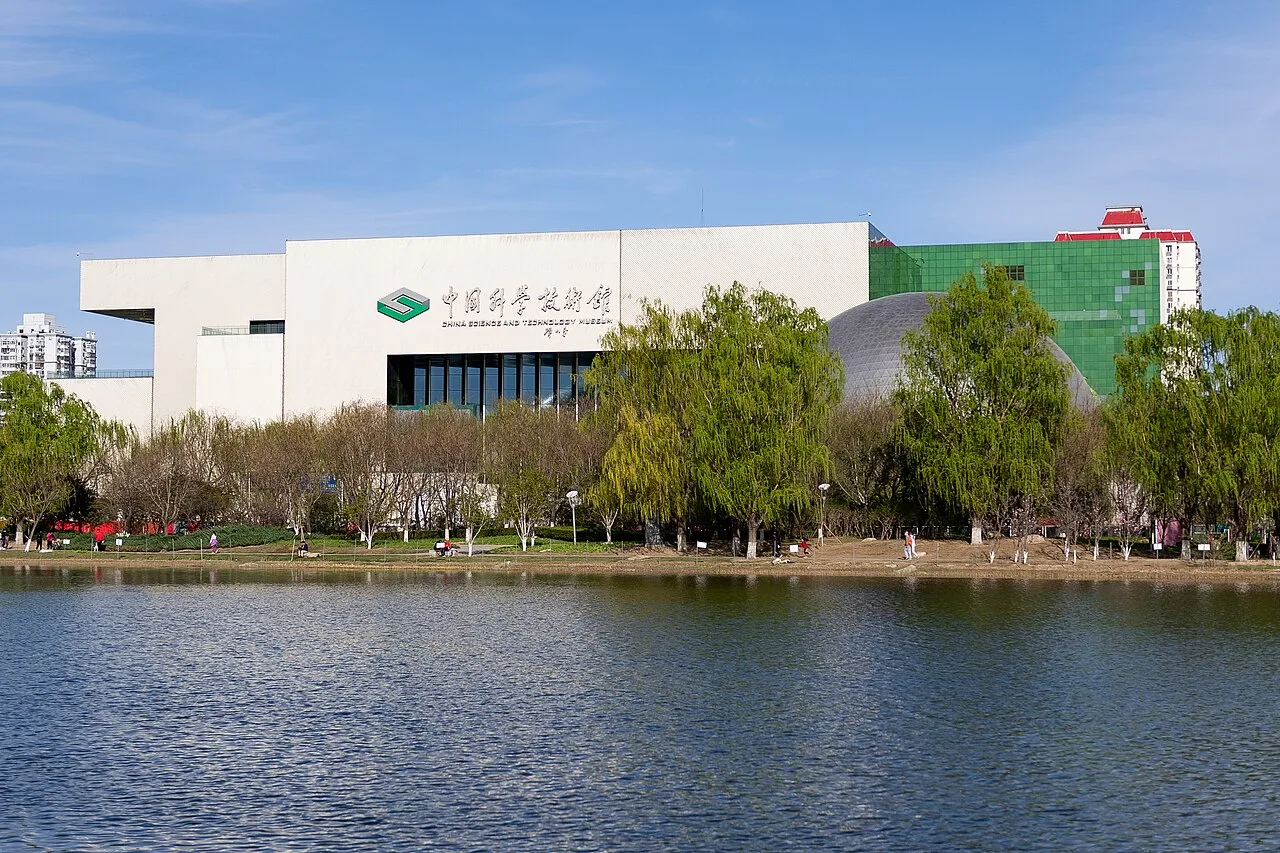
Of all the places I visited during my three days in Beijing, the China Science and Technology Museum is the one I most want to revisit with my family. From “The Light of China” to “Challenge the Future,” the five themed exhibition halls turn physics, aerospace, and robotics into hands-on experiences. The interactive exhibits are particularly captivating—once kids step inside, they never want to leave. This isn’t a museum for “looking”; it’s a scientific classroom for “playing.”
1. Location Overview: The China Science and Technology Museum is located at No. 5 Beichen East Road, Chaoyang District, Beijing. Situated in the heart of the Olympic Park, it is approximately 1 km north of the Bird’s Nest and faces the Bird’s Nest and Water Cube across the park, serving as a key science popularization landmark on the northern extension of Beijing’s central axis. As China’s only national-level comprehensive science museum, the new building officially opened to the public in 2009. Its architecture is inspired by the traditional Chinese “Luban Lock” and resembles a giant Rubik’s Cube, making it a highly recognizable modern landmark. Many visitors come specifically to photograph the building framed with the Olympic Tower. In terms of urban tourism, the museum, together with the Olympic Forest Park, Bird’s Nest, and Water Cube, forms a northern Olympic culture and science tour belt, making it a core destination for family study tours and science education that attracts millions of visitors annually.
2. Cultural Context: The museum’s history dates back to the 1980s. The old museum accompanied the birth of the national science popularization movement and handled many early exhibitions, witnessing China’s journey from a lack of science venues to the construction of national-level facilities. The new facility was completed in 2009 within the Olympic Park, becoming a vital part of the national science infrastructure and reflecting the enhancement of cultural and sports functions in northern Beijing following the Olympics. Its name and positioning reflect the national strategy to improve scientific literacy for all citizens, serving as a hub for science outreach and educational activities under the China Association for Science and Technology. Culturally, the museum is more than a display space; it is a bridge connecting cutting-edge technology with public perception. Its permanent exhibitions integrate two main threads: the history of science and technology in Chinese civilization and contemporary innovation, echoing both traditional wisdom and the pursuit of becoming a modern scientific powerhouse. The emphasis on hands-on participation represents a shift in Chinese science education from static displays to experiential learning, a paradigm that has influenced science museums across the country.
3. Highlights: The main exhibition halls are organized into five themes with a clear flow and progressive content. First is the Science Paradise, designed for young children to ignite scientific interest through gamification, featuring slides and water worlds. Second is The Light of China, which systematically reviews ancient Chinese achievements—from papermaking, printing, the compass, and gunpowder to astronomy, hydraulics, and machinery—featuring several reconstructed ancient instruments for operation. Third is Exploration and Discovery, focusing on basic sciences like sound, light, electricity, magnetism, and life phenomena through interactive exhibits such as the “pull yourself” experiment and the Faraday cage. Fourth is Science and Life, showcasing the forces transforming daily life, including IT, AI, healthcare, and transportation. Fifth is Challenge and Future, focusing on aerospace, energy, materials, and space exploration, with models of space stations and deep-sea probes being particularly popular. The special effects cinema is another highlight, featuring dome, IMAX, motion, and 4D theaters that take audiences on immersive journeys through the universe, the deep sea, and the microscopic world. Additionally, temporary exhibition halls frequently host cutting-edge domestic and international science exhibits to keep the content fresh.
4. Visitor Information: Opening Hours: Tuesday to Sunday, 9:30 AM – 5:00 PM (last entry to main halls at 4:30 PM). Closed on Mondays (except national holidays), and on Lunar New Year’s Eve and the first two days of the Lunar New Year. Ticket Prices: Main hall general admission is 30 RMB, discounted tickets are 20 RMB. Children’s Science Paradise is 30 RMB per person per session (morning and afternoon sessions, cleared at noon), for children aged 3-8 and their parents; all attendees must purchase tickets. Special effects cinemas (Dome, IMAX, Motion, 4D) are 30 RMB general and 20 RMB discounted, with tickets sold separately per session. Reservations: The museum uses a real-name online ticketing system. Reservations are required and can be made via the official website or official WeChat account starting from 6:00 PM seven days before the visit; avoid third-party markups. Free admission to the main hall is available for children under 8 (or under 1.3m), seniors over 60, people with disabilities, active-duty military, and veterans. All visitors, including those eligible for free entry, must present valid identification. Transportation: Take Metro Line 8 or 15 to Olympic Park Station and head north. Several bus lines (328, 419, 484, 518, 628) stop at the Wali South Gate (Wali Nankou) station. On-site parking is not provided; public transport is highly recommended. The visitor flow is entry through the West Gate security and exit through the East Gate. Main halls do not clear at noon, allowing for a relaxed visit. Audio guides and paid study activities are available, as well as wheelchair and stroller rentals, with barrier-free access covering all major areas.
5. Travel Tips: For a half-day trip, focus on the main halls, experiencing interactive exhibits in “The Light of China” and “Exploration and Discovery” in sequence, and ending with a special effects movie (approx. 3-4 hours). Families with young children should prioritize the Children’s Science Paradise, limiting the visit to 2-3 hours to avoid fatigue, and bringing water and a change of clothes. For a deep-dive one-day trip, explore all five main sections in the morning, have a light meal inside or nearby at noon, and spend the afternoon watching a Dome or 4D movie and visiting temporary exhibitions (approx. 6 hours). The best photo spots are the panoramic view of the Luban Lock building with the Olympic Tower outside the West Gate, and in front of the large interactive installations inside. Beyond permanent exhibits, the museum hosts “Science Nights,” lectures, and summer camps, with maker workshops and science shows during holidays. Popular movies and study activities often require separate reservations. Before leaving, visit the creative gift shop for aerospace and mechanical themed souvenirs. During summer and national holidays, crowds are large and queues are common; early entry and booking several days in advance are recommended. Study groups can reserve group tickets and dedicated guides.
6. Best Time to Visit: The museum is suitable for all seasons as the climate-controlled interior is unaffected by weather. Summer and winter breaks are peak times for families and ideal escapes from extreme heat or cold. In spring and autumn, the surrounding Olympic Park is lush with greenery, perfect for pairing with an outdoor stroll, renting a bike to circle the park, or climbing the Olympic Tower for a bird’s-eye view of the city. Nearby attractions like the Bird’s Nest, Water Cube, and Olympic Forest Park can be combined for a “half-day science, half-day outdoors” itinerary, with the evening lights in the park adding a special charm. For local dining, the area around Olympic Park offers everything from fast food to full meals, and the China National Ethnicities Exhibition is nearby for a taste of diverse cultural styles. If time permits, you can head north toward the National Convention Center or south via Beichen Road to the Anzhen or Asian Games Village commercial areas. For educational tours, linking the museum with the Beijing Planetarium and the China Railway Museum creates a comprehensive science-themed route to understand the evolution of technology in China and globally.