Suzhou · Mountains & Scenic Wonders
Tiger Hill
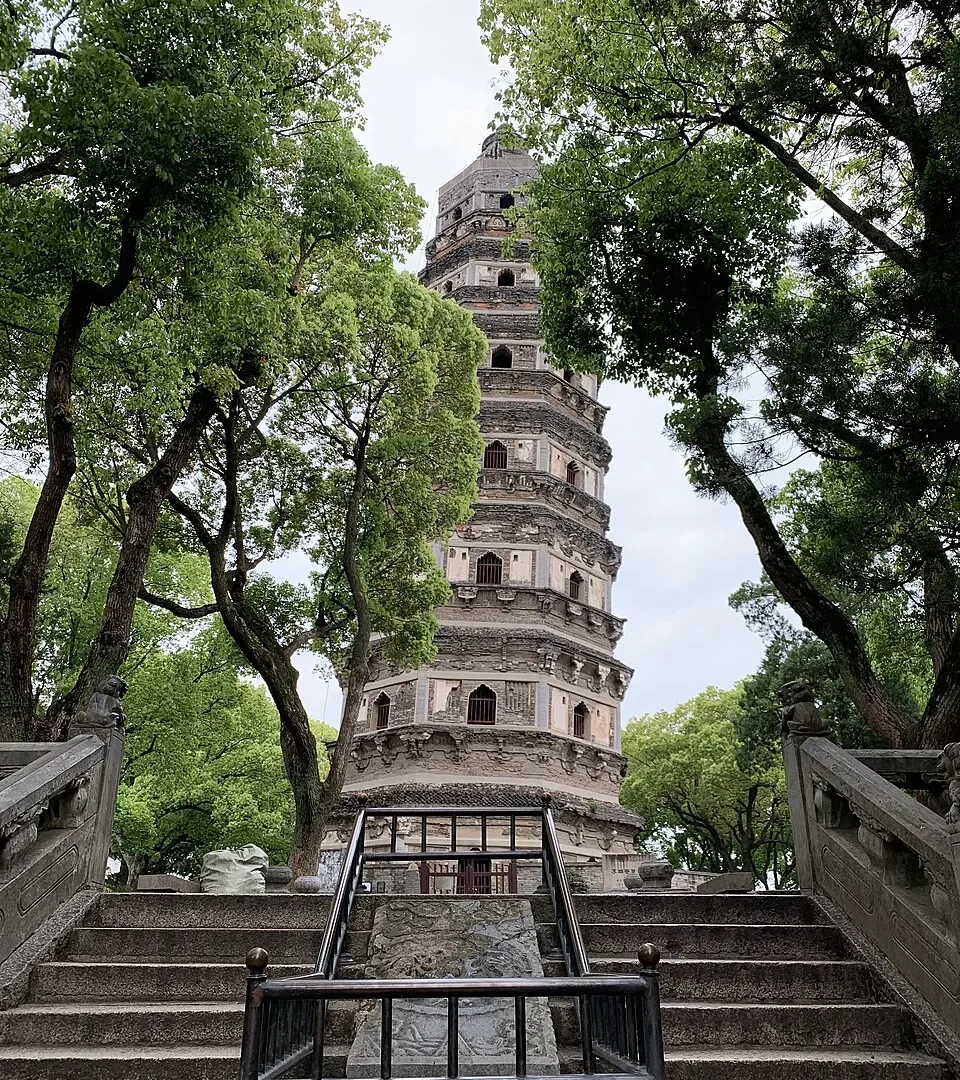
Known as the “Number One Scenic Spot in Suzhou,” Tiger Hill is most famous for the legendary Yunyan Temple Pagoda (Tiger Hill Pagoda)—a thousand-year-old tower that leans but does not fall, serving as an iconic landmark of the city. The great poet Su Dongpo once wrote, “It is a regret to visit Suzhou and not visit Tiger Hill,” a sentiment I found deeply true after my own visit.
1. Location Overview: Tiger Hill is located on Tiger Hill Mountain, approximately 3.5 kilometers northwest of Suzhou’s ancient city center. Despite standing only about 34 meters high, it is renowned as the “Number One Mountain” and “Number One Scenic Spot” of the Wu region and is a National 5A-level tourist attraction. While the hill is modest in height, its profound Wu culture heritage and the Yunyan Temple Pagoda have made it a symbol of Suzhou. Su Dongpo’s remark highlights its indispensable significance to the ancient city. Within the local tourism layout, Tiger Hill complements Shantang Street; visitors can travel from Tiger Hill along the Shantang River directly to Changmen, forming a historical and cultural route through northwest Suzhou that is a must-visit for any traveler.
2. Cultural Context: The name “Tiger Hill” originates from the legend of King Helü of Wu. It is said that during the Spring and Autumn period, King Helü was buried here, and three days after the burial, a white tiger was seen perched atop the hill. Helü was a dominant ruler of the state of Wu, and legend places his tomb beneath the Sword Pond, shrouding the hill in mystery since the pre-Qin era. The Yunyan Temple Pagoda (commonly known as the Tiger Hill Pagoda) was begun in 959 AD (the 6th year of the Xiande era of the Later Zhou Dynasty) and completed in 961 AD (the 2nd year of the Jianlong era of the Northern Song Dynasty). This seven-story, eight-sided brick pagoda, styled after wooden pavilions, stands 47.7 meters tall and is one of the oldest existing brick pagodas in the Jiangnan region. It was designated as a Major Historical and Cultural Site Protected at the National Level in 1961. Other relics scattered across the hill include the Broken Beam Hall, Hanhan Spring, the Sword-Testing Stone, Zhenniang’s Tomb, and the Thousand-Person Stone, each carrying the legends and memories of the Wu region. The beauty of Tiger Hill lies not in its altitude, but in the depth of its 2,500-year cultural lineage. The silhouette of the pagoda has also held a special place in art; since the Song Dynasty, it has appeared in countless poems and paintings, with the image of the “pagoda’s reflection in the water” becoming a synonym for the city of Gusu.
3. Highlights: The first highlight is the Yunyan Temple Pagoda. Due to uneven soil thickness and settlement over the years, the pagoda leans toward the northeast, with the center of the top deviating by about 2.34 meters from the center of the base. Standing lean but firm for a millennium, it is hailed as “China’s Number One Leaning Tower” or the “Leaning Tower of Pisa of China,” serving as a skyline coordinate for the ancient city. To protect the structure, climbing is currently prohibited; visitors must admire it from below, where the sight of the leaning green-brick tower is even more striking. The second highlight is the Sword Pond, where the deep cliffs are rumored to hide the tomb of King Helü. Inscriptions such as “Wind Gorge and Cloud Spring” adorn the walls. During dredging in 1955, traces of a tomb door were discovered but were immediately resealed for protection, leaving an air of mystery. The third highlight includes Hanhan Spring and the Sword-Testing Stone: the former is said to have been carved by the monk Hanhan during the Liang Dynasty and never runs dry, while the latter is said to have been split by King Helü testing his sword, leaving a cleft that looks as if it were sliced. The fourth highlight consists of the Thousand-Person Stone and the Broken Beam Hall. The former is where the high monk Zhu Daosheng of the Liang Dynasty is said to have preached to vast crowds. The latter is a Yuan Dynasty building where the main beam appears broken but is actually two segments cleverly supported by “melon pillars,” giving it its name. The Art Flower Fair in spring and the Golden Autumn Temple Fair add a festive atmosphere to the mountain. The fifth highlight is the cliff carvings at Sword Pond: the inscriptions of “Tiger Hill” and “Sword Pond” are attributed to the Tang Dynasty calligrapher Yan Zhenqing, characterized by powerful brushwork. Calligraphy enthusiasts should not miss these and the works of other masters. The sixth highlight is the Yongcui Villa and the back mountain scenery. Yongcui Villa is a Qing Dynasty forest retreat featuring the Baoweng Pavilion and Wenquan Pavilion nestled among green bamboo. The Two Immortals Pavilion, where Lu Dongbin and Chen Tuan are said to have played chess, is also located in the back mountain area, which features tea forests and bamboo paths that are quieter and more serene.
4. Visitor Information: Tickets are priced seasonally: 70 RMB during peak season (April, May, July to October) and 60 RMB during off-peak season (January, February, March, June, November, December). Half-price tickets are available for students and seniors aged 60-69 with valid ID. Free entry is provided for seniors over 70, children under 1.4m or 6 years old, and active military personnel. Bookings can be made via the official WeChat account, and entry is granted by scanning your ID card. Opening hours: May 1 to Oct 31, 7:30–18:00 (last entry 17:30); Nov 1 to Apr 30, 7:30–17:30 (last entry 16:30). Extended hours may apply during summer; please check official announcements. Special Reminder: You cannot climb the Yunyan Temple Pagoda, and no separate climbing ticket is required; do not be misled by inaccurate guides. A visit typically takes 2 to 3 hours. Although the hill is low, the paths are undulating with many stone steps, so non-slip shoes are recommended. Audio guides and human guide services are available. Transportation: Take Metro Line 6 to Tiger Hill Station; exit from Exit 3 and walk about 400 meters to the North Gate. Alternatively, take bus You 1 to the Tiger Hill stop for the South Gate. For driving, navigate to “Tiger Hill Scenic Area.” Parking is available at both gates, but spaces are limited during holidays; the metro is recommended. Guide and shuttle services are concentrated around the South Gate. The areas near Sword Pond and the pagoda are adjacent to water and cliffs; stone steps can be very slippery on rainy days, so please take care of children and the elderly.
5. Travel Tips: For a half-day itinerary, we recommend entering through the South Gate, following the mountain path via Broken Beam Hall, Hanhan Spring, and the Sword-Testing Stone to the Thousand-Person Stone, then descending to Sword Pond and admiring the Yunyan Temple Pagoda from below, before exiting through the North Gate to the metro. Don’t rush to the top: though the path is short, the sights are dense. The framework of the Broken Beam Hall, the legends of Hanhan Spring, and the cleft of the Sword-Testing Stone are all worth your time. Many tourists head straight for the pagoda and leave, missing half the charm. Try sitting on the Thousand-Person Stone to listen to the wind in the trees and watch the shifting shadow of the tower. The best photo spots are the “framed” view of the Sword Pond cliffs, the upward angle of the pagoda’s lean, and the panorama of the Thousand-Person Stone; afternoon light is best for the Sword Pond. Focus your guide’s explanations on the legend of Helü, the cause of the tower’s lean, and the context of Wu culture. This site is suitable for families, students, and seniors. Families can enjoy the legends, while students can learn about the construction and settlement management of Five Dynasties brick pagodas—conservationists use monitoring, reinforcement, and crowd control to extend the tower’s life. To avoid tour groups, enter around opening time or after 3:00 PM. Regarding physical exertion, the steps from Sword Pond to the pagoda are quite steep; those accompanying seniors may prefer a gentler ascent from the North Gate side. The evening light on the back mountain is soft, making it a second golden window for photos of the tower’s shadow and reflections in the pond. You can also relax in the mountain teahouses.
6. Best Time to Visit: Spring and autumn offer pleasant weather and lush greenery, making them the best seasons for hiking and exploring history. The Art Flower Fair (March to May) and the Golden Autumn Temple Fair (September to October) draw large crowds, blending flowers, markets, and performances. The temple fair tradition has continued since the Ming and Qing Dynasties, and spring outings and autumn osmanthus viewing are long-held Suzhou customs. You can easily pair this with a visit to Qili Shantang Street: from the foot of Tiger Hill, head east along the Shantang River to Changmen. Spend the morning exploring history on the hill and the afternoon strolling along the river, admiring the small bridges and listening to Pingtan storytelling. One mountain and one street, one quiet and one lively—this is the most authentic way to experience the leisure of Gusu. It can also be combined with the Lingering Garden, Xiyuan Temple, or Hanshan Temple. In late autumn, the red leaves on the back mountain appear, and in winter, winter jasmine blooms beneath the pagoda. Tiger Hill’s four seasons offer far more than just two fairs; walk slowly and you will find beauty in every season. For a local experience, try the Suzhou snacks, Pingtan, and Kunqu Opera at Shantang Street, as well as the teahouses around Tiger Hill.