Chengdu · Lakes & Waterfront
Jiuzhaigou
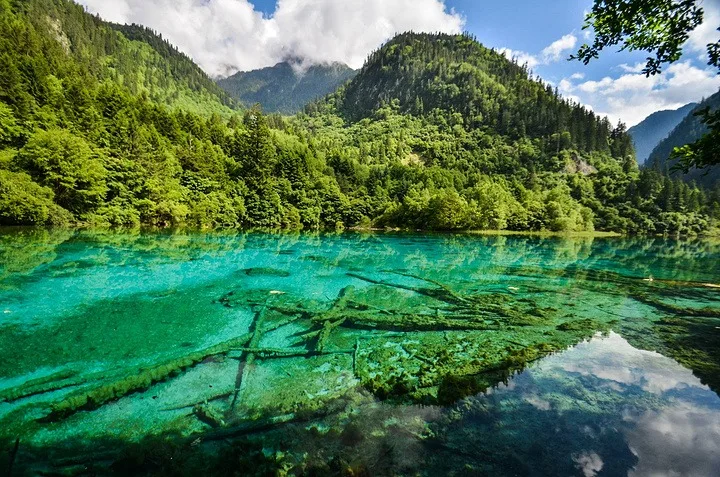
The first time I stood on the boardwalk of Five Flower Lake, I stared into the depths for a long while—the water looked like a spilled palette of paints, with peacock blue, emerald green, and primrose yellow bleeding into one another in layers. Ancient fallen trees resting on the bottom were coated in a layer of milky-white travertine, appearing as clear as if seen through a pane of glass. Located in Aba Prefecture, Sichuan Province, Jiuzhaigou is a World Natural Heritage site and a National 5A Tourist Attraction. The saying “Once you’ve seen the waters of Jiuzhaigou, you need see no other” is not an exaggeration; you have to see it with your own eyes to believe it.
1. Location Overview:Jiuzhaigou is located in Zhangzha Town, Jiuzhaigou County, Aba Tibetan and Qiang Autonomous Prefecture, Sichuan Province, situated in the southern section of the Min Mountains in the transition zone between the Qinghai-Tibet Plateau and the Sichuan Basin. The scenic area is laid out in a “Y” shape consisting of three main valleys: Shuzheng Valley, Rize Valley, and Zechawa Valley, totaling approximately 60 kilometers in length. Shuzheng Valley is the main artery for entering the park and has the highest concentration of sights; Rize Valley, to the right, boasts the most vivid colors; and Zechawa Valley, to the left, is the longest route and reaches the highest altitude. The elevation rises from about 2,000 meters at the entrance to approximately 3,100 meters at Long Lake. The valley is dotted with 108 high-altitude lakes, which locals call “Haizi.” Together with clusters of waterfalls, travertine terraces, snow-capped peaks, and primeval forests, they form a complete set of highland karst water landscapes. Named after the nine original Tibetan villages in the valley, Jiuzhaigou still hosts villages like Shuzheng, Heye, and Zechawa, where Tibetan dwellings and prayer flags blend seamlessly with the lakes and mountains. Because the area is vast and sights are scattered, it is impossible to explore on foot alone. Eco-friendly sightseeing buses serve as the “public transit” of the valley, with stops at every attraction where passengers can hop on and off—a feature that distinguishes Jiuzhaigou from most other mountain landscapes.
2. Cultural Context:The colors of Jiuzhaigou’s waters are the result of a “chemical experiment” spanning geological eras: alpine meltwater and groundwater flow through limestone strata, carrying large amounts of calcium carbonate that deposits into layers of travertine dams, trapping the water into stepped lakes. The interplay of travertine, algae, aquatic plants, and light refraction creates the distinct blue and green layering of the Haizi. The human element belongs to the Tibetan people; nine villages live by the water, and traditions like burning juniper (Wei Sang), walking prayer wheels, and Tibetan architecture add a touch of daily life to the scenery. The white stupas and water mills in the villages are the most captivating cultural symbols beyond the lakes. Its conservation history is also noteworthy: Jiuzhaigou was listed as one of the first National Key Scenic Areas in 1982 and joined the World Heritage List in 1992; even Jiuzhaigou County was renamed from Nanping County because of this valley. A 7.0 magnitude earthquake in 2017 damaged sites like Spark Lake, but after years of ecological restoration, the area fully reopened in 2021. The restored Spark Lake is a testament to the valley’s resilience. Additionally, the region is a habitat for rare animals such as giant pandas and Sichuan golden snub-nosed monkeys; spotting wildlife in the woods is a stroke of luck and proof of the area’s intact ecosystem.
3. Highlights:Five Flower Lake is the most colorful lake in Jiuzhaigou, with bands of blue, green, yellow, and ink-black visible in a single body of water. Looking down from the Tiger Mouth viewing platform, the lake resembles a peacock spreading its tail; in autumn, the reflection of the colorful forests on the shore makes this the most photogenic spot in the entire valley. Pearl Shoal Waterfall spreads its curtain of water across a travertine terrace, with droplets glistening in the sunlight; the closing scene of the 1986 version of “Journey to the West,” where the master and disciples lead their horses across the falls, was filmed here. Nuorilang Waterfall, about 270 meters wide, is one of China’s widest travertine waterfalls, its roar audible from far down the valley. Long Lake at the end of Zechawa Valley is the largest and highest lake, backed by snow-capped mountains that remain white year-round; in winter, the surface freezes over into a vast, desolate expanse. Mirror Lake in Rize Valley is famous for its reflections; on windless mornings, the mountain silhouettes are mirrored perfectly on the water. In Shuzheng Valley, the Reed Sea, Spark Lake, and Rhino Lake are best enjoyed via a slow stroll along the boardwalks. In the upper section of Rize Valley, around Arrow Bamboo Lake and Panda Lake, the vast forests and plunging waterfalls create a stunning backdrop, especially in autumn when red leaves reflect in the lakes, drawing crowds of photographers.
4. Travel Tips:Tickets vary by season: during peak season (April 1 to November 15), the entrance fee is 190 RMB/person and the sightseeing bus is 90 RMB/person; during off-peak season (November 16 to March 31), the entrance fee is 80 RMB/person and the bus is 80 RMB/person. Optional insurance is available for 10 RMB; all prices are subject to official park announcements. Opening hours adjust seasonally: peak season entry is roughly 8:00 to 14:00 (starting at 7:30 in mid-summer), and off-peak entry is 8:30 to 14:00, with closing at 18:00 for all. The park requires real-name online reservations with daily limits (41,000 people during peak season); it is recommended to book via official channels in advance. Tickets are valid for one day. Transportation: The fastest way is via the Sichuan-Qinghai Railway from Chengdu East Station to Huanglongjiuzhai Station (approx. 1 hour 39 mins), then taking a direct shuttle (approx. 93 km, 2 hours) to the entrance. Alternatively, fly to Jiuzhai Huanglong Airport and take an airport bus (approx. 88 km, 1.5 hours). Direct buses are also available from Chengdu’s Xinnanmen and Chadianzi bus stations (approx. 440 km). Only eco-friendly buses are allowed inside the valley; private cars are prohibited. Due to the high altitude, slow your pace and stay hydrated upon arrival. Temperature swings between day and night are significant, so bring a warm jacket even in summer. Tickets are tight during peak season; book several days in advance, as walk-ins at the gate are often unsuccessful.
5. Itinerary Guide:For a one-day trip, it is suggested to take the bus directly to the upper section of Rize Valley first to visit Arrow Bamboo Lake, Panda Lake, Five Flower Lake, and Pearl Shoal Waterfall. The boardwalk between Five Flower Lake and Pearl Shoal runs right along the water and is the best hiking stretch in the valley—definitely get off the bus and walk. Then, head to Mirror Lake for the morning stillness, and have lunch/rest at the Nuorilang Center, which is the transit hub for the three valleys. In the afternoon, switch to Zechawa Valley for Long Lake and Five-Color Pool, and finally return through Shuzheng Valley, walking the boardwalks past Nuorilang Waterfall, Rhino Lake, Tiger Lake, the Shuzheng Lakes, Spark Lake, and the Reed Sea. This allows you to complete the “Y” shape in one day. Sightseeing buses stop on demand; seats on the left side of the vehicle offer better views. To avoid crowds during peak season, try going to Zechawa Valley first and returning to Rize Valley in the afternoon. If you have more time, two days is more relaxed, leaving the second day for the morning light at Five Flower Lake and a slow stroll through Shuzheng Valley. Hotels and restaurants are concentrated in Zhangzha Town at the entrance; staying here is common, allowing you to be among the first to enter the park and facilitating the trip to Huanglong or your return journey. One final tip: there are many boardwalks and stairs; you will easily exceed 20,000 steps a day. A pair of comfortable hiking shoes is more important than any itinerary.
6. Best Time to Visit:The peak of Jiuzhaigou’s beauty is from mid-to-late October to early November. Maples, poplars, and pines dye the valley in a gradient of warm colors that contrast sharply with the lakes. This is also the busiest time of year; it is advised to avoid the National Day holiday (early October). Summer (July to August) has the highest water volume, making the waterfalls most powerful and the valley a cool retreat from the heat, though it is the rainy season, so check weather and road reports. Spring is an underrated season, with azaleas and mountain flowers blooming and the lakes appearing crystal clear as the ice melts, with relatively fewer crowds. Winter is the off-peak season with lower prices and few tourists; Long Lake freezes over and waterfalls turn into ice pillars, making the park as quiet as an ink wash painting. Some side attractions may close for conservation during this time. While first-timers usually choose autumn, those truly captivated by the valley often find themselves returning in winter. The colorful forests consist of maples, birches, and alpine conifers; as the altitude rises from the entrance toward Long Lake, the leaves change color from top to bottom. The viewing window lasts nearly a month, so there is no need to crowd into a single week.