Beijing · Museums & Academia
National Library of China
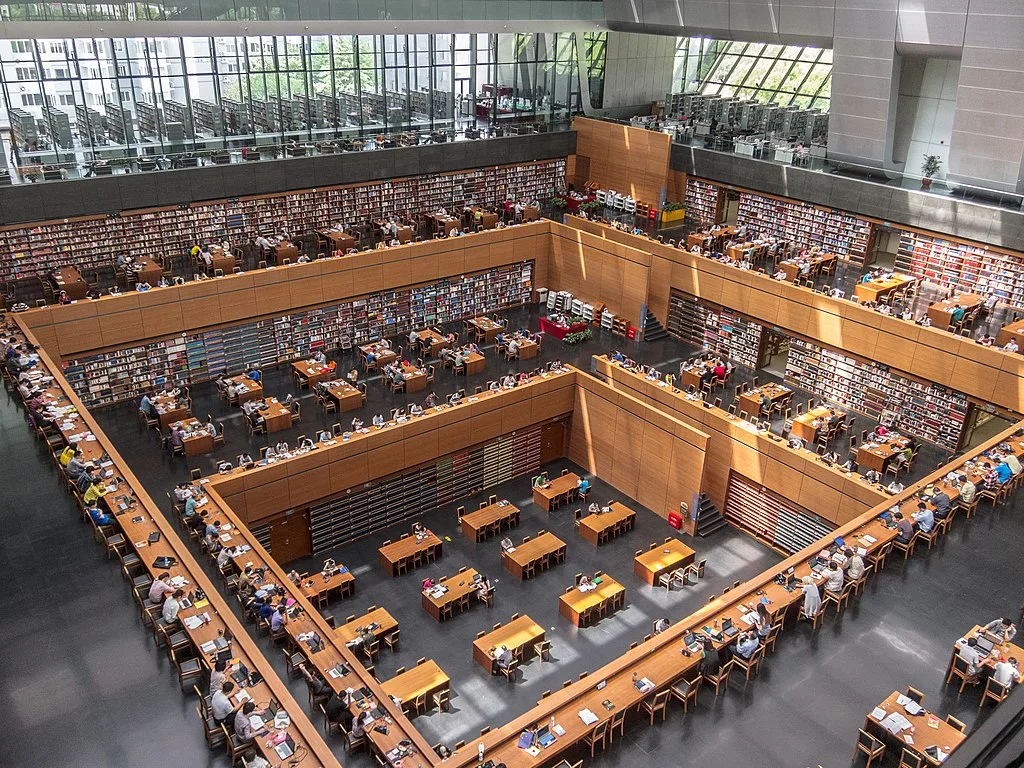
The first time I stepped into the atrium of the North Building, I instinctively softened my footsteps. In the four-story high hall, bookshelves receded into the distance like rolling mountains. Hundreds of reading tables were filled with people, yet it was so quiet that the sound of turning pages was audible. I realized then that a city’s “grand study” truly possesses this kind of aura.
1. Location Overview: The main campus of the National Library of China is located at No. 33 Zhongguancun South Street, Haidian District, Beijing, adjacent to Zizhuyuan Park. It is easily accessible via the intersection of Metro Lines 4 and 9. The main campus consists of two sections: the South Building, completed in 1987, whose white walls and blue glazed-tile roofs are shared memories for generations of readers; this is also where the National Exhibition of Ancient Books is located. The North Building, opened in 2008 as part of the second phase, features a bright, open steel-structure atrium and serves as the primary area for daily reading and book loans. The Children’s Library is also located within the main campus, making it convenient for families. The Ancient Books Library is situated at No. 7 Wenjin Street in Xicheng District, serving as a separate facility. This guide focuses on the main campus. For culture enthusiasts visiting Beijing for the first time, adding this to a one-day Haidian itinerary fits perfectly. The library holds over 40 million volumes and items, making it one of the largest libraries in Asia. A simple tip: the South Building is mainly for exhibitions and archives, while the North Building is for reading and borrowing. Deciding whether you are there to “visit an exhibit” or “read a book” before you enter will save you a lot of time navigating. Given the sheer scale of the facility, spend two minutes studying the directory map upon entry to avoid unnecessary walking.
2. Cultural Context: The predecessor of the National Library was the Imperial Library of Peking, established in 1909 (the first year of the Xuantong era of the Qing Dynasty), marking one of the starting points of modern library science in China. Over a century, it underwent several name changes and relocations: from early temporary quarters to the former site of the Beiping Library on Wenjin Street, then to the completion of the new building by Baishi Bridge in 1987, the official renaming to the National Library in 1998, and the opening of the North Building in 2008. Today, it serves as the national repository and national bibliographic center, as well as a public library open to all. In 2014, the National Exhibition of Ancient Books was established, extending the concept of a “library” into a cultural exhibition space, allowing rare ancient volumes to leave the archives and become exhibits accessible to the general public. In the early years of the Republic of China, Lu Xun worked for the Ministry of Education and participated in the planning of the Imperial Library, giving the institution’s origins a spirit of the New Culture Movement. The former Beiping Library building at No. 7 Wenjin Street, with its red walls and green tiles, now serves as the Ancient Books Library and is itself a Major Historical and Cultural Site Protected at the National Level. Its collection is the result of a century of accumulation; a legal deposit system ensures a steady stream of new publications from across the country, making it both a library and a national vault of documentation.
3. Highlights: There are three must-see areas. First, the North Building’s atrium and Chinese Book Section: the cascading bookshelves and transparent lighting provide the most photogenic views of the library. Sitting down to read for half an hour here is the only way to truly experience the space. Second, the National Exhibition of Ancient Books in the South Building: it features permanent displays of traditional Chinese cultural classics. Its four major collections—the Dunhuang Manuscripts, the Zhao Cheng Gold Collection, the Yongle Encyclopedia, and the Siku Quanshu—are legendary; important exhibits are rotated, and if you are lucky, you may see original manuscripts. Third, the diverse themed services and exhibitions: the Children’s Library is perfect for spending half a day with kids, and various temporary exhibitions—usually themed around ancient texts, maps, or intangible cultural heritage—are consistently high quality. The Digital Library experience area allows visitors to search massive digital resources, showcasing a reading ecosystem where paper and digital coexist. Themed exhibitions on oracle bones and ancient maps in the museum are perennial favorites. On weekends, public lectures by scholars are often held for free; check the official website for announcements. The North Building also offers specialized research spaces for those wanting to do serious literary work. The library also houses a vast collection of maps, rubbings, and manuscripts by famous authors, which are usually kept in archives and only appear during special exhibitions—some of which are worth a dedicated trip.
4. Visitor Information: Opening Hours: South Building (including the National Exhibition of Ancient Books) is open Tuesday to Sunday, 9:00–17:00, closed on Mondays. North Building is open Tuesday to Sunday, 9:00–21:00 in summer (March 1 – October 31) and 9:00–20:00 in winter (November 1 – February 28). Children’s Library is open Tuesday to Sunday, 9:00–17:00, closed on Mondays. Holiday schedules are subject to official website announcements. Admission: Free. No reservation is required to enter the main campus; simply provide a valid ID. Readers aged 16 and above can apply for a reader’s card using a second-generation ID card to access borrowing services; please refer to the official Reader’s Guide for details. Transportation: Take Metro Line 4 or 9 to the National Library station. Multiple bus lines stop at the “National Library” stop. Parking is limited; public transport is strongly recommended. Please maintain silence inside the library; photography and loud talking are prohibited in reading areas. Security checks are required at the entrance, and large luggage can be stored at the cloakroom. For inquiries, call 4006006988 or check the official website before visiting during holidays to confirm if there are any temporary schedule changes.
5. Travel Strategy: I suggest reserving half a day. The smoothest route is as follows: spend the morning in the North Building, pick a book you love in the atrium or Chinese Book Section, and read for an hour to experience the daily life of this “grand study.” Have a light lunch inside or nearby. In the afternoon, head to the South Building for the permanent exhibitions at the National Exhibition of Ancient Books, focusing on the classic texts and any current special exhibits. If traveling with children, fit the Children’s Library into the afternoon; the picture books and activity spaces are great for keeping kids engaged. For first-timers, I don’t recommend trying to see everything—reading in the North and exhibiting in the South is the most complete experience. If there is a public lecture or special exhibition, check the official event calendar in advance to time your visit. Seats in the North Building are often hard to find on weekends, so arrive early if you plan to read. There are cultural creative shops and lounge areas where you can pick up a themed notebook as a souvenir. If you have time left after leaving, Zizhuyuan Park is right next door—a stroll there is the perfect way to end the trip. If you plan to visit often, getting a reader’s card is the most practical move: borrowing services for Chinese books are in the North Building, allowing you to take books home. Borrowing limits and periods follow the official rules.
6. Best Time to Visit: Any season is suitable, but winter and summer are especially great. It is one of Beijing’s most refined “indoor destinations”: air conditioning and the scent of books in the height of summer, heating and exhibitions in the dead of winter. Weekends and holidays are crowded and seats are scarce, so weekdays are preferred. The North Building stays open until 21:00 in the summer, making it a relaxing spot for a post-work visit. In spring and autumn, you can combine the library with Zizhuyuan Park, which is just across the wall: a morning stroll among the bamboo followed by an afternoon of reading and exhibits is the most comfortable cultural itinerary in Haidian, a secret kept by locals for years. In the heat of July, it is the default summer retreat for nearby residents. Near the Lunar New Year, the exhibition museum often holds New Year custom themed displays, ideal for families. In September, during the back-to-school season, the North Building is filled with students researching and writing theses, creating a powerful atmosphere of academic diligence—visit then if you want to experience “straight-A student life.” On days of extreme weather, this is the safest backup plan: direct metro access and entirely indoors, it’s a place where you can comfortably spend an entire day.