Beijing · Museums & Academia
Beijing Planetarium
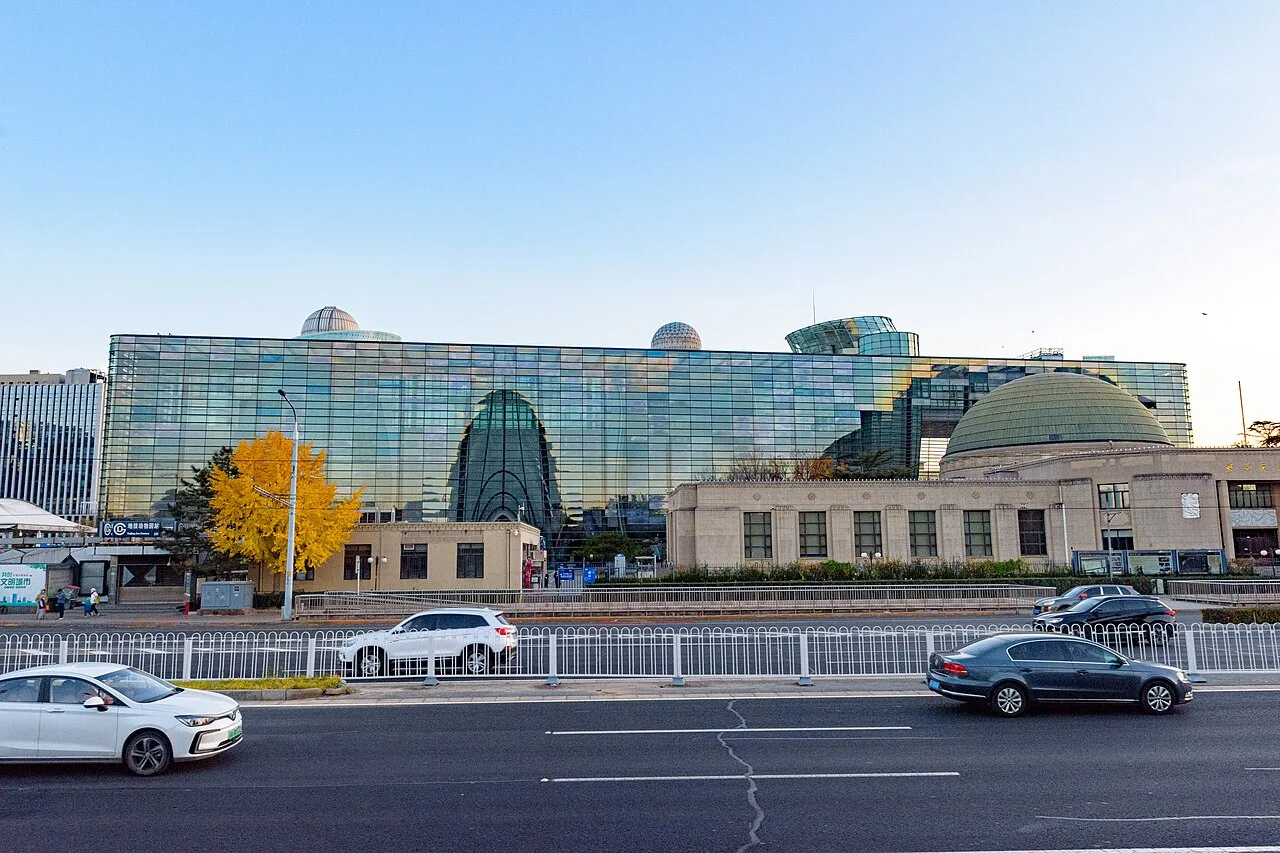
The most breathtaking moment at the Beijing Planetarium is the instant you lie back in the Planetarium Theater—the dome screen unfurls the entire Milky Way above you, and a visible sea of stars rotates slowly, reminding city dwellers that “the night sky is actually this beautiful.” Exploring both Hall A and Hall B offers a complete journey from the Solar System to the evolution of the universe.
1. Location Overview: The Beijing Planetarium is located at No. 138 Xizhimenwai Avenue, Xicheng District, Beijing, situated south of the Beijing Zoo and south of the Changhe River. As the first large-scale planetarium in the People’s Republic of China, it consists of two main parts: Hall A, built in 1957, and Hall B, which opened in 2004. Together, they form a professional platform for exploring the cosmos, with their circular and square architectural designs creating a harmony between the old and the new. Within the city’s cultural and tourism layout, the planetarium is part of the Xizhimenwai cultural belt along with the Beijing Zoo, the Beijing Exhibition Center, and the Capital Indoor Stadium. It is a major destination for science popularization and family outings in western Beijing, and a place where countless young people first sparked their interest in astronomy. Its enduring popularity is bolstered by easy access via the Animal Zoo Station on Metro Line 4.
2. Cultural Context: Construction of the Beijing Planetarium began in the 1950s. As one of the first large-scale science museums established after the founding of the PRC, it officially opened in 1957, marking the transition of China’s astronomical outreach into a professional phase and stunning the public with its artificial starry sky performances. The Planetarium Theater in Hall A is the largest horizon-style planetarium in mainland China and has long served as the hub for simulated star sky shows; for generations of Beijingers, childhood memories include gazing at the Milky Way under that circular dome. The expansion into Hall B significantly boosted the venue’s capacity for theaters, exhibitions, and observations. The planetarium also manages the Beijing Ancient Observatory near Jianguomen; the massive astronomical instruments from the Ming and Qing dynasties there echo the modern star shows here, tracing a complete line from ancient Chinese timekeeping and observation to today’s exploration of deep space. Culturally, the planetarium is both a temple of science and a continuation of the astronomical tradition dating back to the Imperial Astronomer and the ancient observatories. The museum regularly organizes public science lectures, observation events, and “Wonderful Night” programs, bringing profound cosmic topics to ordinary citizens and inspiring many astronomy enthusiasts to pursue professional careers.
3. Highlights: The theater system is the planetarium’s signature feature. Hall A’s Planetarium Theater uses optical planetarium projectors and digital projection to realistically recreate the seasonal starry sky and celestial movements, with the Milky Way, meteors, and auroras unfolding overhead for a truly ceremonial stargazing experience. Hall B’s Universe Theater features an 18-meter diameter hemispherical full-dome screen that can accommodate about 200 viewers, delivering breathtaking imagery of nebulae and black holes. The 4D and 3D theaters use stereoscopic imagery and special effects like water sprays and wind to take audiences on journeys through galaxies, deep space, and the Solar System. Permanent exhibitions cover themes such as the Solar Family, Meteorite Tribe, Giant Eyes to the Sky, Constellation Manifestation, Moon Walk, Escaping Black Holes, Exoplanets, and the Scale of the Universe, displaying genuine meteorite specimens and astronomical instruments—some of the space rocks in the Meteorite Tribe are even touchable. Recent additions include special exhibitions like “Searching for Another Earth,” “Asking the Moon,” and “Dome Starlight,” which enhance interactivity and immersion. For enthusiasts, the ability to view the stars, touch meteorites, and learn about gravity and black holes all in one venue is a rare comprehensive experience; the museum also offers augmented reality (AR) science games like “Asking the Moon.” The permanent exhibits are not static; the museum updates special themes according to aerospace milestones such as lunar and Mars exploration or space station updates, allowing visitors to connect news events with the knowledge found inside.
4. Visitor Information: Opening Hours: Monday, Wednesday to Sunday 9:00–16:30 (last entry at 16:00), closed on Tuesdays (except national holidays). During peak seasons like summer, extended hours and night sessions are often added; please refer to official announcements. Ticket Prices: Exhibition hall tickets for Hall A and B are 10 RMB (discounted 5 RMB); the Planetarium Theater and Universe Theater are 45 RMB (discounted 35 RMB); the 3D and 4D theaters are 30 RMB (discounted 20 RMB). A ticket for any theater grants free admission to the exhibition halls on the same day, making it more economical to watch a film than to visit the exhibits alone. Children under 6 years old or under 1.2 meters in height, and seniors over 60, receive free entry to the exhibition halls; theaters have viewing restrictions for children under 1.0 meter. Reservations: The planetarium requires real-name reservations. It is recommended to purchase tickets in advance via the official WeChat account or website to avoid sell-outs or mark-ups; popular movie slots should be booked early. Transportation: Exit D of Animal Zoo Station on Metro Line 4 leads directly to the venue. Bus lines 7, 15, 19, 27, and 102 also stop at the Animal Zoo station. There is no on-site parking, so public transport is strongly recommended. Self-guided audio guides and human tours are available, as well as wheelchair and stroller rentals, with well-maintained accessibility facilities. Nearby dining and convenience options are plentiful, making it ideal for a half-day visit; the zoo and planetarium are often combined into a one-day family itinerary in Xizhimenwai.
5. Travel Tips: For a half-day trip, start with a film in the Planetarium Theater or Universe Theater, then visit the Solar Family, Meteorite Tribe, and Giant Eyes to the Sky exhibits in sequence. This takes about three to four hours; it is suggested to watch the dome movie while your energy levels are highest. For families, make the Universe Theater dome movie the climax of the visit, paired with interactive displays like Constellation Manifestation to spark children’s interest; younger children will particularly enjoy the Solar System and Moon themes. Best photo spots include the classic dome exterior of Hall A, the street view of Xizhimenwai Avenue, the starry theme wall at the entrance of Hall B, and close-ups of meteorites and instruments. Key learning points should include the principles of star simulation in the Planetarium Theater, the origins of meteorite specimens, and cutting-edge concepts like exoplanets and black holes. The planetarium is more than just a place for movies: the museum regularly hosts public science lectures featuring researchers discussing black holes, galaxies, and the frontiers of aerospace. The “Wonderful Night” event allows participants to explore the museum after hours and gaze at the simulated stars, making it a favorite for families (slots fill up quickly). Those wanting to practice in the real night sky should follow the museum’s outdoor observation activities to identify planets and deep-sky objects using professional telescopes. “Wonderful Night” and lectures require separate reservations; keep a close eye on the official WeChat account. After leaving, a stroll along the Changhe River to the Beijing Zoo or the Exhibition Center makes for a relaxing afternoon. If your children are fascinated by the universe, consider picking up star maps, meteorite specimens, or science books from the gift shop to turn the visit into a long-term interest.
6. Best Time to Visit: The planetarium is suitable for all seasons as the indoor facilities are unaffected by weather, making it an ideal sanctuary during extreme summer or winter conditions. On clear nights, keep an eye out for public observation events to view the real stars with professional equipment. During summer, the venue often stays open late; visiting during meteor showers or other celestial events provides a more complete experience. It can be easily paired with the Beijing Zoo, Beijing Aquarium, Capital Museum, or Beijing Exhibition Center to form a Xizhimenwai cultural route; families often group the zoo and planetarium on the same day. A visit to the Beijing Ancient Observatory allows you to feel the wisdom of ancient Chinese astronomical instruments and timekeeping. For local food, there are many options around the zoo and Exhibition Center, or you can head north to Zhongguancun. For deep enthusiasts, linking the planetarium with the Ancient Observatory and the China Science and Technology Museum creates a science-themed route to fully understand how Chinese people have looked at the stars from ancient times to the present, and how science has turned myths into measurable knowledge.