Wuxi · Ancient Towns & Old Streets
Ancient Canal Historic and Cultural District
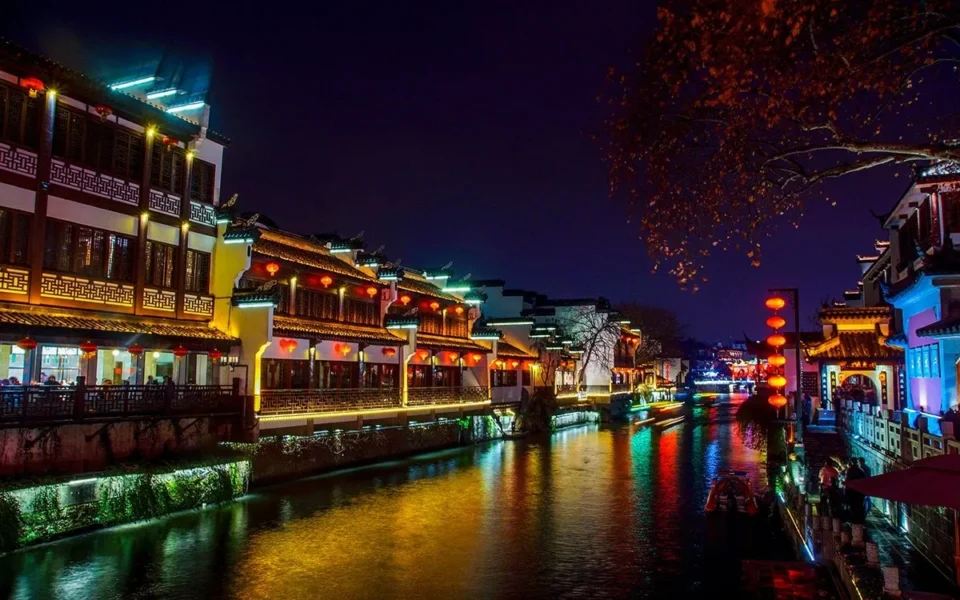
The Wuxi Ancient Canal Historic and Cultural District is a quintessential example of the “Jiangnan Water Alley”—built along the banks of Nanchang Street, it is a tapestry of blue stone pavements, riverside dwellings, and stone arch bridges. By day, it is a bustling marketplace full of local life; by night, it transforms into a Jiangnan dream of rowing oars and shimmering lights. I prefer visiting at night; gliding under ancient bridges by boat and watching the city lights reflect in the canal is the moment you truly understand why this river means so much to the people of Wuxi.
1. Location Overview:The Qingming Bridge Historic and Cultural District (Nanchang Street) is located in the Liangxi District of Wuxi. Built along the Beijing-Hangzhou Grand Canal, it is a National 4A-level tourist attraction and is hailed as Wuxi’s “Jiangnan Water Alley.” Centered around the ancient canal, the district covers approximately 18.78 hectares, with a preservation and renovation area of about 0.44 square kilometers. Nanchang Street spans roughly 5.5 kilometers, with the section from Kuatang Bridge to Qingming Bridge preserving about 900 meters of the canal’s finest heritage. Situated at the southern end of Wuxi’s city center where the Ancient Canal meets Boyu Port, it is connected to the Nanchan Temple and Miaoguang Pagoda. It serves as the most vibrant core section of the Grand Canal’s Wuxi stretch and a floating gallery of the city’s memories. The district perfectly preserves the “parallel land and water” layout: a navigable river on one side and a pedestrian street on the other, with houses hugging the water and shops opening onto the street—a scene that has persisted for centuries. In June 2014, the district was inscribed as a UNESCO World Heritage site as part of the Grand Canal’s Wuxi urban section.
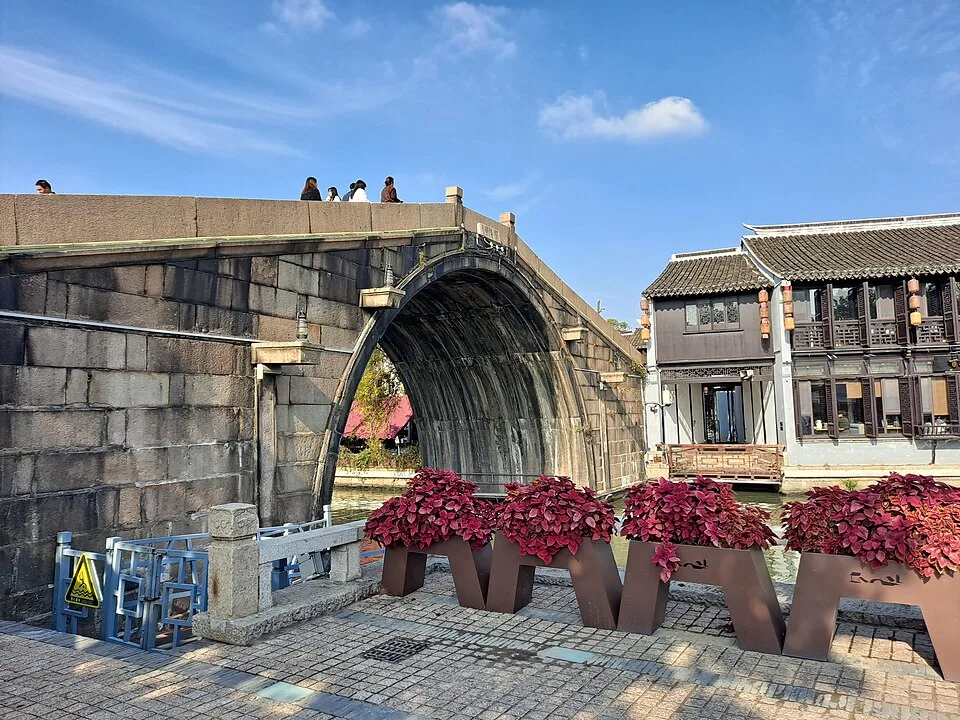
2. Cultural Heritage:Wuxi flourished because of the canal, and the Qingming Bridge district is a microcosm of the commercial civilization it fostered. Legend has it that Boyu Port was opened by Taibo, making it one of China’s earliest man-made canals. During the Ming and Qing dynasties, Wuxi relied on the canal to become a hub for rice and textiles; the area around Qingming Bridge was once lined with wharves and warehouses, serving as a birthplace for Wuxi’s national industry and commerce. The origin of Qingming Bridge is quite storied: during the Wanli era of the Ming Dynasty, the two sons of Qin Yao (owner of Jichang Garden), named Taiqing and Taining, donated funds to build the bridge. Taking one character from each of their names, it was originally called “Qingning Bridge.” In 1666 (the 8th year of Emperor Kangxi’s reign), it was rebuilt by the county magistrate Wu Xingzuo. During the Daoguang era, it was renamed “Qingming Bridge” to avoid a naming taboo associated with Emperor Daoguang. After being destroyed by war in 1860, it was rebuilt in 1869. Today, it is the largest surviving ancient stone arch bridge in downtown Wuxi. In June 2010, the district was selected as one of China’s second batch of Historic and Cultural Streets; in January 2022, it was named among the first national-level tourism and leisure streets, and in July of the same year, it joined the second batch of national-level night-time cultural and tourism consumption clusters.
3. Highlights:The first highlight is Qingming Bridge. Standing in the center of this stone arch bridge, you can look south toward Lake Taihu or north as the city river winds into the town; it is the most iconic image of the Wuxi Ancient Canal. The stone steps of the bridge have been worn smooth by centuries of footsteps, serving as tangible evidence of time. The second highlight is the “water alley” layout, where land and water run parallel. The riverside homes, arcade docks, and embankments are well-preserved, serving as a living specimen of the urban fabric of Jiangnan canal towns. The third highlight consists of industrial heritage and museums: The China Silk Museum, opened in March 2009, is located on the site of the former Yongtai Silk Mill. The Kiln Site Museum was built around the Dayao Road kiln ruins, which were listed as a National Major Historical and Cultural Site in 2013. Other points of interest include the former residence of Zhu Dachun and the Dagong Bridge built in 1930. This three-span reinforced concrete bridge was funded by Xu Daosun and assisted by Rong Desheng after a tragic incident involving female silk mill workers falling into the water—a bridge that carries a fragment of Wuxi’s silk industry history. Finally, the fourth highlight is the local atmosphere; bookstores, Pingtan (storytelling and singing) teahouses, and riverside restaurants dot the landscape, blending ink-wash aesthetics by day and neon lights by night.
4. Visitor Information:The district is open 24/7 and free to enter. Opening hours and fees for specific sites like the China Silk Museum, Kiln Site Museum, and Zhu Dachun’s former residence are subject to on-site notices; please check official information before visiting. Canal cruise boats depart from the Nanchan Temple area, stopping at Kuatang Bridge, Henong, Dagong Bridge, Qingming Bridge, the Kiln Site Museum, Nan Narcissus Temple, and Zhu Dachun’s residence. Tickets are priced at 5 RMB per stop. A full-circuit water tour is 60 RMB during the day and 80 RMB at night. A combined “land and water” tour (including boat tickets and entry to three venues) is 100 RMB. Boats typically run every 30 minutes from 13:00 to 20:30 on weekdays and 9:00 to 20:30 on holidays. Children under 1.3m are free. Immersive night tours are also available for an additional fee. Transportation: Take Metro Line 1 to Nanchan Temple Station (Exit 8), cross Nanchang Bridge, and walk south along Nanchang Street for about five minutes. Special Note: There is another station called “Qingming Bridge Station” on Line 1, but that is for the residential neighborhood and is about 1.5km away (a 30-minute walk)—do not get off at the wrong stop. For buses, take Line 15 or 105 to the Kuatang Bridge/Nanchang Street stop, or Line 15 or 23 to the Nanchan Temple/Chaoyang Square stop. For those driving, parking is available at the Nanchang Street underground parking lot or the N1955 Creative Park parking lot. Sightseeing shuttles run from Kuatang Bridge to Nan Narcissus Temple for 5 RMB per trip.
5. Travel Tips:For a half-day trip, I recommend starting at Kuatang Bridge and strolling south along Nanchang Street, visiting Qingming Bridge and the Silk Museum, and then taking a cruise boat back in the late afternoon or evening. The best photo spots are the reflections of the red lanterns in the arches of Qingming Bridge and the nighttime lights reflecting off the arcade corridors of Nanchang Street. When exploring, focus on the canal’s commercial history, the construction of Qingming Bridge, and the architectural wisdom of the water alleys. Families can enjoy the hands-on experiences at the Silk Museum, couples will find the night cruise romantic, and seniors should avoid holiday crowds and enjoy a slow walk along the river. The revitalization of the district is worth noting: rather than turning old buildings into stagnant museum pieces, the city has introduced bookstores, teahouses, craft shops, and small theaters, allowing historical spaces to host contemporary life. The heritage of the canal isn’t sealed in a glass case; it flows through the daily aroma of tea and the glow of lanterns. Early morning belongs to the locals—residents exercising, shopping for groceries, or walking dogs—while the river is exceptionally quiet. This is the best time for photography without the crowds. Nighttime offers a different magic: red lanterns light up in sequence, the water blends the bridge shadows and neon into a warm glow, and the sound of Pingtan drifts from a riverside window. Time seems to slow down; compared to the clarity of day, the nighttime “water alley” more closely matches the poetic imagination of a misty Jiangnan.
6. Best Time to Visit:The district is beautiful year-round, though summer nights and autumn breezes are most pleasant. Peach blossoms in spring and lotus flowers in summer decorate the banks. Early morning and late night are the two most moving times to visit. You can easily combine this trip with Nanchan Temple, Miaoguang Pagoda, and the Chong’an Temple shopping area, or extend your journey along the canal to Bogong Island and Li Lake. It is a short walk north from Qingming Bridge to Nanchan Temple; a perfect day consists of exploring bridges and museums by day, boarding a night cruise at dusk, and finishing with a traditional Wuxi meal near Nanchan Temple. For local delicacies, try Wuxi Xiaolongbao (soup dumplings), soy-braised pork ribs, Magnolia cakes, and time-honored pastries, as well as the riverside cafes on Nanchang Street. The district’s business landscape continues to evolve: while it once relied on old residences and snacks, it now welcomes independent coffee shops, craft studios, and boutique galleries. Young entrepreneurs are bringing new life into old houses without destroying the “white walls and black tiles” aesthetic. As a national-level night-time consumption cluster, the district weaves together the canal, bridges, and old houses into a seamless experience where bookstores stay open late and jazz bars light up the riverside, giving the historic district a “second life” after dark.